Every Day a Little Death
By Sam Bodrojan
Teenage Sex and Death at Camp Miasma
Dir. Jane Schoenbrun, U.S., MUBI
“I don’t feel great about the progress queer storytellers have made over the past decade.”
Jane Schoenbrun posted this quote to Twitter in June 2026, taken from their own interview in People. In that piece, they go on to lament that despite the wealth of trans filmmakers, there is a conspicuous lack of support for their work.
Since 2021’s The Matrix Resurrections, a film I referred to as “a death knell for the unspoken modus operandi of trans cinephilia” on this very site, there have only been two movies from a trans filmmaker to receive a national release in more than 100 theaters. Both of them were directed by Jane Schoenbrun.
My friends and I joke that the only thing every trans person has in common is that they have an opinion on Schoenbrun’s I Saw the TV Glow. That film is being stripped for parts aesthetically and thematically by every trailer house and pitch deck. How do you follow-up a film like that, one that meant something to everyone “like you?” How do you make a film that feels like your own, when everything about your form has been tokenized, appropriated, wrongly treated as representative of your entire community? This is the impossible, infuriating task at hand for Schoenbrun’s new film, Teenage Sex and Death at Camp Miasma, a dizzying, sybaritic jaunt through the intellectual ouroboros of desire.
The film opens with a shaky POV shot of someone walking through a forested film set, deliberately evoking the prologue of the original Halloween and The Blair Witch Project. But the illusion of danger is abruptly shattered upon the revelation that it is a diegetic camera, rigged in place to film a ridiculous 30-foot geyser of fake blood. This is the movie’s first (and by no means last) zag, deliberately deflating the tension for an absurd sight gag. We’re on the set of one of the dozen-odd Camp Miasma films, a fictional late-century series of trashy horror flicks. After that cold open, the film jumps to the present day to follow Kris, a not-so-veiled insert for Schoenbrun. Played by Hannah Einbinder, Kris is a 29-year-old “Sundance wunderkind" who has parlayed her buzzy debut into a shot at resurrecting the eponymous slasher series. They are, in many ways, the archetypal young queer: ambivalently polyamorous, sexually inhibited, a geek with a nostalgic penchant for reactionary media. She also fancies herself something of a sommelier for novelty sweets.
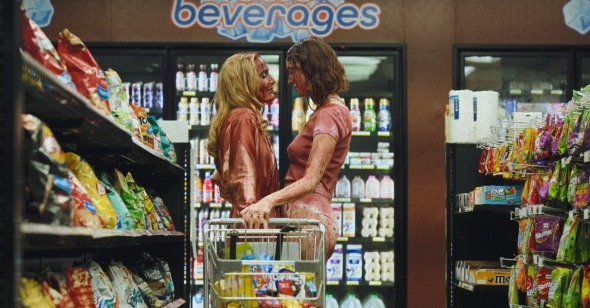
Anybody could tell you that the mountains of candy throughout Teenage Sex and Death, visible in multiple promotional stills, are a metaphor. Here is something “bad for you,” designed to appeal to your basest affections, a cheap thrill and an opportunity for brand synergy. Schoenbrun emphasizes this symbolic overlap between commercial art production and sexual liberation. Throughout the film, Kris rambles to anyone who will listen about what is expected of them and their art. They are being asked to make something unique but impersonal, something to represent their non-normative identity in a totally standardized way, to offer their personal connection to the source text as a sacrificial lamb at the altar of a self-cannibalizing industry.
So, Kris tracks down Billie Presley, the reclusive star and ‘final girl’ of the original film. In our world, Billie is Gillian Anderson—star of The X-Files, Hannibal, Sex Education. She is the formative sexual awakening for three generations of gay losers, and the perfect romantic foil to the prudish, insecure Kris. It turns out Billie has made her home on the abandoned campgrounds where they shot the first Camp Miasma—one of the cabins has even been retrofitted with a projector. The two spend a few nights together, trying to parse their respective obsession with the film and one another.
TV Glow sidelines the minute machinations of its central fictional series The Pink Opaque. In contrast, a solid 20 minutes of Teenage Sex and Death is devoted solely to footage from that first film in the Camp Miasma franchise. The title sequence doubles as a survey of mass-produced Camp Miasma merchandise and a dozen-odd sequels. Schoenbrun and Kris are both eager to fixate on and relitigate the politics of various plot points and individual shots. By the end, it doesn’t feel like you’ve watched the original Camp Miasma, but it feels like a movie that exists, one you know from Treehouse of Horror, or the wall of graphic tees at Hot Topic.
It helps that Little Death, the monster from Camp Miasma, is so persuasively conceived. He was an ill-begot invention, an unholy fusion of Friday the 13th’s Jason and Sleepaway Camp’s Angela (Zach Cherry, telling stories at the campfire, reveals the supposedly revolting rumor that “Little Death changed his gender every day!”). His weapon of choice is a massive harpoon, though he is not opposed to using his hands. He marches up from the bottom of the lake where he was murdered. He wears a silver jumpsuit, suspiciously similar in appearance and texture to a movie theater screen, and a giant metal helmet shaped like a ceiling vent one only notices during missionary, or a night terror.
But there are no true scares, to my recollection, in the entirety of Teenage Sex and Death. It is best approximated as a “stoner rom-com,” with the accompanying submission to trippy, roundabout narrative and characters liable to flirtatious, zonked giggling. It is a celebration of chiller hedonism and lowbrow bacchanalia. Kris and Billie eat KFC out of yonic dipping sauce cups. Gillian Anderson speaks with an unplaceable accent, somewhere between Southern belle and Transatlantic dame. The type of intimacy on display could be triangulated by treating its hypothetical fan-fiction tags like they’re nautical coordinates; for maximum voyeuristic pleasure, Schoenbrun leaves Kris’s anatomy ambiguous.
Halfway through the film, the “age-gap yuri slowburn” is consummated. The previously awkward Kris walks out one night in nothing but boxers, and the two lie together on a bear rug in front of the fireplace. They begin to have sex, only for Kris to almost immediately recoil. They reveal a lifelong struggle with sexual dissociation. In a movie that has so far embraced a heightened style of performance, Einbinder delivers these lines with a disarming, unsettling level of realism.
Each of Schoenbrun’s films comes equipped with a mantra of sorts. We’re All Going to the World’s Fair had, “Keep posting so I know you’re okay.” In TV Glow, the phrase, “There Is Still Time” is etched in chalk. This time around, Billie flirtatiously coos, “If it gets too real, you can always turn it off,” in Kris’ ear. These lines point respectively towards both a central theme and the dramatic thrust. Such signposting makes their work legible to straight audiences as much as it lets people wrongly dismiss their work as superficial or corny. This bad habit is validated by cis people who crave chic proximity to us through art as a kind of cultural tourism. But gay art is only about being esoteric if the audience will only ever be adjacent to gay living. Whether it’s the New Narrative movement of the 1970s and ’80s or John Waters, dorky pastiche has been perhaps the great constant of all American queer cultural movements. Teenage Sex and Death is defiantly, subversively uncool. It likes R.E.M. and plastic kitsch. Schoenbrun’s script, especially in the first act, embraces Whedonesque quips at a time when that style is approaching the nadir of its cultural relevance. Yet Jane’s newest shares a great deal of DNA with something as chic as Inauguration of the Pleasure Dome; both are obsessed with deviancy, music, and incessant reference.
Like the Wachowski sisters’ films, it is about internal desires projected onto formative, schlocky media. This is similar to the dysphoric creepypasta in World’s Fair or the repressor purgatory of TV Glow. Yet here, Schoenbrun has abandoned the emo Americana of their previous work. Teenage Sex and Death recalls Guy Maddin, not just in the painted backgrounds and low-frame rate windswept kisses but also in its Matryoshka doll structure and bawdy psychoanalytic lampshading. But most crucially, this movie is about adults having sex. It is not about solitary activity or hypothetical situations; it is not about being a teenager. Like Resurrections, it is about a messy and difficult interpersonal phenomenon.
Schoenbrun is insistent that their signature style can safely harbor something so emotionally mature, something that looks out as much as in. Perhaps that is why the screen is bursting with other trans and nonbinary filmmakers. Avalon Fast, Eva Victor, Louise Weard, Jess McLeod all fall lovingly victim to Little Death. Behind the camera, Alice Maio Mackay, a 21-year-old trans woman with seven micro budget features to her name, shadowed Schoenbrun on-set.
The last third of the film loses its already tenuous grip on reality, gleefully submitting to a role-play session in which Kris and Billie are transported into the original Camp Miasma so that Billie can coach Kris through a truly embodied orgasm. Our initial encounter with these scenes came through a diegetic screening, accompanied by Kris’s preemptively neurotic political commentary, despite Billie’s repeated attempts to shut her up. In contrast, the film’s extended finale is immersive, luxurious, and joyful.
Camp Miasma is steeped in ironic postmodernism, although where said distance pops up is deceptive. The finale, for instance, might come off as a joke. The combination of Donna Lewis’s “I Love You Always Forever” and a split-diopter shot (a camera trick which Kris noted while watching the original Camp Miasma) certainly feels like a punchline. In practice, though, this is Schoenbrun deploying a memetic, universally recognized device of genre film in idiosyncratic but terms. And sure, it might be a silly song to use, but its titular romantic proclamation is totally earnest.
Conversely, the unspoken implications of the film are noticeably more brutal. Take Little Death: Jack Haven, a thirty-something transmasc, plays a demonic, offensive stereotype of a trans child with overt, proud sensuality. Little Death, a murdered trans kid, is transformed into a sexually liberated heartthrob.
In order to be satisfied, Kris reframes this clear victim in her fantasy as the person in control, the literal lens through which she can finally resolve her dissociation in ecstasy. In such an optimistic and blunt movie, this cruel and subtle narrative maneuver is a bit shocking. The climax, in which Kris gets every other person in her life slaughtered so she can cum, her orgasming face intercut with images of a child sitting beneath the light of a CRT, is a boldly personal, “problematic” referendum on the typical narratives of self-discovery through art.
None of this would work without Jack Haven’s visceral, full-body performance. The keystone for the entire film comes about a third of the way through. In a scene that blurs the line between Teenage Sex and Camp Miasma itself, Little Death butchers a dozen people in ludicrous mountains of flesh, set to the anachronistic but intuitively correct inclusion of “A Long December” by Counting Crows. What might, in other hands, feel goofy or extreme is here totally sincere. The gushy, unnatural CGI bloodletting is tender. In a film that routinely deploys POV shots, here we finally see the camera turn, an elaborately choreographed single take that follows Little Death as they spin around in orgiastic exultation for kill after kill. There is no ironic distance in the split second where Haven’s eyes appear from beneath the helmet’s shadow. It’ll become clear later that the entire film is calibrated around this one moment. Schoenbrun allows everyone—skeptics, academics, fail lesbians—a glimpse of real bliss before taking it all for themselves.