I Get a Kick Out of You
by Juan Barquin
I Want Your Sex
Dir. Gregg Araki, U.S., Magnolia Pictures
Gregg Araki’s I Want Your Sex opens with a corpse floating in a pool. It’s an obvious nod to Sunset Boulevard, with the dead body of Olivia Wilde’s provocateur artiste Erika Tracy recalling William Holden’s Joe Gillis. But this reference is tossed aside almost immediately, and much of Sex operates similarly, blithely barreling through gags, allusions, discourse points, and softcore sexual imagery without settling too long in one place. The film has been heralded as a “return to form” from one of New Queer Cinema’s brashest voices ever since its premiere at Sundance, yet it turns out to be a fairly conventional coming-of-age story.
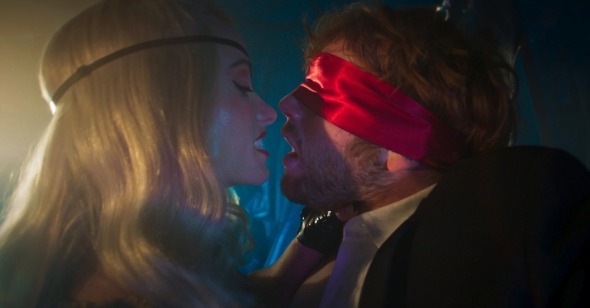
So, what is Gregg Araki into now? Pretty much the same stuff as decades ago, this time filtered through a tale of (barely) forbidden love between a dominant artist and her submissive assistant. In I Want Your Sex, Cooper Hoffman’s Elliot is bright-eyed and bushy tailed, a lustful little golden retriever of a boyfriend who has a girlfriend (a perpetually deadpan and disinterested Charli XCX) who barely fucks him and who soon finds himself in a consensual affair with his boss. With the image of Erika’s dead body and a number of cutbacks to an interrogation room (populated by a wooden Margaret Cho and Johnny Knoxville) where Elliot is being questioned, Araki plants the seed of misfortune. But any gesture toward something darker is a red herring; there’s no real danger other than the usual follies that come with sexual exploration and growing to understand oneself.
In Araki’s oeuvre, I Want Your Sex most closely resembles his gleeful romantic comedy Splendor, which followed a young woman trying to manage being in a throuple with two men. Just as Splendor presented an “alternative lifestyle” (albeit a straight one with a splash of bisexuality) as appealing, I Want Your Sex rejects shame. Where the former film leaned into the potential romance of polyamory, the new film aims to offer a learning lesson for a young man who needs to embrace his sexuality and submissive personality.
Others have noted that Sex is like the straight version of this year’s Pillion; and, yes, the two function similarly from their respective twenty-something shy boy bottoms to dominant and dismissive tops. Yet Araki’s film, co-written by Slutever founder and Now Apocalypse co-writer Karley Sciortino, is far less interested in its leading man’s growth beyond the traditional beats of maturity. He’s largely content to use Hoffman like a rag doll eager to be tortured and pleasured, while offering up jokey sexual imagery. The film coasts on the lead actors’ charisma, whether they’re coyly flirting, loudly fighting, playing drunk, or frustratedly crossdressing.
Wilde gets to chew the scenery like a contemporary art world Norma Desmond, while Cooper rolls his eyes back in ecstasy at everything from a gentle whipping to a thoroughly lubed-up dildo. There’s so much levity that when the film tries to raise the stakes by way of its noir trappings or bluntly reminding us of the skewed power dynamics between boss and employee, Araki loses control of the tone. A collection of frivolous supporting performances don’t help. Chase Sui Wonders gets the most chance to shine, playing Elliot’s best friend, Apple, who gets dragged into an uncomfortable threesome with the toxic duo. That scene shows her skill at physical comedy, especially when compared to Mason Gooding’s Zap, who seemingly only exists to deliver tossed aside gay jokes that would feel dated and out of touch for even Michael Patrick King.
Much like the film’s characters can’t commit without hurting each other, Araki can’t seem to commit to what truly works about his picture without getting distracted by peripheral ideas and satirical asides. In contemporary mainstream film culture where, as the phrase goes, “Everyone Is Beautiful and No One Is Horny,” Araki’s I Want Your Sex is as proud of its horniness as its leads are. But that horniness doesn’t necessarily come across as erotic, no matter how much nudity there is, or how many light references to erotic dramas and thrillers there are (an intertitle saying “9 ½ Weeks Later” drops almost immediately).
That may very well be because this is a film about what it’s like to discover your kink in your early twenties made by a man in his mid-sixties. There are various moments that lean into pointed criticism of how Gen Z doesn’t fuck. When Wilde has to deliver lines like “woke police” or “do you know what eroticism is?”, it feels like Araki is talking to others who think like him rather than the kids he claims to be encouraging to go out and hook up. The film also betrays an easy cynicism toward the art world and today’s “content creator” landscape, showing an artist willing to exploit those she even mildly cares about for fame, complete with shrugged-off jokes about selling your personal story for an opportunity. Erika serves as a mouthpiece for Araki’s own musings on both the industry and contemporary sexuality; her anxiety about being considered “over” by the scene that once loved her comes across like an admission from the director that the world has left him behind.
When Erika (a harassment lawsuit waiting to happen) talks about “cutting through the bullshit,” it’s hard not to wonder why the film’s director isn’t doing precisely the same thing. The precious few moments where Wilde reacts like a real human being instead of her dominatrix persona reveal a vulnerability to both character and storyteller; both seem to be poignantly wondering what a future without them and their provocative work might look like. But in choosing to focus mostly on Elliot’s evolution, Araki ensures the façade of coolness remains all we really know about Erika (and himself, by extension).
In the twelve years since his last feature—the misunderstood White Bird in a Blizzard, a smart and sensitive adaptation of Laura Kasischke’s novel that came out just before the lifeless YA boom of the streaming era—Araki found himself in TV no man’s land. Though he was largely anonymous in his Ryan Murphy series contributions, and merely pleasantly self-referential in the TV adaptation of Heathers and his own series Now Apocalypse, there were still glimpses of the Araki we love. I Want Your Sex shows he’s still the same filmmaker, though perhaps lacking the same edge.
I Want Your Sex may not have the anger and tragedy of The Living End, Mysterious Skin, and The Doom Generation; there aren’t any images that feel as incendiary or surprising as those in Araki’s earlier work; and even the soundtrack doesn’t feel as inspired or eclectic as usual. (The on-the-nose use of Jessie Ware’s “Free Yourself” in the credits is missing the energy and impact of New Order’s “Bizarre Love Triangle” at the end of Splendor.) But it’s still a welcome burst of color in a depressingly grey world, rejecting the dull, digital sameness we’ve become accustomed to. Even the distracting digital effects, like badly animated breasts popping out of Charli XCX’s chest, aren’t enough to detract from these performers’ natural live-action cartoonishness; Wilde and Hoffman often seem like Tex Avery’s horniest characters come to life.
A movie this silly doesn’t have to say much more than “go have sex and discover something new about yourself and the world.” If this new generation is as conservative and sex deprived as Araki claims, maybe this is the call to action they need. I find myself thinking about a scene in Splendor in which Kathleen Robertson, in one of her many direct addresses to the audience, says, “I thought Three’s Company was pretty progressive for its time.” Similarly, watching Splendor in the 2020s makes one wonder how Araki so impressively captured the nuances and beauty of a polyamorous relationship in the 1990s. As entertaining as it often is, I Want Your Sex doesn’t feel all that progressive beyond its hope that people might get a little messy in their attempts to find fulfillment.