Love for Scale
By Vadim Rizov
The Odyssey
Dir. Christopher Nolan, U.S., Universal
“The Odyssey was shot and finished on film”—an unusual line for the end credits scroll of a studio production, one almost certainly attesting to Christopher Nolan’s ongoing mutual-admiration society with British visual artist Tacita Dean. Both are avid celluloid loyalists who have spoken together on the medium’s irreplaceability at multiple Kodak events; he credits her with teaching him the term “medium specificity,” and it’s improbable that the coinage “finished,” most often heard in the realm of experimental film, snuck in any other way. Both have pushed beyond standard film usages: there’s not such a world of difference between the instinct that led to Dean’s 2011 installation FILM—which projects a 35mm loop on a 42-foot screen—and Nolan’s nearly two-decade quest to normalize IMAX. The shared goal, on some level, is to overwhelm with scale in service of highlighting the stock itself.
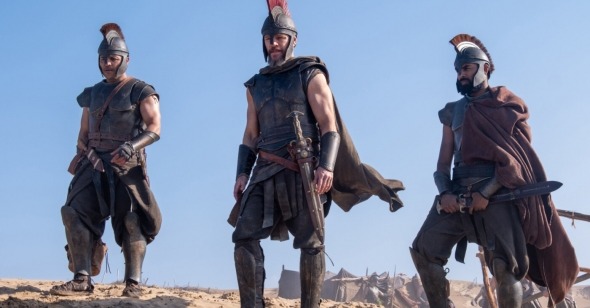
The first narrative feature to be shot start-to-finish on IMAX film, The Odyssey showcases lustrous ocean hues and $250 million worth of production value to sporadically radiant color effect. Projected on celluloid, it does meaningfully look like something that avoided a digital intermediate as much as possible. Nolan has taken a great deal of publicized time and trouble to get around the volume of the IMAX camera, whose sewing-machine clatter while operating previously precluded the possibility of recording dialogue. Having designed a new “blimp” to surround the camera and contain its noise (an innovation that required actors positioned around it to make eye contact via mirrors), he offers the first test-case for this as a feature-length narrative medium. After seeing Tenet in both 70mm widescreen and IMAX 70mm and decisively preferring the former’s crisp compositions to the latter’s unwieldy visual bulk, I wasn’t surprised to find I don’t think IMAX 70mm works here either. There are expected pleasures from familiar sources of IMAX’s previously demonstrated strengths: long helicopter shots soaring over cliffs and other images that include humans primarily as reference points for scale. But screen-filling close-ups with lots of headroom do not make a convincing case for this as a compositional strategy. Perhaps it’s the lack of visual texture and attention to color and set design; size aside, the visual effect is generally bland, and it’s difficult to forget that you’re watching a product designed for two entirely different compositional modes and releases. Sometimes, while bored, I would mentally reframe shots for widescreen, which was often easy to do when the set was systematically underlit at both top and bottom in ways that makes that part of the framing’s loss negligible.
Nolan plays the expected hits of Odysseus (Matt Damon) making his way back home after the Trojan War, peaking early with two of the most famous setpieces. This rendition’s Cyclops is very cool indeed, a synthesis of animatronics, puppetry and some kind of CG finishing appliqué that’s decisively uncanny with its humanoid frame, lumbering with a center of gravity and slowness that places him surprisingly close to the smaller but similarly sinisterly lumpy creature in Dea Kulumbegashvili’s April (2024). The transformation of Odysseus’s crew into pigs by the goddess Circe (Samantha Morton) is admirably grody, with the witch sculpting men’s faces into pigs like a rogue, real-time Tom Savini. Thematically, The Odyssey’s larger arc aligns with Nolan’s regular preoccupations. His male protagonists are nearly always haunted by either the possibility of losing their female partner or having actively contributed to their harm, and Nolan’s Odysseus is the definitive wife guy, grinding for 20 years to make it back home. Waking on a beach as an amnesiac, Odysseus tries to recall how he ended up in this situation, something the nymph Calypso (Charlize Theron) warns against: “You want to remember, but what if memory destroys your happiness?” We are nearly back where Nolan started, with Odysseus adrift in the literal boat Memento’s Leonard Shelby occupied metaphorically.
Nolan’s big adaptation contribution is to bend the text towards atheistic ends. Rejecting religion is a fine line to walk when your story involves multiple gigantic monsters, but Nolan cordons off the fantastical into the realm of Ray Harryhausen, functionally separate from any of the mythological faiths they were attached to. The opening title card sets the agenda: “A time of apparent magic,” that penultimate word setting the skeptical tone. There are no gods in the clouds debating the mortals’ fates here, and Odysseus is constantly denying their will or existence, as is son Telemachus (Tom Holland). In this context, while “Zeus’s law” is often invoked and defined as the obligation to host strangers lest they be a god in disguise, its usage is bandied out by characters of varying levels of admirability, sometimes quite cynically. The only god Odysseus actually encounters is Athena (Zendaya), whom he converses with and who no one else can see, which is in keeping with the source material, where she’s frequently either disguised or invisible. But Nolan has a final twist: Athena bears the same face as one of the victims slaughtered in the invasion of Troy, and Odysseus talking with her is quite possibly just a form of processing his trauma. Religion is a story we tell ourselves to reconcile with that which we can’t rationalize or comprehend, a less preferable form of storytelling to the purely secular; the final voiceover spells out, with Nolan’s usual lust for clarity, that we will forget the lessons of history until we revisit its stories.
Why Nolan wants to use a lot of resources at this moment to triple-underline “the power of storytelling” is clear enough. We are repeatedly told that we are watching a civilization nearing its end, in which the breakdown of the laws of hospitality is part of the larger decimation of the social contract. It turns out right-wing critics who preemptively decried the film were right to be wary, insofar as it stands against war, violence, and misogyny and for civility. While Nolan’s dialogue is certainly not taken from Emily Wilson’s 2018 translation, he might well have borrowed some guiding principles from her translator’s note, which states that “A translator has a responsibility to acknowledge her own agency and to wrestle, in explicit and conscious ways, not only with the multiple meanings of the original in its own culture but also with what her own text may mean, and the effects it may have on its readers. Because The Odyssey has become such a foundational text in our educational system and in our imagination of Western history, I believe it is particularly important for the translator to think through and tease out its values.”
Nolan takes that principle and extends it out to Circe all but explicitly saying she was raped, then having Odysseus confess that the invasion of Troy, while seemingly his greatest triumph, in fact traumatized him for life, echoing the historical hand-wringing of his Nolan predecessor Oppenheimer. The text can take reinterpretation, but the effect doesn’t seem to land: my audience applauded at the final kill, the opposite of the desired response. Whom the gods wish to undermine, they first make ambitious against the inevitable.