The Camera Eats First
By Saffron Maeve
Maddie’s Secret
Dir. John Early, U.S, Magnolia Pictures
“I call it scarf and barf,” the girl on the screen grins, saucer-eyed at her own admission. The classroom broke into a giggle. It was 2015, and thus objectively funny that our Southern Ontario health class was still adhering to its ’90s curriculum. By this point, we had already watched a handful of schmaltzy after-school specials about teens with eating disorders: For the Love of Nancy (1994), When Friendship Kills (1996), and, now, “The Secret Life of Mary-Margaret: Portrait of a Bulimic,” the pilot episode of HBO’s Lifestories: Families in Crisis (1992), about a popular girl who vomits into mason jars and stuffs them in her closet. (I thought this was what bulimia was, even after developing an eating disorder shortly thereafter.) One couldn’t suture a strand of relatability into these “lessons,” which taught us significantly more about melodramatic film form than about binge eating. My adult appetite for parody and kitsch might be easily traced back to the erratic sensation of watching these films, which registered as both asinine and grotesquely appealing to my gummy 15-year-old psyche.
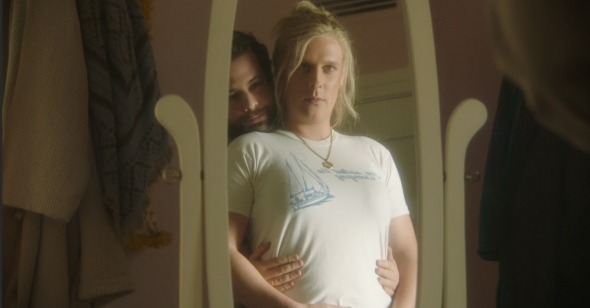
Maddie Ralph, the Nancy or Mary-Margaret of American comedian John Early’s directorial debut Maddie’s Secret, is that familiar blend of blonde, mousy, and ingratiatingly pure. Working as a dishwasher for GourMaybe, a culinary studio behind trendy test kitchen-style videos à la Bon Appétit, Maddie boasts the brand of clumsy innocence which typified after school specials of yore and millennial identity formation in the Buzzfeed era. She’s also played by Early in drag, a queer quiver in the subgenre’s formulae that evades gimmickry through a totally embodied (and impressively measured) performance. Attuned to the body as a projection of our competing desires, Early’s Maddie feels so meticulously constructed that she becomes more sincere with each added layer of artifice. She scurries around the studio kitchen with her feral lesbian coworker Deena (Kate Berlant), who makes her fratty romantic feelings known in spite of Maddie’s doting husband (Eric Rahill). Maddie’s first secret is that she aspires to become a recipe developer (a “vegetarian Nigella”) in the upper crust of GourMaybe’s content creation. When her recipe vlog of a Tortang talong–inspired smash burger goes precipitously viral, Maddie is thrust by her douchebag boss (Conner O’Malley) into a distending limelight where public sentiment triggers a relapse into bulimia.
It’s a pristine present-day parable: a food influencer capsizes from the impossible constraints of internet diet culture. To activate the low tragedy of Maddie’s situation, Early pushes beyond parody and contemporary critique (though the inclusion of “The Boar,” a prestige kitchen dramedy shopping for their food stylist at GourMaybe, feels overstated).There’s inevitably a campy gloss to the queer overtones—a gay man in suburban millennial drag, a predatory lesbian who slinks in and out of frame—but Early’s clarity of vision makes for something more akin to Sirkian melodrama or body horror than to sketch comedy. Pink donuts, wet with spit, are shot in distorting extreme close-up. The controlled whirl of a stand mixer harmonizes with Michael Hesslein’s ’80s-inflected score. Following each of Maddie’s episodes (Early avoids any depictions of retching), she is seen bloodshot, clammy, and in a stupor, like James Mason in Bigger Than Life (1956).
The film does not interrogate disordered eating any more than its wealth of straight-to-DVD influences do, but instead beholds the very logic of consumption in the digital era as an outcrop of our messier desires. Consuming content about consumption is a bit of a “scarf and barf” unto itself; in the perpetual scroll of lifestyle media that judges the digital body for its real-life appetite, eating becomes a performative gesture. Is the aioli sliding down your chin a turn-off? Was the chili crisp on your shelf ethically sourced? Deena’s fixation on Maddie—scaffolded from the stereotype of the excitable best friend in love with the clueless lead—balloons simultaneously with Maddie’s relapse and online ascension. So too does the bubbling envy of another GourMaybe recipe developer, and Maddie’s husband’s detachment. Everything spins off the very same axis of want.
The film is unofficially cleaved into two parts: before and after Maddie seeks (or, rather, is forced to accept) help from an inpatient program at an eating disorder clinic. The sterile test kitchen gives way to a shared hospital room where patients are strictly regimented, and the film’s rolling playfulness decelerates into a more somber feel. After-school specials orbited around the restitution of the nuclear family (generally, mother figures were shown fighting for the lives of their daughters), but Maddie’s Secret upsets this trope with the ominous inclusion of an unsupportive mother (Kristen Johnston) goading Maddie further into her disorder. Maddie’s mother looms over the plot with genuine cruelty—why would a parent send their vegetarian child boxes of steak?—until a confrontation scene disgorges their toxic dynamic.
“I love movies because of women,” Early recently told Time. “All the people I fell in love with as a child were women.” This lovesick attraction to women and the specificity of their struggles might have felt mocking in the image of a lesser comedian, but Early—whose body becomes the film’s membrane between performativity and self-inflicted violence—seems, genuinely, to love women and the movies.