Illuminations
By Jawni Han
A. Rimbaud
Dir. Patrick Wang, U.S., self-distributed
“[R]eality was too prickly for my lavish personality.” So begins Arthur Rimbaud’s poem “Bottom” (exquisitely translated into English by poet John Ashbery). Aside from being a killer opening line, the quote encapsulates his solitude as an artist at odds with the world that remained indifferent to his poetic vision. Now a towering literary figure who has influenced countless cultural icons, from Samuel Beckett to René Magritte to Bob Dylan, Rimbaud did not enjoy much success until well after his premature retirement from literature at age 20. In an 1871 letter to Paul Demeny, who preserved the poet’s early works against his wishes, the then 16-year-old prodigy declares that a true poet is “the thief of fire.” For him, poetry was a civilizational project of a Promethean magnitude that could—and should—reshape humanity.
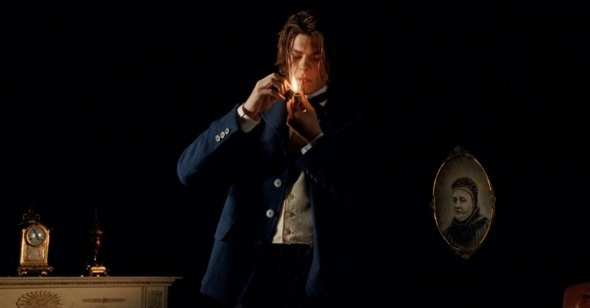
Patrick Wang’s A. Rimbaud (2026), an utterly original “one-man-film” biopic that traces the visionary writer’s life from his adolescent years to his untimely death at 37, underscores Rimbaud’s ambition at the outset. Its first image, through rack focusing, shows a small patch of what appears to be a cave wall engulfed in darkness, lit only with a sharp spotlight. We see more of the wall when another off-screen light source bathes the space in an amber glow just as the teenage Rimbaud (Blake Draper) emerges from the unlit foreground and occupies the center of the frame, as if he himself has brought the fire. He addresses the camera, asking, “Would you like to hear a story? It is by Horace.” By the time he moves away from the rock formation and gets seated in an empty black box, he has forgotten the story. Instead, he recites his own musings about how much he hated school as a little boy. Draper’s doe-eyed face and remarkably assured line delivery of Rimbaud’s precocious observations animate the blank spaces of the frame with ingenuous conviction and lust for life.
The majority of A. Rimbaud is confined to the black box theater, dressed with only what is essential to evoke a given setting and mood—a bold aesthetic choice that mirrors a poet’s economy of words. Wang’s masterful framing and lighting, aided by Draper’s spellbinding performance, transform the austere setup into a boundless realm where Rimbaud’s hallucinatory imagery can fully transmit its cosmic potency. Early in the film, we see the poet, still a teenager but now dressed in a military uniform, lying on the ground and surrounded by green chalk marks meant to represent grass. He recites “Sun and Flesh,” a lyric poem written in French alexandrine that reinvigorates Victor Hugo’s Romanticism and Horace’s Latin verse with blunt sexual innuendo. The camera slowly zooms out over the course of the reading, and by the time he gets to the second stanza, the chalk grass starts to move as if dancing to his spoken words. “How can you love Baudelaire and want to stand still?” asks Rimbaud later in the film. His grand endeavor to animate not just his reality but the entire world with poetry finds a perfect vehicle in Wang’s filmmaking imagination, which harkens back to D. W. Griffith’s lamentation: “What the modern movie lacks is [...] the beauty of the moving wind in the trees.” Wang seems to wonder, perhaps through Rimbaud’s vivacious arrangement of words, could we reclaim cinema’s embryonic enchantment as “motion picture”?
He is not the first to pose this question, of course. Most notably, Jean-Marie Straub’s and Danièle Huillet’s many “reading” films feel like A. Rimbaud’s immediate spiritual predecessors. In Antigone (1992), for instance, the duo tests whether Fordian framing can be upheld solely by Hölderlin’s radically literal German translation of the Sophocles tragedy. A decade later, they dispensed with traditional dramatization altogether, putting their faith wholly in the spoken word’s capacity to sustain the moving image in Workers, Peasants (2001), in which amateur actors take turns reciting passages from Elio Vittorini’s novella Women of Messina. The press kit for Workers, Peasants comes with a 1947 interview with Vittorini where he says: “There is in every historical period a certain sum of possible means, if you like [...] But the capitalist world is such that these means are practiced in an absurdity and an absolute hypocrisy. They are endless means, a chaos of means.” Vittorini’s remark feels even more pertinent in our present moment, each day further degraded by AI-generated imagery and sound. Why bother with the latest technological fads when we have yet to completely exhaust the possibilities lying dormant in the tools we have had at our disposal for centuries and even millennia? Beyond their shared preoccupation with the musicality of words, what unites Wang and Straub-Huillet is precisely their resistance to “a chaos of means,” opting instead to strip cinema down to its most quintessential elements in order to reinvent it.
Wang captures the feverish delirium and infernal imagery of Rimbaud’s A Season in Hell using only a handful of “humble” means. Back inside the black box theater, our poète maudit, tormented by the disastrous two-year romance with Paul Verlaine, who has wounded him with a gunshot, stands in front of a wooden table; on it are pieces of scrap paper spaced out at uniform intervals. The lighting is soft, and his demeanor is timid. When he picks up the first sheet, however, a different persona possesses his body, accompanied by a much harsher and bluish lighting scheme. Venomous words flow out of his mouth. The light switches back to the initial diffused glow once the narration concludes, and he moves horizontally along the table, which seems to extend perpetually, and reads out different fragments from what would become his masterpiece. Hell is the unfathomably long table situated in the middle of the abyss, and the snapshots of its frightening splendor reverberate throughout the black box theater each time Draper utters Rimbaud’s words.
It’s worth noting that the poems and passages from Rimbaud’s epistolary correspondence we hear are presented in Wang’s own English translation. This was in part due to his dissatisfaction with the available English rendition that preserves the alexandrines and rhyming schemes of Rimbaud’s early lyric pieces. For a film that treats poems exclusively as embodied articulations instead of written texts, the echoes from Rimbaud’s rhyming verses were of utmost importance—hence, Wang took it upon himself to create a new English translation suitable for the film. With A Season in Hell, one of the great monuments of French prose poetry, Wang’s translation serves a different purpose. His version subtly amplifies the immediacy of Rimbaud’s visceral self-portrait of his tortured psychology. Take, for instance, a passage from its prologue: “Le malheur a été mon dieu.” Whereas Wyatt Mason and Louise Varèse accurately translate this into “Misfortune was my God,” Wang changes the tense and gives us “Misfortune has been my God.” Unlike in the pre-existing translation, misfortune continues to hover over the narrator, suggesting that he—both Rimbaud and the speaker of the poem—is still in the thick of a calamitous affair.
Even more crucially, the iteration of “Bad Blood” performed in the scene deviates significantly from the published text, with “My race never rose up but to pillage” from the second subsection preceding a passage from the first. Could it be that what we are watching is not the recital of a finished work, but an act of creation? Rimbaud is toiling through an early draft, metabolizing every scornful letter he has poured onto the pages before reshuffling them into the version we are now familiar with. In addition to Wang’s superb command of cinematic apparatus, this scene demonstrates his literary mind, prodigious enough to produce a convincing “rough draft” of A Season in Hell.
Such acts of creation abound in A. Rimbaud. Throughout, Rimbaud alone speaks human languages, and every “line” from other characters, all off-screen, takes on the form of musical fragments played on various instruments: Verlaine as viola, his employer Alfred Bardey as French horn, his servant Djami Wadaï as erhu, etc. On the surface, this feels like a humorous way to accentuate the poet’s loneliness, reflected in asymmetrical verbal communications. However, the positioning of music on par with human languages also speaks to Rimbaud’s sharp ear, which restlessly searched for melody and rhythm hidden in the most mundane, whether it was a casual chatter at a bar or a tedious quarrel with his unsupportive mother. His “lavish personality” was always attentive to what the world had to offer and gave back through his Symbolist poems. During his London years, he picked up several English words and injected them right into his poetry: the most indelible example being “her heart of amber and spunk” (“son cœur ambre et spunck”) from “Devotions.” And Wang seems to believe that the poetic ear never left Rimbaud, even as he worked as a coffee merchant in Ethiopia and Yemen in the second half of his life. It’s possible that he continued to produce poems and never wrote them down. One may also wonder how Rimbaud might have described the tasting notes of the coffee beans he was trading; could he have liberated us from cookie-cutter adjectives such as “floral” and “nutty”?
Above all, A. Rimbaud is a film that grapples with the poetic form: not the kind that forces the viewer to extract a vague revelation from meandering nature shots, but one that emulates the succinct arrangement of words that give structure to life’s wonders. If we can call Wang’s vision “poetic,” it has everything to do with how it urges us to be more precise with our expressions. Vladimir Nabokov’s dictum that “in a work of art there is a kind of merging between [...] the precision of poetry and the excitement of pure science” applies to A. Rimbaud. The journey to Rimbaud’s delirium requires not chaos, but rigor, as evidenced by Wang’s fastidious mise-en-scène and prosodic undertaking. For even ineffable enchantment needs precise forms to appeal to our senses.