Crossing the Threshold
By Nicholas Russell
Hokum
Dir. Damian McCarthy, Ireland/U.K./U.S., NEON
Art is, by nature, derivative. The artistic drive comes, in part, through mimicry, emulation, the ambition to match or outdo that which inspired in the first place. There is no shortage of column inches devoted to Hollywood’s concerted lack of inspiration in the 21st century. Downstream from this conversation about IP fatigue and lucrative but mind-numbing appeals to the lowest common denominator is a discourse about how easily and quickly aspects of a successful film’s style can be cannibalized without any true understanding of how choices worked. This typifies an exhausting set of trends in mainstream horror filmmaking, all of which have been cribbed from prestige indie cinema: center-framing, extremely low lighting, desaturated color grading, split diopter and Dutch angle shots, crash zooms, ironic needle drops, the slow push-in on an emotionally muted protagonist trapped amidst an ever-escalating series of allegorical terrors, and the sudden cut to black.
These aesthetic choices, cut up and reposted without context to showcase little more than symmetry, have become a recognizable crutch in horror cinema, marshaled together as a means of signaling a seriousness and quality that is rarely reflected in the script. The narrative and formal demands of screenwriting are specific to cinema, but the ideas and choices that feed them need not be hermetically bound to a single medium. And yet, even within the wide field of their own chosen art form, it appears many filmmakers have an active disdain for the history and craft of cinema. In an essay titled, “On the Teaching of Shakespeare and Other Great Literature,” a 22 year-old Orson Welles, in collaboration with his high school headmaster, puts it succinctly, “The truth of it is that we in the field of English expression have been indoctrinated with the scientific approach theory so thoroughly that we are making dissecting-rooms of our English classes to the slight buildup of our own sense of importance but to the infinite detriment of our charges. We are tossing away their aesthetic birthright for a dubious and unsavory mess of analytical pottage.”
The films of Irish writer-director Damian McCarthy are a welcome reminder of how a reverence for and attention to classic tenets of filmmaking—indeed, to the rich history of cinema, both mainstream and independent—can still yield surprising, thrilling results. One of the very first thoughts I had after watching McCarthy’s 2024 film Oddity was that it had the rhythms and atmosphere of a short story. There is a distinctly literary quality to McCarthy’s work, which spans several shorts and three features. His settings, so far all staged in his native Ireland, are both mundane and mythic, featuring ancient houses, secluded cabins, remote hotels, and the unsettling sterility of hospitals hidden in the forests of a country whose landscape has eluded modernity’s grasp. The supernatural and uncanny lurk at the edges of this reality, rule-bound creatures of folklore as ancient as they are unforgiving. McCarthy’s films feature characters who exist in a world where a single aberrant request—say, being strapped into a chained harness that limits how far into an unfamiliar house they might travel, as in 2020’s Caveat—is perhaps unexpected but a natural part of its internal logic.
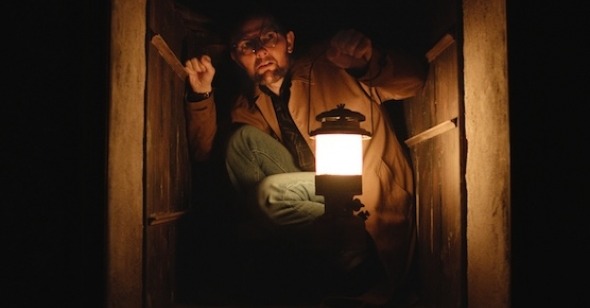
This fable-like milieu recurs in McCarthy’s newest film Hokum, distributed by Neon, making it his highest-profile American release yet. Adam Scott stars as prickly novelist Ohm Bauman, whose bleak Conquistador trilogy is coming to a frustratingly uncertain end. While laconically sketching out what, for Bauman, is a typically dark and violent conclusion to the series, the writer is continually haunted by the tragic murder of his mother when he was a boy. It is in service to her memory that he travels to the Bilberry Woods Hotel in rural Ireland, where his parents spent their honeymoon, to scatter her ashes. It is the week of Halloween, and in Bilberry Woods Bauman encounters the small hotel staff and the denizens that surround it, featuring characters by turns friendly and taciturn, though Bauman’s quick rudeness does him no favors. A deft comedian, Scott is a stiff dramatic actor in the mold of Keanu Reeves, though this is to Hokum’s advantage. His rationalist deadpan delivery turns Bauman’s every line into a pronouncement designed to stifle any intimation of internal depth, his harsh, cold behavior a smoke screen that few are willing to squint through. As such, Bauman is the perfect straight man to which McCarthy’s horrors reveal themselves.
Another literary quality of McCarthy’s films is their careful construction and pacing. The truncated space in which short stories are meant to introduce and convey a narrative privileges vivid but swift descriptions, as in the masterful works of Algernon Blackwood and Shirley Jackson. In Hokum, McCarthy utilizes quick flashbacks and simple idiosyncrasies specific to each character to move the story along. There is always one more wrinkle to smooth out, one narrative complication that heightens tension. Favorite among McCarthy’s stylistic identifiers, and quickly becoming his signature, are totemic props: the mangy stuffed rabbit in Caveat, the life-sized wooden doll in Oddity. There are several items that fit this description in Hokum, including a series of disturbing porcelain figurines, a gas lantern, and an old clock with the likeness of a boy golfer on the top, which are played with and rendered essential as tools of survival by both living and dead characters. McCarthy’s props almost never perform the function one would expect.
The same is true for the horror McCarthy is interested in mining. Immediately upon his arrival at the hotel, Bauman notes that the honeymoon suite where his parents stayed is closed off. The staff members playfully offer diverging explanations: the room is haunted, a witch has been trapped inside it. Bauman’s eventual journey to that room reveals a supernatural reality he did not think existed. McCarthy favors simple execution with his scares, setting up an empty frame, cutting away, then cutting back to show a shape occupying that same frame. Often, the camera is pointed at a shadowy corner or hallway in which something lurks, but McCarthy’s goal, particularly when it comes to his richly classical lighting, is legibility rather than confusion. As such, when something scary appears, the audience sees it clearly, even if the setting is dark or the frame is crowded with other objects or people.
Juxtaposed with the supernatural is another, more distressingly tangible fear. McCarthy’s films all deal with the silencing of inconvenient women by desperate, unimaginative men. In the parallax between the seemingly impossible and the mundane, McCarthy locates a uniquely uncomfortable niche within the genre, one which subverts the audience’s expectations as to who or where the antagonist will manifest. Ghosts feature prominently in his films, but their behavior is difficult to predict. The British writer Robert Aickman says, “The successful ghost story does not close a door and leave inside it still another definition, a still further solution. On the contrary, it must open a door, preferably where no one had previously noticed a door to exist; and, at the end, leave it open, or, possibly, ajar.”
For Ohm Bauman, not only is his conception of a rational and unsurprising world disrupted, but so is his understanding of the finality of death. The door opened to him can never be closed again. Trapped in the honeymoon suite while the hotel is unoccupied, Bauman dwells on his family’s tragic past and that of others who have met similarly violent ends. At the same time, Bauman is being toyed with by ancient forces that take memorably disturbing forms. McCarthy draws Bauman as a person who lives by the adage that hell is other people. Before the night is out, Bauman just might catch a glimpse of the real thing. The lethal inevitability of Gothic literature, where a threshold must be crossed, a repressed history must be violently revealed, or an ethereal force unlocks a terrifying essential truth about the universe is dramatized most potently in McCarthy’s decision to push Bauman into a kind of chamber of reflection where the writer must face the reality and meaning of his death, whether now or in the future, and a dizzying, unsettling question: what awaits him on the other side?