Into the Night
By Caden Mark Gardner
Moonglow
Dir. Isabel Sandoval, Philippines/Taiwan/Japan/U.S., no distributor
Moonglow screens May 3 at Museum of the Moving Image as part of First Look 2026.
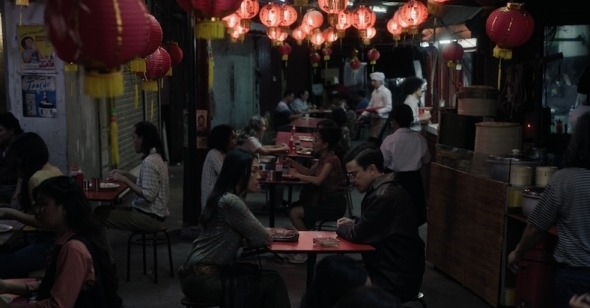
In her long-awaited follow-up to Lingua Franca (2019), writer-director and star Isabel Sandoval returns to the Philippines and turns back the clock. As with Sandoval’s other films, Moonglow invites viewers down pathways through her cinephilic lodestars from the atmospheric Wong Kar-wai–inspired vintage neon colors and simmering melodrama to the plot mechanics of hardboiled film noirs like Out of the Past and Double Indemnity. The film is not an all-out pastiche but is rather playful with its genres, remixing and pushing against their conventions. Ultimately, Moonglow is a film about how national memory interlinks with personal, romantic memory. It opens with the James Baldwin quote, “People are trapped in history, and history is trapped in them.” The characters find themselves in an uneasy age of corruption, defeatism, and Martial Law under the dictatorship of Ferdinand Marcos. In such difficult times, nostalgia remains a lifeblood for characters who risk losing themselves. Moonglow looks back down roads not taken, images and gestures emanating through the hazy humidity of the Manila night like cigarette smoke.
Sandoval plays Dahlia, the name of a flower but also a nod to film noir (the Raymond Chandler-penned The Blue Dahlia). Dahlia is not a classic femme fatale, however; she is a deeply disillusioned police detective in Manila. Dahlia is also not a conventional detective, even beyond her gender making her a minority within her field at the time. Not yet fully hardened by the Marcos regime, she has been using her position to funnel money to the poor under the nose of her corrupt superiors and uses the Catholic church, with help from her Aunt (Agot Isidro), a nun named Sister Therese, to help hide the money. The Robin Hood-like nature of this scheme nods more to Dog Day Afternoon’s Sonny Wortzik than The French Connection’s Popeye Doyle. Technically, Dahlia is committing a crime, but she’s not a “crooked cop.”
Soon, her boss, Bernal (Dennis Marisigan), tasks her with leading the investigation of the crime she committed. Dahlia's rationale for her actions is resolutely unwavering and well-calculated; being Bernal’s right-hand allowed her to observe the ways in which she could manipulate the system. The irony of her self-investigation is compounded when Bernal recruits his magistrate nephew, Charlie (played by Filipino actor-turned-politician Arjo Atayde), who is Dahlia’s former lover. Charlie is an unconventional romantic lead in his bookish looks, which are further contrasted against the oafish and lumbering Bernal, a strongman to the corrupt dictator.
In flashbacks to the late 1960s, Charlie and Dahlia’s past is pointedly tied to a pre-Marcos period, although there are oblique nods to what was to come. This past world is more colorful and realized with a recognizable traditional Hollywood glamor. The film's cinematography, by Isaac Banks (who also shot Lingua Franca with intimacy and notes of solitude), shifts between this brighter, richer palette of the past and a darker, more nocturnal present, filtered through a Gordon Willis–esque vision of the 1970s. The jazzy Keegan DeWitt score and the accomplished soundscape by longtime Edward Yang and Hou Hsiao-hsien collaborator Tu Duu-chih bring the past into echoing conversation with the present, highlighting analog technologies, from the of pop music echoing in the distance, to the street and rotary telephones, to radio broadcasts crackling through the airwaves. Yet, despite the evocative period detail and production design, Moonglow does not get lost in nostalgia for its time period, nor does it lose sight of the corrosive realities of the Marcosian era.
Sandoval's breakout Lingua Franca was a New York–set immigration story with a doomed romance at the center, sharing with Moonglow characters navigating systems and red tape, and bending the rules—both personal and lawful—out of romantic and heroic impulses. But that film’s central character, Olivia, was far more circumspect and the narrative was in a more social realist register than Moonglow. It is Apparition, Sandoval's film about a 1970s monastery set in a remote Filipino forest, that Moonglow most resembles. Both films are “ghost stories,” asking what one does as a member of an institution seen as a beacon of morality in a time and place where autocratic kleptocracy rules with an iron fist and immorality begins to consume one’s surroundings. The Marcos regime in these films tests the “better angels” of individuals within these systems who seek out their own forms of resistance.
In Moonglow, we see that resistance is not limited to Dahlia but also applies to everyday, like-minded people, such as the journalist Nick Garcia (Rocco Nacino), who wants to confront the corruption head-on. In much of 1970s cinema, these efforts were often portrayed as futile or reckless actions that inflict collateral damage on innocents. Contemporaneous Hollywood titles such as Alien and Apocalypse Now are seen on cinema marquees, and one character even expresses a love for Robert Redford. This was also the time of Filipino auteurs Lino Brocka, Mike de Leon, and Ishmael Bernal (referred to by Sandoval as “the holy grail” of Filipino cinema) at their zeniths, making names for themselves with urban-set dramas featuring overt social commentary. These films would turn them and other national filmmakers into targets of the censorious Marcos regime during the period of Martial Law. Their critical voices persisted even after the People Power Revolution toppled the authoritarian rule in 1986 and were directed at the succeeding government. Moonglow refuses to define itself strictly in terms of what existed pre-Marcos versus the Marcos era but instead points to the possibilities for what might emerge in the Philippines after the regime change, especially in a jolting flash-forward image. Dahlia is preoccupied with what lies ahead, whether it is her wealth redistribution scheme or a possible future with Charlie even as she is being closely followed by Bernal’s goons.
There is perhaps no film genre more cynical or bleak than noir, yet Sandoval's oeuvre upends conventions by never defaulting to outright cynicism, even when her characters are faced with impossible dilemmas and cruel disappointment. Ultimately, Moonglow is less about the intricacies of double-crossing and money laundering than about finding what can galvanize you through the harshness and cynicism of the times in which we live. While the political currents of today show how challenging that can be for all of us, Sandoval's romantic filmmaking offers an atmospheric, tantalizing tonic.