Caught in the Act
By Clara Cuccaro
The Whole World Is a Lie
Dir. Charlie Birns, U.S., no distributor
The Whole World Is a Lie screens May 1 at Museum of the Moving Image as part of First Look 2026.
Since Lee Strasberg’s death in 1982, Method acting has fallen out of favor with the public. Former students of Strasberg like Al Pacino and Ellen Burstyn have attempted to preserve their mentor’s legacy with their celebrity status as co-presidents of the Actors Studio, but his teaching lineage has shifted toward niche environments rather than major institutions. Now, pupils like Tony Greco, an acting coach perhaps best known for teaching Philip Seymour Hoffman, carry on Strasberg’s lineage in a smaller, some might say cult-like, pedagogical setting.
Greco’s acting class at the Gene Frankel Theatre in Manhattan is the primary location of Charlie Birns’s reflexive documentary The Whole World Is a Lie. It’s here that the director, once a student, wants to “elucidate ideas and associations” he discovered while taking this class with Greco 10 years ago. Unfortunately, his vague thesis, tentative demeanor, and camera crew, with its observational yet disruptive position, seem to rub everyone in class the wrong way. The resulting tension undermines Birns’s initial project and becomes the film’s subject, revealing the uneasy power dynamics at play between filmmaker and participants while simultaneously exposing the performative nature of the space, where “emotional truth” and staged expression is often blurred.
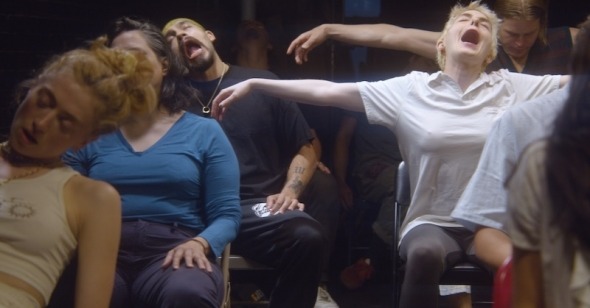
Greco establishes his authority with Strasberg’s basic relaxation exercises. As his students chant, slump forward, and roll their necks in foldable chairs, Greco reminds them that this tension is the enemy of the creative process. He’s teaching the fundamentals of Strasberg’s work, but rather than exerting a zen aura, he embodies his former acting teacher’s dogged spirit. Greco maintains this dominance during his first class with Birns in attendance. He calls the director a tool, much to his students’ enjoyment, and reminds everyone that the cameras will heighten and change their classroom dynamic before breaking the fourth wall. This brief moment of eye contact with the camera underscores Greco’s awareness of the filmmaking apparatus. Rather than accepting Birns’s obscure, and possibly self-serving premise for a documentary, Greco controls every scene he’s in. He’s aware of the camera’s presence and actively resists its absorptive framing through direct address that is sometimes passive and other times openly hostile.
Birns is in many ways the polar opposite of Greco. His muted, go-with-the flow mentality is perhaps inspired by all the random talking heads in his film. He enlists tarot card readers, movement researchers, and Buddhist monks to provide commentary on consciousness and transformation. Their anecdotes leave more questions than answers, like why is this happening and who is this film for? Birns’s exploratory nature structures the film, but this doesn’t make his presence any less frustrating for his classmates. It’s clear that the director needs guidance and is struggling with some sort of emotional block, the same one that is holding him back in Greco’s class. During one heated exchange, a group of students attack Birns over his indecisiveness, eventually mutinying. He never matches their vitriol, but the camera captures his disappointment after Greco delivers the death blow, “you’re a very bad producer and director.”
The Whole World Is a Lie has a conventional visual language that highlights its reflexiveness. Birns includes scenes where he consults his cinematographer, Peter Butaine, and camera operator, Marina King, who remind him that “actors are crazy,” and he doesn’t shy away from the less glamorous moments of moviemaking (lights being repositioned, boom mics dipping into frame). But because Birns’s on-screen persona is often verbally withholding, these choices suggest he has the intelligence and financial resources to assemble a skilled and capable crew. When the director’s father, Michael, asks, “How much money are you wasting on this documentary?” while driving around the Hamptons in a BMW, the question registers both as a cruel joke and a pointed reminder that Michael is most likely funding the film’s production in one way or another.
Method acting is built around the conviction that audiences desire access to an actor’s emotions. Unlike real life, in which people are often self-conscious, Method performances are expressive. Michael adheres to this principle despite, like Greco, playing himself. As a self-made man from the Lower East Side, he embodies a certain chutzpah despite his age. Michael is not afraid to chastise his son in front of the camera, perhaps as a way of toughening him up or asserting his dominance. Rather than arguing with his father, Birns shows himself taking most insults on the chin, internalizing his pain rather than reacting to it. The director admits as much during one of Strasberg’s “song and dance” exercises. After singing “Happy Birthday” and looking his classmates in the eye, he becomes visibly upset as Greco presses him about his complicated relationship with his father. His voice cracks as he admits to numbing himself so that he could “move through these violent spaces without seemingly being affected.”
The Whole World Is a Lie can be read as an unintentional form of filmmaking-as-therapy, aligning with executive producer Robert Greene’s process-based documentaries, where performance becomes a way of working through experience rather than resolving it. This is evident during the film’s final scene rehearsal of Anton Chekhov’s Three Sisters. Birns admits to Butaine that he needs to give the audience what it wants: catharsis, so he moves to stage it. He experiences affective memory, the core component of Strasberg’s Method techniques, and for a brief moment, Birns, not Greco, is in command of the film as both an actor and director. He is present, unguarded, and momentarily at ease, suggesting that the film is less invested in resolution than in the process of working through the past.