Makin’ It:
Chloe Lizotte on James N. Kienitz Wilkins’s The Misconceived
What can movies do? Movies may be uniquely able to impart images of the real world, but this only happens through distortion. They train us to seek “authenticity” in an assemblage of artificial elements; certain tropes in lighting, editing, sound, and performance have become conventionally accepted signifiers of the real. At the same time, we know we’re surrendering to an illusion.
The narrator of James N. Kienitz Wilkins’s 2015 short B-Roll with Andre suggests that images that are too high-fidelity have turned perception into an intellectual exercise: the higher-definition the camera, the more you obsess over how real the image looks. “We need to get to the highest level…understanding,” he continues. “Pure ideas, pure form.” This has come to be a structuring ethos for Wilkins’s cinema. Is it possible for movies to house a thought process when film production seems designed to thwart nuance and complexity? Narrative cinema is about communicating subjective experience through a toolkit of objective forms and familiar frameworks: cast, setting, camerawork, music cues. When an emotion or an idea finds a concrete form, it limits it, transforms it, keeps it from feeling so fluid, surprising, or unique. Viewers have internalized the rhythms of three-act structure and are primed to parse characters through stock types. Every aesthetic choice reminds the audience of a lineage of earlier filmmakers. Plus, before they’re even made, movies are pitched and funded based on a packet of digestible themes and buzzwords, then marketed based on the profile of the director, importing the “right” industry credentials and institutional affiliations to a project. Isn’t there supposed to be a movie at the heart of this—that is, a person, a perspective, an author?
When it comes to filmmaking, the idea of the author—the auteur—is something of a convenient fiction, always at odds with conditions of production and reception. Wilkins’s narrative films center on artists trying to make ends meet, spending most of their time overcoming obstacles to artmaking, sidetracked by humiliating and mundane rituals at the intersection of art and commerce. In his 2017 feature Common Carrier, a filmmaker writes a treatment for a lowest-common-denominator horror movie so that he can pay back legal fees; the monster in the film is called the “Jibber-Jabber,” spouting a torrent of marketing copy and nonsense words. Another character, a young actor, seeks help making a reel for the sake of creating a generic Backstage profile, a requirement for entry but far from a guarantee of success. All of Wilkins’s projects are preoccupied with language—many are anchored in monologues, a mode that suggests a filibuster toward something unfiltered, “pure thought, pure form.” But all of these films are also comedies, and something funny happens when these ideas are released into the real world, mutating like an Animorph from individually authored screenplay to collectively realized fiction. Though auteur theory might train us to say that these films reflect Wilkins’s individual vision, they’re also all made with a small cohort of regular collaborators, including cowriter Robin Schavoir and producers Emily Davis, Paul Dallas, and Joey Frank.
His newest feature, The Misconceived, catapults his recurring constellation of themes into his craziest visual world yet. You never know what you’re going to see when you watch a Wilkins film—it could be a 30-minute shot of a coffee cup (This Action Lies), an hour-long succession of press stills from ’80s and ’90s Hollywood movies (Still Film), or a three-and-a-half-hour gradient shift from a black frame to a white frame (The Republic—the narration is a hyperverbal five-act play about libertarian social outcasts). But it still comes as a surprise that Wilkins has made a film in Unreal Engine, a 3D graphics engine that was originally designed in the late ’90s to animate video games.
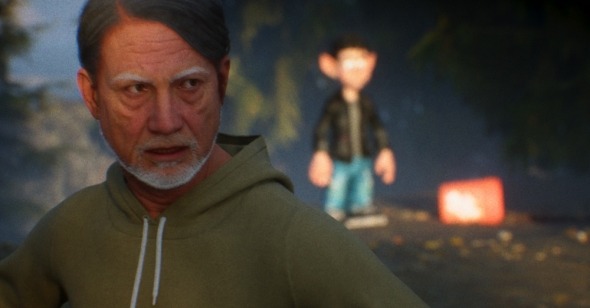
Gaming engines have since become popular in the film industry to craft virtual sets; these surroundings can be rendered on LED volumes in real time behind the actors, like exceptionally good-looking rear projections that cameras can easily track around, eliminating the need for finicky green-screen in post. They’re also used to animate characters through motion capture, but instead of making something like The Mandalorian or the photorealistic Lion King, Wilkins here uses Unreal Engine to render a script that is decidedly not sci-fi or fantasy—it’s a low-budget drama requiring a single set and maybe a dozen actors, but for which he and his team could not secure traditional financing. The result is deeply uncanny, making immersion impossible; just when you get used to the way some of the figures move and speak, a few new characters will show up whose animation style seems to come from an entirely different aesthetic universe, throwing you off balance. By the same token, it’s also impossible to imagine the film being made with live actors; if it were, it would lose a crucial source of tension. As so many key conversations in the film swirl around authenticity in artmaking and identity, it’s pointed for the film’s visuals to encourage you to question everything you are watching.
The plot has to do with physical construction—a home renovation project—which is a good framework for a movie that foregrounds its digital tools. At the heart of the film is an unlikely reunion: fortysomething Tyler takes a carpentry job remodeling the vacation home of a sculptor named Tobin, who happens to be his former best friend from college. Tobin remembers Tyler as a burgeoning filmmaker, but Tyler never broke into the industry; now, he is the primary caregiver for a young son, and wonders if his own unproduced screenplay has mostly become a “therapeutic” exercise. Although Tobin is more conventionally successful than Tyler on paper, he reeks with desperation to remain relevant in the art world, courting the attention of the Whitney Biennial curators as he enters middle age. He and his wife, Gwen, leave the workers—alongside Tyler, that’s lead contractor Widget and young helper Mikey, a gleefully crass aspiring screenwriter—at the mercy of their own whims and neuroses. Their relationship is transactional, and newly fraught because of circumstances that brought Tyler on the job in the first place; he was invited aboard as a replacement for a contractor who experienced some sort of a breakdown.
Most of the characters are animated fairly photorealistically, with intentional, unresolved stiffness in body language and mouth movements. Tyler looks a lot like Keanu Reeves, pulling in A Scanner Darkly and The Matrix as visual reference points, suggesting a labyrinth of signifiers and surveillance. He perpetually regards the high-strung, self-absorbed Tobin—sort of a funhouse-mirror Jason Sudeikis, gritting his teeth at the exact midpoint of a smile and grimace—with a world-weary fatigue, exhausted by his privilege to obsess over his art-sphere standing and tune everyone else out of his field of vision. But this consistency of style breaks down soon enough. Mikey, for one, looks like more of a cartoon than everyone else; his pointy ears evoke an elf, or an imp, suiting his personality. His jarring appearance also reflects the other characters’ classist perspective toward him—for a gag late in the film, it’s revealed that his contact is saved in Tyler’s phone as “Mikey Worker.” These sudden deviations from visual expectations beg the question of whose gaze is shaping the world we’re seeing—the more cartoonish or one-dimensional a character appears, the more we have to work to overcome the artifice of the film and afford them greater depth. As The Misconceived progresses, Mikey becomes something of a bizarre force unto himself, transcending this reductive reading through sheer will of disruptive comic relief.
*****
The Misconceived was pitched as a companion piece to Wilkins and Schavoir’s 2019 feature, The Plagiarists, which is built around a highly specific deception. After their car breaks down in Upstate New York, a white yuppie couple finds shelter with a middle-aged Black man (Clip Payne of Parliament-Funkadelic), and he delivers a moving monologue of reminiscences about his own childhood—only for them to discover months later that this was a word-for-word quotation from Karl Ove Knausgård’s My Struggle. This sends one half of the couple, aspiring memoirist Anna, into a complete tailspin; it brings her own racial and class biases to the surface, perhaps all the more acutely since for her, these words were more than a searing moment of authenticity and poetic vulnerability. This conversation was the sole motivator that got her to buckle down and finish her book—and, with Clip’s encouragement, declare herself a writer in her own mind. There is often anxiety in Wilkins’s films about the gap between ideating and producing work, especially when producing and completing a film can come at massive personal expense—it’s why Tyler in The Misconceived frames his screenplay as a form of therapy. The Plagiarists was shot on a Sony Betacam, producing visuals that evoke TV news or independent filmmaking from the ’90s, self-consciously tapping into the aesthetic of Sundance’s heyday; characters continually note that the “video” look is associated with authenticity—they wonder, were filmmakers in the ’90s aware that they were doing that as a choice, or was it more naïve? That is, genuine? Clip’s Knausgård monologue is delivered over test footage shot on these cameras—displaying random B-roll of different rooms in Clip’s house, a ceiling fan, the forest by night—and the oddest part of the film is how perfectly matched these throwaway, banal shots seem to be to the confessional mode of the voiceover. When Clip’s words are revealed to be a quotation, the images of the B-roll register with a newfound intentionality. It’s all about context: these otherwise unremarkable images should feel so tossed off, but in the specific vessel of the movie, everything comes together to signify something “real.” And to that end, perhaps the greatest trick the film pulls off is that Clip and the central couple were never in the same space at the same time during production—their conversations, framed entirely in isolated medium shots, were stitched together in the edit.
In contrast, The Misconceived does away with every single image that may suggest a shortcut to indie-movie authenticity. Besides, “it’s all CG these days,” as Tyler says to Tobin, a reminder that even the unlikeliest movies might be digital composites, as evinced by this VFX reel for Luca Guadagnino’s After the Hunt. Instead, the film makes these ideas explicit in-text through two conversations about the modern state of filmmaking, the audio offering an ironic counterpoint to the visuals. The first is a long conversation between Tyler and Tobin after work—Tobin downs beers; Tyler looks on—during which Tobin encourages Tyler not to give up on his dreams of directing. He name-checks a torrent of filmmakers who have seemingly been able to shoot movies on the fly and impart something “gritty” or “real”: the Safdies for their 1970s New York style; Sean Baker and Steven Soderbergh for shooting quickly on iPhones. Neon and A24 are into that, says Tobin—those famously homegrown incubators of microbudget talent, rather than the new moneyed award-season disruptors—but Tyler brushes it off.
We learn why toward the end of the film, when the Whitney Biennial curators pay Tobin a studio visit. He and Tyler duke it out with two dueling monologues on the state of the art world: Tyler asserts that the feature film—as a platform for original vision and an artistic format—is “outdated,” doomed to be swallowed up by a tsunami of content, with no screening or streaming venues that would allow it to cut through the noise and connect with audiences. At worst, a debut feature is a “cynical prelude to directing a Marvel movie,” a “lifestyle add-on at 1.5x speed” that exists only to be consumed. Tobin, doing worse than Tyler in his bid to hold the curators’ attention, freaks out in response, insisting that feature films must have their place as transmitters of collective narratives to make sense of the world: boss-battle electro music plays as he breathlessly yells, “It’s belief that makes the real world real and not a surrealistic nightmare!” (These monologues, it’s revealed in the end credits, smuggle in quotations from a few arts writers, including Richard Brody and Violet Lucca.)
The Misconceived is, on its face, a surrealistic nightmare—and that feels right for the state of affairs it’s describing. But Wilkins and co. have found a way for the surrealistic nightmare to convey something personal and homegrown. The Misconceived is about the layers upon layers of human-made artifice that always stand between the maker and the viewer; by making that plain to see, the nuts and bolts of the construction project become the film’s subject. Motion-capture animation serves as a perpetual reminder of the human labor that brought The Misconceived to life, allowing the film to function as an anti-AI provocation. In a 2024 essay for Triple Canopy, Wilkins touches on the discomfiting nature of these sorts of visuals: “The 2023 remake of the 1989 [Little Mermaid] is an unsettling CGI extravaganza with Javier Bardem playing Ariel’s father, King Triton, whose head looks like it’s falling off his neck (a common side-effect of bargain-basement motion capture, for which Disney has no excuse).” It’s a perverse conceptual stunt for The Misconceived to use these same tools to reckon with humanity in filmmaking at a fraction of The Little Mermaid’s budget.
But The Misconceived takes things a step further, transcending its status as a single film to expand on a self-referential, deeply idiosyncratic body of work. It is definitely set on Planet Wilkins: it begins in a Dunkin’ Donuts, a frequent setting and point of obsession across his work; all of the music is sourced from royalty-free Shutterstock affiliate Pond 5, which may as well be Wilkins’s house sponsor; and the bottle of wine at the Whitney Biennial party, Ménage à Trois, is the same wine in Clip’s house in The Plagiarists. These in-jokes call to mind his 2023 work Still Film: the voiceover here takes the form of a deposition with four speaking roles, all performed by Wilkins, giving the sense of a split-personality internal monologue. The psyche is putting itself on trial, or at least trying to get to the bottom of something. All the while, we’re looking at press stills from films in the ’80s and ’90s—the period of Wilkins’s childhood—taken by on-set photographers for lobby cards and promotional purposes, and showing a different angle on scenes than the actual camera of the film. Why, you may ask, have these images occasioned a legal proceeding? The lawyers fret over the porous boundaries between movies and lived experience—the way that pop culture can hijack our memories of childhood, and certain scenes feel like they happened to us. It’s all too much: the movies bombard us with an overwhelming amount of narrative information, especially at an impressionable time like childhood. “No one knows what matters anymore,” one of the lawyers says, explaining that this deposition is about clarifying the facts of Wilkins’s memories and lived experience. “All facts are equal in value,” he adds, and only legible in aggregate—in the context of the larger body of evidence, deposition, or thought process.
Movies dwell in the ambiguous space between narrative information and individual affect—the constructed form, and the people behind it. Desperate to separate out these two elements, one of the lawyers chirps up “object to form” so frequently that the phrase devolves into pure sound, a grouping of syllables. Instead, Wilkins’s cinema is perched on that thin line between legibility and abstraction: narrative cinema can impose some comforting coherence on the world, but then, these familiar devices collapse on themselves if we look at them too closely. Even if a film is an exorbitantly pricey oversimplification of reality, there’s still the drive to pick up one’s tools and build something new. Tyler might ask, how do you reach people? A voice from a childhood memory might offer a parting reassurance that you can take or leave: if you build it, your audience will come.