The Mirror Has Two Faces
By Alexander Mooney
Mother Mary
Dir. David Lowery, U.S., A24
In a recent conversation with his friend and peer Chloé Zhao for Filmmaker, David Lowery was prompted to explain the “origin story” of his new psychodrama Mother Mary, which observes the turbulent reunion of the eponymous fictional popstar (Anne Hathaway) with her former costume designer Sam (Michaela Coel) years after a falling out. In response, Lowery recalls the cognitive dissonance he experienced working on his prior A24 passion project, The Green Knight (2021), while simultaneously lining up his second Disney live-action remake, Peter Pan & Wendy (2023). The perceived contradiction made him question his choices as a filmmaker: “I started writing a dialogue between the part of me that could make Disney movies and the part of me that could make The Green Knight. It sounds reductive to say it that way because of course I can make both. I love all forms of cinema. But in that moment, I was confused, and that confusion—my search for clarity—became the early pages of the screenplay.” In this context, the key players in this strange, stagey two-hander come to embody an archetypal creative opposition.
That Pete’s Dragon (2016), Lowery’s first mainstream project for Disney, remains his best film is no small irony. Ditto the fact that The Green Knight’s savvy social media marketing and frictionless, screen-cap-ready contents further evince how even an Indiewood “one for me” project can smack of corporate branding and studio notes. To his credit, Lowery’s words display an awareness that these naive distinctions between commerce and craft are frequently porous. It’s fitting, then, that the two protagonists of Mother Mary seem to resist such a binary as well.
Their psychic connection is teased out in the film’s distended opening montage, which depicts the two women lurching inexorably toward each other. An introductory shot of Mother Mary, awaiting her big entrance behind a partition, finds her at the crest of a shimmering sartorial wave, panning up from ripples of scrunched silver fabric to the metallic “halo” affixed atop her head like a crown. Accompanying this elaborate shot, Sam addresses Mary abstractly in voiceover, delimiting the thin line between love and hate before proclaiming venomously, “You deserve neither.”
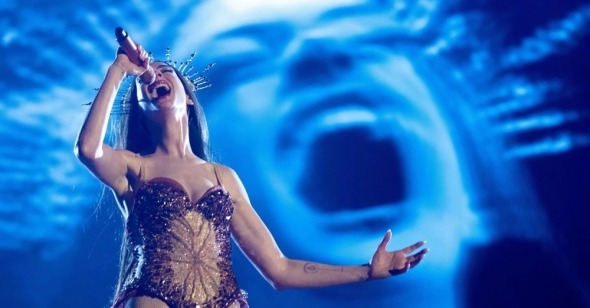
Ironically, the cape is cast off almost as soon as Mother Mary hits the stage, revealing the singer in an angular leotard and stilettos as she performs “Burial,” a disappointingly listless song written for the film’s seven-track tie-in album by Jack Antonoff and Charli xcx. This tentative opening number serves as a fleeting showcase for the markers of pop-world credibility at Lowery’s disposal, which he doesn’t seem especially interested in (scenes of Mary actually performing are few and far between).
Immediately after, dizzying crosscuts set to the bouncier “My Mouth Is Lonely for You” (FKA Twigs’s contribution) show Mary’s dressing-room crash-outs over costuming and Sam’s preparations for her upcoming show in parallel, rushing us toward their confrontation. (In light of the impressive supporting cast whose screentime is paltry, the film gives the impression of having been cut down from a longer version.) By the end of the song, Mary has impulsively decamped to Sam’s remote fashion house outside London, barged in past her harried assistant Hilda (Hunter Schafer, grossly underused), and zeroed in on the designer’s bedroom as if she knows the building like the back of her hand. Sam, sensing her arrival, sits up to face her just before the door swings open. Their exchange quickly boils down to: “I need a dress.” They have four days to pull it off.
Verbal standoffs abound in the film that follows, which, confined to the barn where Sam does her work, takes the form of a chamber piece. The bitter couturier spends most of their hurried collab cutting this desperate diva down to size, effortlessly establishing artistic dominance and wielding grandiloquent jibes with a preternatural sense for the weight and force of her words. Through Mary’s brittle mannerisms, we see how her evident guilt converges with the pressures of the impending comeback show––blurry footage prior to the A24 logo suggested an onstage injury that eerily resembled self-harm. As the women negotiate the details of Mary’s wardrobe––“no red,” she insists at the outset, and you’ll never guess what color the eventual garment will be––they exhume past betrayals and thumb their sores. Eventually, they surmise that these festering wounds have manifested something spectral, an occult presence that demands to be addressed.
Mother Mary is relentlessly talky, perhaps Lowery’s most writerly film so far. It is also self-aware in this regard––Mary complains that “these metaphors are getting exhausting,” in response to one of Sam’s typically lofty remarks. Their conversations lead to flashbacks, which are staged as physical extensions of the same set. While Lowery frequently struggles to stylize Sam and Mary’s tête-à-tête, his approach to the figurative spatiality and sinuous artifice of memory fares better. Multiple stand-out, long-take tableaux follow Mary through stages of exhaustion, terror, and exaltation, the most striking being a cyclical climb up and down an interlocking series of backstage staircases as she whispers repeatedly “this what I do.”
When the supernatural turn comes, the imagery does the heavy lifting. Supposedly born from the tooth Sam––freshly booted from Mother Mary’s creative team––cracked while clenching her jaw during a performance, this ghostly apparition manifests as a floating cluster of crimson fabric. Mary, who divulges subsequent encounters after Sam set the spirit free, describes it as “the idea of a she,” a telling metaphor that better describes the film’s human characters.
Mother Mary’s explorations of the psychological effects of fame are mostly decorative, frequently splitting the difference between timeless and timeworn. The argument could be made that this befits a film that dramatizes the process behind decorating a cultural icon, and once again, Lowery preempts criticism in his dialogue when Mary suggests that one of Sam’s ideas is obvious, to which she retorts that obviousness can beget clarity––Mother Mary bets big on the veracity of her statement.
Such are the bewildering pleasures and pitfalls of Lowery’s self-defeating project, an ungainly almost-horror movie filled with labored abstractions that it can’t help but acknowledge. Rather than soften the impact of Lowery’s ostentatious swings, these conceits merely undercut the disquieting images and scenarios Mother Mary frequently stumbles upon. By holding up a mirror to his own movie, Lowery obscures our view, and clarity, despite a wealth of obviousness, recedes further from our reach.