You Were Never Really Here
By Matthew Eng
Blue Heron
Dir. Sophy Romvari, Canada/Hungary, Janus Films
Binaries can be a security blanket for the brain. How convenient, pacifying, and self-affirming to seize on a person from our past and either venerate or vilify them, to be struck by a fugitive memory and adjudge its tenor either light or dark, to rummage through a period of life and resolve that it was either conducive or detrimental to all that followed in its wake. Discarding this thought pattern is an eternal exercise, most difficult to unlearn—at least, in my experience—when it comes to considering those closest to us. Blind adoration can sustain us, but a grudge can anchor even as it enervates its holder. It is harder to make peace with indecision, to allow room in one’s heart for love and hurt and ambivalence.
Such feeling suffuses Sophy Romvari’s humbling and quietly awe-inspiring first feature Blue Heron, which could only half-accurately be described as an autobiographical coming-of-age drama. The subject matter is familiar and familial terrain for the Canadian filmmaker. Her previous short films—including 2020’s intriguing Still Processing—have largely been creative experiments in what she describes as “memory retrieval,” pivoting around relations near and far. Her practice is grounded in the understanding that the real and the merely remembered are separated by the finest and slipperiest of lines.
Romvari’s parents and three older brothers emigrated to British Columbia from Hungary in 1989, a year before she was born, and subsequently settled in the suburbs of Vancouver Island. Her film bears all the markers of a normal turn-of-the-millennium childhood: water balloon fights with the neighbors, hours slumped in front of boxy TVs, primitive forays into Microsoft Paint as dad plays his ambient German electronica from the same device. But Romvari’s youth was clouded by the deteriorating and increasingly disturbing behavior of her eldest sibling, a late half-brother produced by her mother’s previous relationship. The toll that his short and troubled life had on the family is immeasurable, her early life warping around a single member. Resentment, by Romvari’s own account, has been claimed like a legacy.
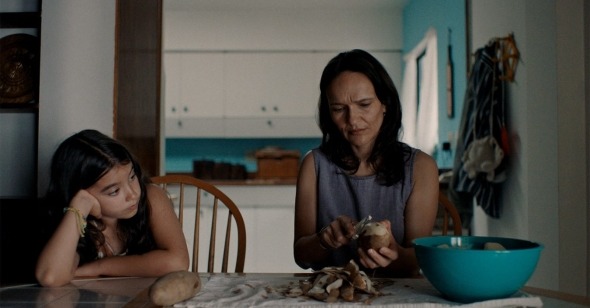
Blue Heron strikes a far more nuanced balance in its recreation of the writer-director’s upbringing during the family’s first tumultuous summer on Vancouver Island in the late nineties, a breaking point in her parents’ ability to care for her rabble-rousing brother. He is fictionalized here as Jeremy (Edik Beddoes), a lurking, lanky, close-lipped presence with a strong jaw and a pair of clunky, corrective spectacles that magnify a mutinously numb stare. “The older I get, the more I feel like I never knew him at all,” a voice intones over the opening images of a recording iPhone zooming in on hilly, tree-lined streets, the narration and composition equally signaling that the ensuing film is less straightforward and beholden to realism than meets the eye. For the next 50 minutes, Romvari places us in the perspective of her placid, eight-year-old avatar Sasha (Eylul Guven), occasionally veering away to focus on her parents: her sweet-natured father (Ádám Tompa), who is glued to the desktop on which he works from home, and her stress-ridden mother (Iringó Réti), who shepherds Sasha, Jeremy, and their very nearly indistinguishable middle brothers (Preston Drabble and Liam Serg) from outing to outing.
In these scenes, Blue Heron evokes recollections with the muted, clear-sighted precision of Charlotte Wells’s father-daughter drama Aftersun (2022), an unavoidable forerunner. But Romvari bends the time-hopping, fourth wall-breaking impulses of that film even further, not just reenacting the past but unsettling and transmuting it in order to see this past—and her brother—anew. The house becomes a stage for Jeremy’s escalating misbehaviors. He lies supine on the porch like a corpse for hours on end, arrives home in handcuffs with a police escort after getting caught shoplifting, and gashes his wrist when he puts his arm through a glass window in the dead of night. When Jeremy creeps along the house’s gable roof in another scene, what proves more unnerving than the prospect of his falling is the pleased smirk that he offers his pleading parents, as if proud to hold them prisoner to his chaos.
Incidents like these send both of them, but particularly his mother, through a rotating door of interactions with doctors, psychologists, social workers, and law enforcement, who only seem to create more confusion, pulling them down a sinkhole of reckless exploits, punitive measures, unconfirmed disorders, and life-draining despair. Finally, a representative from social services pays a visit to the house and recommends that Jeremy be voluntarily placed with a foster family. After much indecision, his mother consents and later agonizes over the decision on the phone. But there is someone surprising reassuring her on the other end of the line: a curly-haired adult woman sitting in a cozy apartment, speaking into an iPhone.
This is the present-day Sasha (Amy Zimmer), who both is and isn’t Romvari. She, too, is a filmmaker, a fact we learn as we are relocated to a conference room where she assembles and records a panel of social workers as they retrospectively examine Jeremy’s behavioral issues and muse on how her family’s thwarted attempts to help might have been bolstered by modern knowledge and practices. It is at this point that Romvari entirely upends our expectations, not so much maneuvering between the past and the present as establishing a liminal space where the traumas and uncertainties of the past reside keenly and mutably in the here and now. With Blue Heron, Romvari serves as the architect, constructor, and inhabitant of her own memory palace. As Sasha returns to the home of her childhood, she encounters her mother and father, her brothers, and herself unchanged from when we last encountered them. Through reenactment, Romvari holds an impossible intervention between daughter and parents, the former’s cautionary monologue unleashing a perpetual cycle of what-ifs. What if Jeremy had found the aid he required? What if her parents had summoned the self-preservation to give up searching for the assistance that was never to come? Perhaps all unhappy families are alike in their pattern of sorry speculation, their penchant for raising hypothetical questions without answers; they are held captive by the grim comprehension that things could have been done differently. Their gaze is persistently trained backwards.
It is enough that Romvari’s film inspires such solemn and rigorous meditation, enacted by performers working in tandem with a trusting and intuitive director. Romvari draws an especially graceful and deeply shaded performance from the Romanian-born Réti, the piercing, playful, and immensely sympathetic standout in an instantly credible ensemble of actors. But Blue Heron also announces its maker as a self-assured stylist who maintains narrative clarity while engendering a bracing disorientation on visual and sonic planes. Working again with the talented cinematographer Maya Bankovic, Romvari alights on unexpected sights that assume an eldritch power: a couple’s twinned reflections in the swirling glass frame of their living room mirror, neglected potato pancakes burning in a cast-iron skillet, the empty, fluorescent-lit hallways of an office space that could be anywhere and nowhere. These images linger, as do the jolting sensations of the sound design: at one point, the heightened thwack of a basketball ricocheting off the side of a house brings to mind nothing so much as the “rumble from the core of the earth” in Memoria (2021).
Of course, the source of this ruckus is Jeremy. And yet Romvari’s meta-segue suggests that we are witnessing the warning signs of a young man’s decline, rather than its exceedingly harrowing episodes and woeful outcomes. The fuller history remains deliberately elusive, the extremity of Jeremy’s disobedience and his loved ones’ grief more often verbalized than depicted outright. One of the most chilling details emerges during a Zoom conversation between Zimmer and a real-life support worker named Bonnie Murrell, who knew Romvari’s eldest brother and reveals that he stowed gasoline in his room, should he choose to make good on a recurring threat to burn the house down with everyone inside.
It is a struggle to summon up untroubled memories of a brother who tapped his family’s patience and vitality with vampiric rapacity; to not prioritize the residual anger of the aggrieved and willfully remember a sibling’s love of maps, bursts of clownlike whimsy, and capacity for tenderness; to allow him all of his dimensions despite the bitter regrets and destabilizing bouts of anguish that are the inheritance of the bereaved, though not its sum total. In one scene, young Sasha and her father watch with bemused curiosity as Jeremy coats his brothers with a cascade of powdered sugar. Given all that we have seen of Jeremy thus far, this moment of spontaneous levity could beggar belief. But in the midst of sorrow and strife, there it is.