Family Values
by Elhum Shakerifar
Hamlet
Dir. Aneil Karia, U.K./U.S., Vertical Entertainment
Prayers are muttered over a dead man’s body at the foreboding opening of Aneil Karia’s Hamlet. Bewildered with grief, Hamlet (Riz Ahmed) looks to his uncle Claudius (Art Malik) for guidance—he is unfamiliar with the Hindu rituals of death. Almost imperceptibly, Claudius drags a finger across his throat. The gesture hovers uneasily in its double-edged meaning, as Hamlet marks his father's neck with the turmeric-infused yoghurt traditionally used in final purification rituals. The mourners follow suit, marking the sallow skin, before the body slides into the incinerator, its hatch dropping down sharply, like a guillotine.
This somber scene underlines the power of this searing modern-day retelling of Shakespeare’s enduring tragedy. Here, the tale’s royal family is reimagined as a dynasty of South Asian property moguls in present-day London. The first words spoken in the film are in Sanskrit, from the epic wartime poem Bhagavad Gita, which shares resonances with Hamlet—maybe even inspired the story—as it wrestles with the existential question of how to live one’s life meaningfully.
Hamlet had long been a passion project for Ahmed, who encountered the play as a wayward teenager when it was prescribed to him by his English teacher. He was surprised to find so much cultural resonance in it, from questions of blood debt to family duty, even the fact that Hamlet cannot marry his beloved Ophelia because she is from the wrong family. He found the perfect collaborator in Michael Lesslie, a playwright who won acclaim in 2011 for his wry stage play Prince of Denmark, a “prelude” to Hamlet that imagines the titular prince as a frustrated teenager who rejects his father’s bloodlust. Working with Ahmed, screenwriter Lesslie reimagines Hamlet in a present-day multicultural London that allows for new layers to emerge: questions of agency and belonging in a society that, as you come of age, reveals itself to be more sinister than you had grown up thinking. The process took 13 years, Karia joining the production a decade into direct the film. The story is stripped down to a taut psychological unraveling, creating a charged first-person Hamlet, tightly wound around Ahmed's angst-filled, visceral performance. Rebuffing the idea that “Shakespeare isn’t for us,” their retelling also retains the Shakespearean verse.
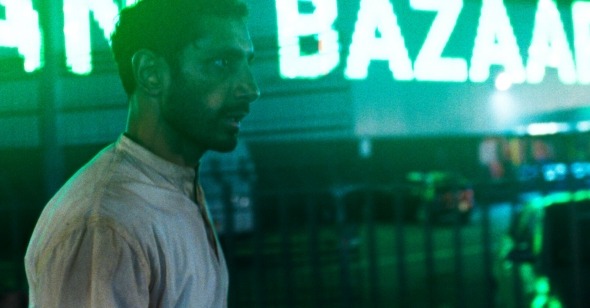
Shortly after learning of his mother's betrothal to his uncle Claudius, Hamlet stumbles out of the jagged lights of a drug-fueled nightclub into the concrete jungle of the metropolitan night. Alone and disoriented, he encounters the ghost of his deceased father, who addresses him in Hindi. Skimming metaphor from the surface of the father-son interaction, Lesslie’s script channels the complex bonds of first- and second-generation immigrants into the well-known words of the original text—that Hamlet's responses are less verbose intimates respect of one's elders, the words being uttered in Hindi infuse them with intimacy, underlines the discomfort of living in between cultures, and the way this is experienced differently by different generations.
The film’s casting is inspired: the expanded roles of Gertrude (Sheba Chaddha) and Ophelia (Morfydd Clark) are particularly rich. Bollywood royalty Chaddha brings elegance to Gertrude, whose discreet attentiveness to Hamlet complicates the mother-son relationship of the original text. With no Horatio in the mix, Ophelia is Hamlet’s closest friend, not merely his love interest, making their lost love and wider family entanglements more devastating. Similarly, the roles of Hamlet’s friends Rosencrantz and Guildenstern are amalgamated into Laertes (Joe Alwyn) so that he is not merely a rival but also a friend. His betrayal, therefore, cuts even deeper, as it entwines with that of his father Polonius (a smarmy Timothy Spall), who maintains allegiance to Claudis’s callous and violent greed—the symbol of capitalism and empire, rotten and ruthless to the core.
Karia and Ahmed had previously collaborated on The Long Goodbye, a music video for Ahmed’s track “Where You From,” which went on to win an Oscar for Best Live Action Short Film in 2022—a first for a music video. The film is bewilderingly direct, first easing you into the familiar familial rhythms of joy and bickering as a South Asian family prepares for a wedding – Ahmed’s character plays with his younger brother, images of unrest flicker on the TV in the background; upstairs, girls giggle as they paint the nails of their hennaed hands, the bride-to-be confesses to having invited “James” to her wedding to shrieks of thrilled disbelief by her cousins—before gears shift into the absolute horror of a gratuitous racist attack against the family. The neighbors watch on as the women are bundled into black vans, and the men summarily executed with a gunshot to the back of the head. Ahmed is shot in the back as he runs to rescue his brother; from the ground, having seen his family kidnapped and murdered, he spits lyrics through gritted teeth.
They ever ask you, "Where you from?"
Like, "Where you really from?"
The question seems simple, but the answer's kinda long
I could tell 'em Wembley, but I don't think that's what they want
But I don't wanna tell 'em more, 'cause anything I say is wrong
Britain's where I'm born, and I love a cup of tea and that
But tea ain't from Britain it's from where my DNA is at.
Ahmed’s rhymes are satisfyingly witty, but Karia’s storytelling brings a visceral quality to their horror. The film feels like a warning—loud, clear, sharp—that racism is deadly. Hamlet, too, holds this knowledge close and recontextualizes the legendary soliloquy, which sits at the very heart of the film. Having escaped the wedding, Hamlet recites “to be or not to be…” in the huis clos of a car speeding down the motorway; hands lifted from the wheel, eyes closed, he expresses the turbulence of his mind moments before dodging the truck he was driving straight into. This decisive move claims action as the measure of a life. The scene’s propulsion causes Hamlet to return to the wedding with a purpose.
He rejoins the celebrations via the dancers’ dressing room, having come to understand the extent to which his family’s fortune is built on blood. Draping himself in a sequined veil, a smear of vermillion on his lips, he wanders into the wedding hall defiant with the power of someone who has nothing left to lose. He mocks the newlyweds—his mother and uncle—by giving an awkward introduction to the dancers, who snake out under a sickly orange light. The astonishing ensuing dance scene, devised by the acclaimed contemporary choreographer Akram Khan, crescendos into a river of blood, mirroring the rotten history of his generational wealth. Khan had been asked to imagine a scene that would “turn the dream wedding into a nightmare” (reminiscent of The Long Goodbye); because dance and performance are a customary part of South Asian weddings, the play-within-the-play conceit in the source text is absolutely fitting. This pleasing conjunction echoes an earlier scene in which the vibrant wedding procession marches to the rousing tempo and fanfare of drummers and performers approaching a drab West London hotel; the scene quietly underlines how migrant cultures have not merely built Great Britain, they give it life.
Such fertile juxtapositions speak powerfully to our conflicted present; as Hamlet questions his own role in his family’s corruption, he is moved to act in a way that gives his inevitable death meaning. In this adaptation Gertrude’s words to her son, “All that lives must die, passing through nature to eternity” are not a pacifying philosophy but a reminder of our responsibility to the world we live in—broken and violent as it is. So how are you going to change the status quo? That is the question.