Material Culture
By Jasmine Liu
Cover-Up
Dir. Laura Poitras and Mark Obenhaus, U.S., Netflix
Some 20 years ago, Laura Poitras, back in the United States from filming My Country, My Country (2006) in Iraq, approached Seymour Hersh about the possibility of making a film. It would be observational and show the journalist meeting with sources or—reputedly—throwing temper tantrums in editorial meetings. Hersh declined, wary of participating in a project that might imperil his sources. Like Edward Snowden, Poitras’s subject in CITIZENFOUR (2014), who expressed in that documentary a worry that “modern media has a big focus on personalities,” Hersh shied from making himself the subject of the story. Poitras kept in touch in case he changed his mind. Finally, in 2023, he did, seeing that she was “interested in more than just the person” in her work.
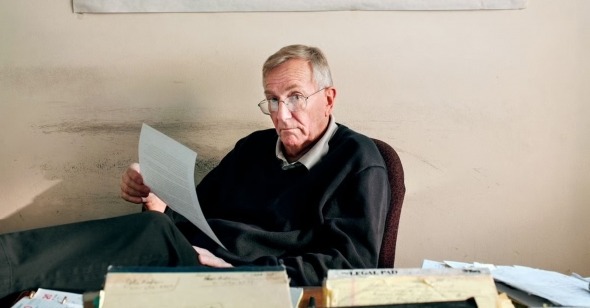
The resulting film, Cover-Up, takes the shape of a career retrospective. Hersh granted the filmmakers—Poitras teamed up with Mark Obenhaus, a longtime friend of the reporter—access to significant portions of his archive. This access is hard-won, and it is critical to their project. Hersh erupts into fury midway through filming when it dawns on him just how much trust he’s placed in the filmmakers, who are given carte blanche to riffle through notes of his interviews with sources. His archive supplies a paper trail of how the truth came to light, and the documentarians dwell on these materials with the covetousness of a curator eyeing an imminent bequest. The first contemporary shots show an array of paper objects: a purple manila folder, notes scrawled across it; a green manila folder, whose cover is censored; another folder, inside which are packets of lined pages filled with notes; a typewritten draft marked up with corrections and excisions; rows and rows of Bankers Boxes, topped with piles of binders, legal pads, and spiral notebooks. These documents were used to undertake some of the most consequential reporting done in America.
The archival sensibility pervades the film. Foolscap paper, ballpoint pens, typewriters—longhand writing, bureaucratic documents, print—these are relics of an earlier era for Poitras, a documentarian ever sensitive to the technologies that help make resistance possible. In CITIZENFOUR, Snowden communicates with Poitras through encrypted means; to display his messages, the film, with its hacker-chic aesthetic, includes scenes of a Terminal Emulator simulating the commands used to decrypt them. In Risk (2016), Julian Assange works in darkness, his face aglow with the blue light of his screen. All the Beauty and the Bloodshed (2022) steps back into the analog world to match the artistic medium of her subject, Nan Goldin. She dwells on Goldin’s projector and slides, imitating the slideshow format that Goldin used to exhibit The Ballad of Sexual Dependency (1985) down to its audible clicks. Now, Cover-Up sees Poitras absorbed in our most basic information technology: writing.
Poitras’s fidelity to the materiality of Hersh’s medium, that of daily newspapers and magazines, urges the viewer to consider not only his doggedness, and not only the consequences of his investigations, but how print media once syndicated public consciousness. In its diminished form today, newspaper journalism has utterly ceased to play this role. Hersh’s reports on the My Lai massacre, on Watergate, and on Operation CHAOS, the CIA’s first major domestic espionage operation, had real ramifications—convictions, firings, resignations—however piecemeal and occasionally insufficient. By contrast, Snowden’s revelations produced minimal legislative reform, and WikiLeaks disclosures that the U.S. systematically underreported civilian casualties in Iraq and Afghanistan garnered no significant domestic outrage. Adversarial journalism on the page has a more definitive and literal palpability—even as its headlines drift just as often on the vagaries of public discourse, one day enumerating the number of innocents indiscriminately killed, the next day questioning if its own account was propaganda. Hersh, and Poitras and Obenhaus, seem ambivalent about whether newspapers were better at disseminating official narratives or challenging them. And yet it is impossible to ignore that the decline of traditional print journalism has resulted in an eradication, and deterioration in quality, of the sort of work at which Hersh excelled. When Hersh cracks a self-deprecating joke about how he’s “slumming it” on Substack now, it’s hard not to despair.
***
In two notable instances, game-changing images surfaced which supplied ocular proof for his allegations. One was in the case of his reporting on the My Lai massacre. Dozens of newspapers ran his story in the week after he sold it, but few put it on their front page. Things changed when it was revealed that an Army photographer had documented the Charlie Company’s atrocities on March 16, 1968, in color. One image showed dozens of villagers’ mutilated bodies, including the naked limbs of toddlers, strewn along a dirt path. More than thirty years later, in 2004, images again proved pivotal in Hersh’s reporting on the War on Terror, when Hersh persuaded CBS to air photographs of the torture which had taken place at Abu Ghraib. He had already filed his story with The New Yorker, but it was the images which ran alongside it that everybody remembers. Cover-Up opens with a series of photos of woolly sheep lying prone on a ranch, their faces streaked with blood, just some of the six thousand which were killed in Skull Valley, Utah in 1968 by a secret nerve-gas test. Hersh’s meticulous reporting on the government’s chemical and biological weapons programs can make for dry reading, but the pictures of the poisoned sheep provoke terror.
Hersh likes to tell journalists to “get out of the way of the story,” to let sources, quotes, and the facts speak for themselves, advice which he repeats in Cover-Up. Poitras and Obenhaus do as he decrees, ceding him the stage to recount the major beats of his life. As a result, the documentary covers much of the same ground that Hersh did in his 2018 memoir Reporter: his adolescence working in his Lithuanian Jewish father’s dry-cleaning shop on the South Side of Chicago; his big break getting into the University of Chicago; his beginnings reporting for local newspapers and then the Associated Press; the backstories of all his famous exposés. Another is that we get Hersh at his most winning, in spite of flares of crankiness. Early on, Hersh rebuffs a question about why his sources talk to him. “I don’t psychoanalyze those who talk to me—just like I don’t psychoanalyze myself, thank God,” he says, prickled. In the past, in less sympathetic contexts, his persona has come off as less lovable. A few basic questions Isaac Chotiner posed in 2015 about his alternative account of the bin Laden raid had him flying into a rage and ending the interview with the non-apology, “I don’t mean to yell at you but I feel good doing it.”
Close to ninety, Hersh embodies what cognitive scientists call a super-ager, infusing his recollections with the energy that he once put into chasing leads. If her subjects are skeptical of personality, Poitras is adept at illustrating how fundamental it is to their politics and their method. Hersh, for one, has often liked to describe himself as a “loner,” and we see that his pride in this identity stems in part from a lifelong antagonism with the media. Early on at the AP, he developed a distaste for the Pentagon Press Corps, believing its ranks to be plagued by mediocrity. The documentary pairs his critiques with archival footage of photojournalists clambering to snap photographs of important people in the Pentagon; of rows upon rows of male reporters transcribing news items from military leaders; of a hallway once designated “correspondents’ corridor”—striking visuals of the coziness between warmongers and the press. Whether it was owing to professional skepticism, cynicism, or misanthropy, Hersh wanted no part in this, and Cover-Up’s title recognizes that his achievements were driven, powerfully, by his distrust of colleagues and officials both. It also underlines the unsettling reality that large groups of people have often been capable of suppressing terrible things: hundreds of people had known about the My Lai massacre; dozens had likely seen the photos from Abu Ghraib.
Hersh’s narration faithfully captures his indefatigability. Upon revealing that American soldiers had committed an act of spectacular violence in Vietnam, the fiercely antiwar Hersh insisted on proving that commanders at multiple levels on the chain of command had concealed or failed to investigate the event—and then sought to show that the war was a procession of massacre after massacre. (A chapter of his life which the film omits is his stint as press secretary for Eugene McCarthy’s 1968 campaign.) Convictions are still thought of as obstructions to, rather than catalysts for, good journalism, and Hersh’s record demonstrates their vitality to the profession. But they can be double-edged, and they have at times gotten him into trouble. The film includes these missteps, casting them as slight. One was his prolonged flirtation with a cache of forged letters to Marilyn Monroe written, purportedly, by John F. Kennedy. Hersh worked with the forger for months, despite obvious red flags; a greater interest in psychology would have saved Hersh time and embarrassment. Perhaps a bigger failure in judgment was his questioning whether Bashar al-Assad had launched chemical attacks on civilians in multiple articles. In this documentary, Hersh offers the most categorical renunciation of his reporting yet, attributing the error to his impressions of Assad. “I saw him two or three or four times, and I didn’t think he was capable of doing what he did. Period,” he says. “Let’s call that wrong. Let’s call that very wrong.” Poitras doesn’t grill him about how he allowed his personal feelings to affect the integrity of his reporting, instead opting for something more anodyne. “But is that an example of getting too close to power?” she asks.
In Risk, Poitras admitted that she had wanted to ignore Assange’s contradictions, something which becomes untenable when sexual assault allegations bring his misogyny to the fore. She and Obenhaus take a similar approach with Hersh, focusing on his achievements rather than his contradictions, which have nevertheless magnified in recent years, and which deserve scrutiny. He faces a threat common to Poitras’s parrhesiastes: in a multipolar world saturated with disinformation, adversaries to American institutional power have become increasingly compromised. A suspicion of U.S. government narratives can metastasize into credulity toward other nefarious actors, leaving them vulnerable to manipulation. Given his professed disdain for psychology in favor of hard evidence, it’s strange that Hersh once claimed that most foreign policy came down to “character” rather than “a realistic look at international affairs”—precisely the kind of mentality that clouded his radar on Assad’s chemical attacks. While Hersh hasn’t descended into propagating Russia apologism or January 6th conspiracy theories—hobbyhorses which have sullied the work of anti-imperialist critics like Max Blumenthal and Glenn Greenwald—his outsider instincts have sometimes facilitated dubious alliances, including appearances on RT and Alex Jones’s show. Cover-Up is dedicated to “those who resist, past and future.” For the latter, these are among the hazards they face.
***
Hersh’s trajectory can sometimes look like succeeding downward. He was edged out of the Associated Press because his reports on the Pentagon were too hard-hitting. He became a gadfly to his bosses at the New York Times because he held corporate interests to rigorous account. He became too critical of the Obama Administration for The New Yorker’s tastes. There were no farewell parties for him, Hersh says. In the past decade, his reports have largely appeared in the London Review of Books, Die Welt, and his personal Substack, and their claims have been hotly contested. If he has blundered, and if his reporting increasingly relies on tenuous sourcing, he has also continued to draw attention to inconsistencies in official narratives. In light of reflexive dismissal of his claims of possible Pakistani cooperation in the bin Laden raid, n+1 asked: “Why isn’t the media more paranoid? What may be irking journalists about Hersh is the way he harks back to an era of heroically paranoid journalism — the kind that once brought down governments — that they no longer feel themselves to be living in.”
The bigger shock may be that “heroically paranoid journalism” ever existed at all at places like The New York Times. And yet, in this documentary and his memoir, we still get a sense of Hersh’s unmistakable excitement when he is finally employed by the paper after his My Lai reports, of having made it to the big leagues. Only at the Times could his coverage reach millions of Americans every morning, and could his pieces be pored over by several members of the staff. There is no longer the assurance that his reporting has been backed up by the same army of editors and fact-checkers who have vetted his anonymous sources. If online journalism is more fearless, it is also still often inferior—perhaps an uncomfortable truth for Poitras, a founding editor of the Intercept. The filmmakers seem hesitantly hopeful, including brief scenes of Hersh speaking with a source in Gaza, though they perhaps serve as more forceful illustrations of the relentlessness of war than the frontiers of resistance. In a couple of instances, the directors show us their setup: an overhead rig trained on a black-draped table, used to display the documents Hersh narrates. Reconnaissance photos, redacted documents from the CIA, confidential reports, charge sheets: the filmmakers place each of these items, and then Hersh’s front-page coverage, under the lens—as if respectfully documenting, then conducting an autopsy of, a bygone age of print journalism.