Great Expectations
by Mark Asch
Marty Supreme
Dir. Josh Safdie, U.S., A24
Martin Mauser is a Jewish table-tennis prodigy and thrill-seeking, wheedling motormouth, like a rec-room Sammy Glick, whose rise to the top of international rankings in the early years of the Cold War is alternately driven and hindered by his superhuman ambition and callous single-mindedness. In the promotional run-up to Marty Supreme’s release, Timothée Chalamet has said that the character is “the most me” of any role he has played.
Because Marty is, in a word, a dirtbag, this will still strike some of Chalamet’s fans as incongruous. Floppy of hair, consumptive of figure, the actor first won hearts as the sensitive, sexually questioning Elio in Call Me by Your Name, but his background as a millennial city kid reveals another facet to his character. The son of artsy parents, a journalist and a former dancer, Chalamet grew up in Hell’s Kitchen and was educated in the city’s public schools, which, with the great diversity of life experience, ethnicity, and class represented in their student body, offer middle-class white kids many routes to social distinction. His grindset mentality—which sees him swagged out in streetwear, dancing to Soulja Boy, and making unguarded statements about his “pursuit of greatness”—would have been part of the oxygen breathed by Chalamet and his peers in his youth, in which masculinity is associated with entrepreneurial shamelessness, and authenticity is associated with street-level brazenness just this side of sleaze.
Chalamet has an obvious spiritual kinship with Marty Supreme’s cowriter director, fellow native New Yorker Josh Safdie. Safdie’s films, prior to Marty made with his younger brother Benny, likewise an early-2000s graduate of the exclusive Columbia Grammar & Prep, pay exultant and ostentatious attention to NYC’s underbelly. The Safdies’ New York is the New York of, say, Larry Clark and Harmony Korine’s Kids—a film that loomed huge in the imagination of white millennials as a perversely aspirational cautionary tale, an only-in-New York story of decadence just off one’s doorstep, starring young adults not much older than the Safdies as characters partaking in casual sex, indulging in recreational drugs, and appropriating the baggy clothes and AAVE of pre-mainstream rap culture, all equal sources of parental alarm. The Safdies’ films are a product of the NYC dirtbag mixture of privilege and proximity to real danger, reveling in their protagonists’ bad decisions and flaunting what most Columbia Grammar parents would call bad taste.
This comes through most notably in the rubbernecking fascination with local color and notoriety in the casting that defined Elara Pictures, the production company founded by the Safdies with their professional mentor and Marty Supreme cowriter Ronald Bronstein. When making his first and thus far sole directorial feature, Frownland, in the early 2000s, Bronstein recently told The Hollywood Reporter, he “had cast the project with all of the very profoundly idiosyncratic people that I had amassed in the years leading up to its making,” an approach the Safdies subsequently adapted to their own purposes. They populate their films with street-cast nonprofessionals including Heaven Knows What discovery Buddy Duress, who fulfilled his press obligations for the film from an inmates’ phone at Rikers Island, as well as Josh’s own criminal defense attorney, raspy-voiced longshoremen, disco-dress designers in Good Time and Uncut Gems; they appear alongside figures of local infamy—often from the bowels of local talk radio, such sportsradio call-in godhead Mike Francesa in Uncut Gems and supermarket magnate, WABC owner, and Curtis Sliwa frenemy John Catsimatidis in Marty Supreme—and minor celebrities with street cred, frequently basketball players and rappers. It all gives the sense of teeming, odorous city life, especially when the films are photographed, as Marty Supreme is (by Darius Khondji), with a pockmarked realism and scrupulous attention to the deep blacks, beyond the reach of the warm tungsten lighting sources, that seep in at the edge of the frame. It’s out of such a vision of primordial New York City darkness that the Safdies’ protagonists seem to emerge—or would it be more accurate to say that they seek to disappear into it?
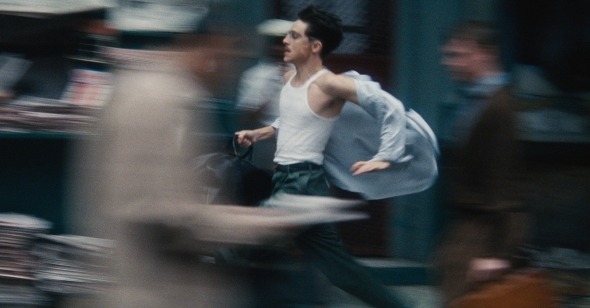
Fittingly for a film released in the last week of the mayoralty of Eric Adams, an Elara-worthy New York weirdo who wore a bracelet spelling out the word HUSTLE to pray at the Wailing Wall, Marty Supreme begins with its lead character already on his grind. Martin Mauser works at shoestore in the immigrant melting pot of the post-WWII Lower East Side, where we first meet him trying to convert a sale to a customer whose size is not in stock, as well as working multiple other angles. The store’s owner, his uncle, wants to promote Marty to manager and secure the sort of petit-bourgeois respectability that will make the family proud; Marty wants his uncle to spot him the money he needs to travel to London for an international table-tennis tournament, where his all-but-certain victory will allow him to launch a branded line of high-visibility orange ping-pong balls. But first: a garter-ripping stockroom quickie with his friend and neighbor Rachel (Odessa A’zion), who has slipped out on an errand away from her lumpen husband. The film is already at a climax at its opening credits, which play over a digital animation of Marty’s sperm, set to Alphaville’s “Forever Young,” with its fatuous and elegiac hedonistic lyrics, the first of several '80s soundtrack cuts that harmonize with Oneohtrix Point Never’s dreamy score. All those wriggling little strands of potential, each striving toward its goal as if convinced that it, and not any of the millions like it, will be the one who makes it. (And one will, just not in the way that Marty expects.)
Having lifted the promised advance on his shoe-store salary right out of his uncle’s safe, Marty gets to London and proves himself first a bad winner, then a sore loser. Already considering himself the sport’s global ambassador, a breakout star who can lead it to new heights in the newly booming American economy, he showboats his way into the finals and checks himself into the Ritz on the tournament organization’s tab. His opponent in the championship match is Koto Endo (Koto Kawaguchi), a Japanese player with a new soft paddle and a hearing aid, a paragon of stillness and focus whose finesse and implacability throws the more aggressive Marty off his game, and sparks McEnroe-esque tantrums after he’s ignominiously swept.
With his sick, clingy mother (Fran Drescher) and aggrieved uncle waiting for him at home, and a large hotel bill still outstanding, Marty embarks on something like a grand tour, traveling farther than the Marshall Plan—to Yugoslavia, North Africa—as part of a halftime entertainment act for the Harlem Globetrotters. Reduced to a novelty, he seems to resent playing against a trained seal less than he resents playing against fading former champion Béla Kletzki (Géza Röhrig), a tattooed Holocaust survivor. He returns to New York City eight months later: just before the due date of a now heavily pregnant Rachel. As played by the snappish, savvy A’zion, Rachel proves no less canny an operator than Marty, leveraging herself into his headlong quest to raise the money he needs—not to fulfill his obligations to his family and roster of creditors (both growing) but in a headlong sprint away from them, to Japan, for a rematch with Endo and, he’s convinced, a rescheduled date with his destiny.
*****
As in their previous collaborations, Safdie and Bronstein relish the wake churned up by the improvisatory wranglings of a New York City survivor. On Heaven Knows What and Good Time, the Safdies worked with the cinematographer Sean Price Williams, who established a visual vernacular—sickly, pallid colors; rough-grained celluloid—which Khondji iterates on here, shooting on imperfect vintage lenses and employing a long focal length to keep up with Marty, more or less, on his sweaty peregrinations. Marty eludes cops and collectors through back alleys and fire escapes; ducks into tenements with hall bathrooms and upstairs ping-pong parlors whose dankness and atmosphere ofpredatory wariness recall the pool halls in The Color of Money; wheedles crash pads and seed cash; and concocts schemes including, but by no means limited to, a “borrowed” family car and the reward money for a lost dog belonging to the mysteriously monied transient Ezra Mishkin (Abel Ferrara), a far less virtuous Magwitch figure to Marty’s far more opportunistic Pip.
The inevitable consequences are comic, but confrontational. Safdie and Bronstein love pushing a joke too far for comfort, whether it’s the emotional cruelty of Marty’s blinkered wiseass egotism, or cartoonish slapstick that goes brutal. Insistent and motormouthed, with a bulletproof presumptiveness and a prodigal son’s casual outrageousness, Chalamet gives Marty the darting libido of a handsy boy who keeps touching a girl under the desk in class. He comes at people like a ping-pong player, moving them to their forehand then their backhand, backing them up and moving them around with question after question and demand after demand until they finally forget to tell him no.
Marty thinks of himself as an underdog with nothing to lose, but both he and the film display a gift for escalation more in line with a bully with a point to prove or a rich kid with nothing to fear. In the Ritz, laying it on thick for the assembled U.K. press, Marty sizes up his semifinal opponent, Kletzki, and cracks a joke at his Auschwitz experience. He explains he’s allowed to do it, as a Jew himself: he’s “the ultimate product of Hitler’s defeat.” Marty means that his success is a repudiation of antisemitism—it’s a flourish of self-branding, not an introspective moment of diasporic pride, but he means it more sincerely than he knows. Across the room at the Ritz, he spots for the first time his twinned golden tickets: shiksa goddess Kay Stone (Gwyneth Paltrow), a retired star of Hollywood’s Golden Age, and her husband, Milton Rockwell (Kevin O’Leary, Shark Tank’s “Mr. Wonderful”), the head of a global stationary concern and the father of a son who died in the Pacific Theater—a fact which he seems to hold against the Jews more than the Japanese, whose business he covets. Both inspired and triggered, Marty sets out to win two prizes, first seducing Kay through sheer persistence. Paltrow’s chic and winsome ennui, once assayed so memorably in The Royal Tenenbaums, makes this convincing—the Goop impresario and mostly former actor almost seems stunt-cast, but is so welcome back on movie screens. Marty also pitches himself, less successfully, to Kay’s husband, O’Leary’s industrialist Rockwell, but sabotages his chances by needling him whenever he senses obsequiousness is expected.
In his dealings with Rockwell, Marty is willing to come off as a stereotypical little pusher, nakedly transactional and implicitly self-loathing in his assimilationist impulses. He is a wandering Jew, first during his and Kletzki’s stint with the Globetrotters, and then in New York, as a rootless wheeler-dealer. This makes him an outsider, like his friend and table-tennis rival Wally (Tyler the Creator, acting under his given name Tyler Okonma), whom he ropes into one of his many overlapping plans to raise money once back in New York City.
An affinity with Blackness, reciprocated or otherwise, is one classic definition of a hipster, especially a Jewish one. Race snapped into focus as a main subject for the Safdies beginning with Lenny Cooke, their documentary profile of a Brooklyn-bred high school star, at one time a higher-rated prospect than LeBron James and Carmelo Anthony, who never made it big. Lenny Cooke, which ends on a note of disappointment and a rueful reckoning with its subject’s squandered chances and unfulfilled dreams, comes in the Safdie filmography between Daddy Longlegs, starring Bronstein as an impulsive and immature hipster dad, and Heaven Knows What. Their interest in characters who shred holes in their own safety net continued with Good Time, in which Pattinson cuts a swath of chaos through the city, insulated, to a greater extent than many of the Black characters he encounters. And in Uncut Gems, Sandler’s Howie Ratner, like cantor’s son-turned-jazz-singer Al Jolson, hides out from family responsibility under a mask of blackness, indulging in his most self-destructive impulses while selling bling, ingratiating himself with basketball stars, and running around on his nice Jewish wife with a mistress who also draws the eye of The Weeknd. (The role of the basketball star who plays himself in Uncut Gems was originally intended for Amar'e Stoudemire, who turned pro straight out of high school, as Lenny Cooke tried to do; he appears briefly in the documentary.) As Lenny Cooke covers, the NBA of the fin de siècle, when the Safdie brothers were teenagers and immediately before hip-hop became synonymous with mainstream pop, was the subject of alarmist commentary for allowing unpolished Black teenagers to jump straight to multimillion-dollar contracts—or to nurse unlikely dreams of them.
In Marty Supreme, Marty persuades Wally, a married father and cabbie, to take a night off work and drive out to still-rural New Jersey to hustle the hicks. The con they run on the racist and antisemitic patrons of a bowling alley works well enough, but when the rubes chase them down afterwards, the consequences are much worse for Wally. Marty is both insider and outsider: at once an underclass striver whose eventual triumph, when he finally reaches Japan, is necessarily compromised and quixotic, and an Ugly American abroad, causing a ruckus, cheered on against the local hero by the American military, and serving merely, in an exhibition match organized by Rockwell, as an adjunct of vampiric capital. Even during his former tenure as a cultural goodwill ambassador with the Globetrotters, Marty chips off a piece of a pyramid as a souvenir from Egypt—another precious stone extracted from Africa, like the black opal in Uncut Gems.
Uncut Gems, the last great film of the 2010s, came a bit too early to attract the year-end consideration that Marty Supreme has earned a half-decade later. The Elara house style is now a subset of contemporary prestige filmmaking in the deep twilight of the studio era. This is, partly, literally true, in that three of this year’s big films are by Safdies and Bronsteins. Benny Safdie’s The Smashing Machine and Mary Bronstein’s If I Had Legs I’d Kick You are, like Marty Supreme, noteworthy for their unconventional casting (The Rock in a dramatic role alongside real MMA fighters; a supporting cast populated by Conan O’Brien, rapper A$AP Rocky, and extremely online Gen-Z comic Ivy Wolk), white-knuckle tension (a toxic relationship spiked with threats of suicide; the one-battle-after-another anxiety of single motherhood), and gritty visual textures (mocked-up ESPN clips with basic-cable image quality on the edge of kitsch; pore-close handheld cinematography). It’s quintessentially urban filmmaking, free, thrill-seeking, and risky.
So risky, in fact, that it’s an open question whether Elara is still a going concern. Josh and Benny Safdie have not worked together since the publication of a Variety article reporting on damaging allegations made against the company’s fourth and final cofounder, Sebastian Bear-McClard, including that he had cast a 17-year-old actress in Good Time via Instagram DM, not informing her that she would be performing in a nude scene with “an actor who had recently been released from prison before being hired for the film.” The allegations also raised questions about the sustainability of the Safdies’ filmmaking practices: unconventional casting of amateur actors, guerilla shoots, a certain amount of dirtbaggery as the necessary lubrication for pulling seamy truths from the corners of New York City untouched by gentrification.
But their collective influence lives on, in an evolved form, within frequent distribution partner A24 as a whole, and not just in the coincidence of the studio releasing If I Had Legs, Smashing Machine, and Marty within the last few months. (A disclosure: I have worked with A24’s publishing arm as a contractor on individual projects.) The influence persists in A24’s hypebeast-courting brand strategy—the title Marty Supreme overlaps with a certain streetwear company, though it’s hardly the first A24 film to be the subject of a limited-edition merch drop attracting hypebeast city kids. You see it in the analog fetishism of bespoke-looking A24 films like Dream Scenario and Materialists. And Elara’s eye-catching casting has become a studio trend. Both A$AP Rocky and Ivy Wolk are in multiple A24 films this year (respectively, the Apple coproduction Highest 2 Lowest and Andrew DeYoung’s Friendship, which A24 passed on financing but then acquired to distribute). More generally, A24 is interested, as described by Alex Barasch in a recent New Yorker profile, in cultivating talent (or farming aura) from outside of the film world, whether in developing YouTube–bred horror filmmakers Danny and Michael Philippou, or buying New York’s Cherry Lane Theatre in order to build relationships with hip artists with followings on other media.
As legacy studios lean ever more desperately on consolidation and IP, this indie-studio aesthetic, a mood board of the hip and handmade, has become the language of prestige film, an evolution also enabled by a younger, more diverse, and more international pool of Oscar voters. (Two of the last ten Best Picture winners, Moonlight and Everything Everywhere All at Once, have been A24 films with a Wong Kar-wai homage; only one, Oppenheimer, was developed by a Big Five studio.) The death of the monoculture is great news for curators and tastemakers—for city kids with a hungry eye for a trend. And this points to a sticking point with Marty Supreme—not incidentally, a film about a subcultural star bashing his head against old money and institutional power. With two-plus months of principal photography plus a week in Japan, a two-and-a-half hour runtime—at a more or less constant fever pitch—and well over 150 speaking parts, many performed by non-actors, this is hand-to-mouth filmmaking at an epic scale, which is something of a paradox.
Marty Supreme aims for something like grunge Barry Lyndon, a period picaresque epic about a sociopathic climber, but scrappy instead of stately, obnoxious instead of ironic. Yet beneath the grime it’s comparably handsome. Safdie and Bronstein indulge a specificity of historical wormholing that would tickle Paul Thomas Anderson, with digressions including a Tennessee Williams knockoff for Kay to star in, complete with floridly subtextual intimations of mother-son incest, and magpie jokes about the culture clashes caused by newly Method-trained actors. Production designer Jack Fisk gets a budget he can sink his teeth into, redressing multiple blocks of Orchard Street into a terrarium of tenement life that could have been photographed by Bruce Davidson, and shaping suburban bowling alleys and car lots with chrome-fin detailing and a Leonian anticipation of widescreen space, contrasting the old-world burnished woods and chipped tile of Marty’s New York with the coming spacious complacency of automotive sprawl. In New Jersey, a clapboard pile in the middle of a cornfield is, surely, a conscious reference to the house Fisk built, inspired by Wyeth’s “Christina’s World” and Hopper’s “House by the Railroad,” for Days of Heaven.
Following the downer conclusions and unlearned lessons of Good Time and Uncut Gems, Safdie and Bronstein also try something different with Marty Supreme, as if willing their protagonist to live up to the scope of the film. Their ending, which echoes their opening in music and lyrics, inverts Marty’s immaturity and gives Chalamet something that Good Time and Uncut Gems withheld from Robert Pattinson and Adam Sandler: an Oscar-clip showpiece. The dirtbag grows up.