El amor duerme:
An Interview with Los Javis
By Juan Barquin
Javier Ambrossi and Javier Calvo, known as Los Javis, have been a staple of Spanish television for the past decade. Their web series Paquita Salas was a hit in Spain, as was their directorial feature debut, La Llamada, an adaptation of their own stage play that earned them a Best New Director nomination at the Goya Awards. It’s no surprise that these works are relatively unknown in the United States, as they’re a bit “niche” in their Spanish comic sensibilities. But then came the miniseries Veneno, a stylish and impressive piece of historical fiction following the life of Spanish trans icon Cristina “La Veneno” Ortiz. Their first crossover hit, the series garnered critical acclaim beyond Spain and introduced American audiences to their work, a process helped along by their subsequent appearance as judges in Drag Race España. It was also the first real showcase of their stylistic and thematic interests as writers and directors.
Veneno and La Mesias, their follow-up series about two people who escaped a religious cult, are decades-spanning works about how the past reveals itself in the present. The former grounds itself in the perspective of real-life author Valeria Vegas, a young trans woman discovering and navigating her identity while also uncovering the rich history of trans women who came before her. The latter, though inspired by Spanish Christian pop group Flos Mariae, is a work of fiction, using a sprawling, nonlinear narrative to explore how familial trauma reverberates across generations.
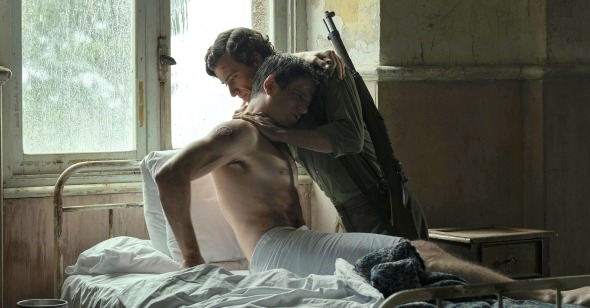
Those who have seen either of these will recognize how much of their pet interests and stylistic touches are still present in their breakout second feature, La Bola Negra. This adaptation of playwright Alberto Conejero’s La Piedra Oscura (which translates to “The Dark Rock” as opposed to “The Black Ball,” a more literal title referencing the blackballing of “undesirable” members, in this case queer men, within private clubs) expands the source text into an ambitious triptych of tales about queer men from 1932, 1937, and 2017. The core narrative in 1937 comes from Conejero’s two-hander about the intimate connection between two men during the Spanish Civil War: Sebastian (played by gay musician Guitarricadelafuente in his debut role), forced to survive by joining those who massacred his family, and Rafael, an approximation of real soldier Rafael Rodríguez Rapún, with whom poet Federico García Lorca had a personal relationship.
La Bola Negra’s 1932 arc is an attempt at adapting and expanding Lorca’s own unfinished play (of which only four pages exist), the first time he had planned to write a queer protagonist into a story. This segment pays homage to Lorca’s surrealist motifs while also drawing on ideas he shared with those closest to him in letters, leaning into the fantastical in stark contrast to the subsequent wartime drama. The two segments are held together by the film’s 2017 section, which follows Alfredo, a disaffected queer academic who stumbles upon missing pages from Lorca’s unfinished play preserved by his estranged grandfather, whom he knew only as a Francoist who abandoned his family. This narrative thread recalls the way characters in Veneno and La Mesias are forced to confront, consider, and reveal the actions of those who came before them.
Though some of its references and declarations about queerness under fascism can skew towards the obvious, La Bola Negra is a gratifyingly dense text. I was pleased to interview Los Javis and Guitarricadelafuente when they were in South Florida for one of many local screenings of La Bola Negra. Our chat was brief, but it gave me time to dive into their latest film, its connections to one of Spain’s most essential authors, how it ties into some of their past explorations of history, and what it means to make a work about such a still-fraught subject as the Spanish Civil War.
–
Reverse Shot: Alberto Conejero’s La Piedra Oscura is this contained wartime two-hander. What was it about the play that you were drawn to, and why did you decide to expand it to three timelines, with the 2017 portion and the actual Lorca adaptation and expansion?
Javier Ambrossi: I guess we fell in love with the characters and we found that intimacy could be portrayed in a movie, but we didn’t want it to play as this classical “niche” LGBTQ+ movie. And when I read it, I knew I wanted to do this, but I wanted to do it big.
Javier Calvo: When you adapt something, you take what you think is really interesting for you—like, it tells you something about yourself—and turn it into another format. There’s something about legacy in La Piedra Oscura that was compelling to us, so we thought: if we’re talking about legacy, we have to talk about these different eras and how being gay worked in all of those timelines and felt in those timelines.
RS: And it feels of a piece with what you two have been doing with works like La Mesias and Veneno—each of which features intertwined narratives and looks at how one era impacts another.
JA: I get a lot of my influences from literature. I was the kid that used to read every day. So that kind of scripting comes from that time in my life. I feel like in Latin American literature, like [Roberto] Bolaño or [Jorge Luis] Borges, there are such masters of mixing timelines and they’re not afraid of poetry. So I think, in writing this movie, I was in my Bolaño era [laughs].
JC: I’m also drawn to complex movies and stories; I like to come back to them and see new details and new readings. I want a new understanding every time I come back to that movie. Movies, for me, are safe places; I think we like to make complex universes because we want people to come back to them.
JA: And, coming from TV, where you have a lot of time to experiment and to improve and to try to create different characters and scenarios… when you go back to movies, you go with all you’ve learned and grown.
RS: There’s a lot of Latin American and Spanish literature and history in La Bola Negra—and I’m interested in asking you, Guitarricadelafuente, about how that kind of work has played into your own art. Even your new piece of music for the film, “La Nieve” is Lorca’s “character” of “the snow” speaking to Carlos.
Guitarricadelafuente: When they first approached me about making the music, I thought that was exactly what had to be taken into account, because Lorca is so present throughout the movie. He’s omnipresent through these three stories and, as someone who has been inspired so much by his poetry, much like many in the generations that have come after him, it was compulsory to kind of try and make the most honest homage to that. You start noticing all the symbology and iconography that runs through the film, so to put that poetry and symbolism into song form felt like the most honest and faithful way to approach music for the movie.
JC: And you’ve done homages to Lorca in previous songs as well, it’s amazing. Like, in “Taramuntana”, where you sing, “Esa noche corrí el mejor de los caminos. Nos ponían a cien y ahora ponen el freno”—that’s tied to Lorca’s La casada infiel.
G: Lorca is always present [laughs]
RS: Was that part of what drew you to this role and project?
G: I was amazed because it was the first time that I knew about this particular story, through Alberto Conejero’s La Piedra Oscura. Lorca being such an important part of that and how it represents this legacy of showing the next generations what impossibility could be [a reference to Lorca’s “impossible” theater, surrealist and experimental works] was inspiring and made me willing to get into this story.
RS: And how was it to navigate this space of both “real history” and fictional interaction as both filmmakers and a performer?
JC: Well, with Sebastian, it was easier because he’s ultimately a fictional character. But what we did was actually make this military boot camp with Guitarrica and the rest of the actors who played soldiers. It was all done with this colonel and our choreographer, because we wanted to make this boot camp with a sense of beauty and, of course, dance. So they would learn how to load the guns and shoot them, and, after that, when they were really exhausted, we had them go to history class. We had everyone reading and talking about the Spanish Civil War.
JA: And I think we were not afraid of mixing history and fiction. When I get worried about that, I always go back to Aristotle. He wrote that historians write about what happened, but poets write about what should have happened. So that mix is the kind of balance that we wanted to strike with the movie.
RS: The fact that you both made the cast take history lessons about the Spanish Civil War makes me think about just how hesitant a lot of people in Spain are to talk about their relatives or ancestors and that dark history. I’m curious—how is it to make a film all about that and also about the ways people sort of sidestep discussing it?
JC: It’s not that they don’t like to talk about it, it’s just that they don’t talk about it among each other. So each side discusses it in their own way, but there’s no consensus or agreement about the things that happened.
JA: There’s no “list of facts” for them.
JC: So, it’s like, you know when you sit at the table at Christmas, you avoid certain subjects so that no one is throwing the table through the air? That’s why that happens. There’s no agreement because it’s not healed yet.
JA: And that’s why this movie is about the dangers of a lack of communication, because it’s the easiest way toward violence. That’s why we wrote the present timeline: to emphasize that we need to talk more and we need to express more about ourselves but also about history and the facts that exist within our own family histories and how they tie into societal history. It’s important to put what has happened in order.