The People in Your Neighborhood:
An Interview with John Wilson
By Conor Williams
From 2020 to 2023, How To with John Wilson was the most uniquely hilarious and refreshing thing on TV. In the style of underground pioneer George Kuchar, Wilson makes diary films that celebrate the odd minutiae modern life. After three seasons of How To, Wilson opened Low Cinema, an appropriately low-fi microcinema in Queens where you can get popcorn by the piece from a 25-cent gumball machine.
Now he’s expanded his output further with his first feature film. Made without the team of street videographers who assisted him on How To, Wilson returns to his roots here as a personal filmmaker. This is a daunting task, as depicted within the film. “What’s the working title again?” Wilson’s producers ask him in a Zoom meeting. He is sitting in front of a green screened photo of a creepy, dilapidated interior. “Uh, The History of Concrete,” he replies, to unenthused silence.
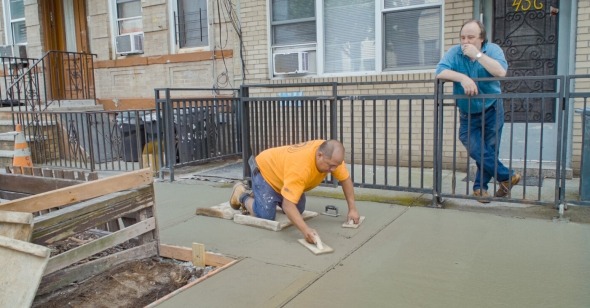
Opening at IFC Center, where one can find an actual concrete promotional poster, The History of Concrete explores the foundational material that holds New York City together, before going off on wildly disparate tangents. As in his show, Wilson touches on just about everything, from the creative credo of Hallmark films to marathon runners in search of transcendence. There are cameos from the Naked Cowboy, reality TV royalty, and a former star of The Sopranos. On his filmmaking journey, Wilson meets a boozy amateur rock musician and forges a companionship with him that reaches a level of genuine poignancy. He goes to Italy and speaks with locals to try to divine the secrets of their country’s long-lasting concrete. Wilson may occasionally play the fool, awkward and stammering, but he’s always more cunning than he lets on. In each encounter, Wilson engages his subjects with true curiosity, not making them the butt of a joke, but attempting to reveal what makes them worth documenting. When something catches his eye, he digs deeper until he’s reached documentary (and comedy) gold. Wilson’s feature debut is often unusual, and occasionally uncomfortable. (One revelatory sequence towards the end involving human skin is a lot to take in.) The History of Concrete is quietly profound, however, urging viewers to examine and question what’s taken for granted in modern city living.
Sitting in front of a green screened teen’s bedroom littered with anime toys and stuffed animals, Wilson spoke with Reverse Shot about drawing poetry from concrete, his thoughts on public housing, and his favorite Frederick Wiseman films.
Reverse Shot: How long after How To ended did you decide you were going to make a feature?
John Wilson: It took me around six months, like, maybe a little longer to really commit to this. We started filming in 2023. I've always wanted to make a feature doc. I found it kind of funny that I ended up in TV, and it felt nice to be able to work on something that had a bit more freedom.
RS: Your brother Tom is a photographer, and I noticed that he snapped some pictures for The New York Times of the hastily constructed concrete ramps outside of New York bodegas. Did you guys collaborate on this project or does concrete happen to be a shared interest?
JW: It's hard to tell. We become fascinated with certain things in tandem. I think he was taking photos of the concrete ramps for a while. As the foundation to my house was cracking, I started to read about this stuff. And then I saw he was doing the ramp stuff. I remember asking him to shoot some video of concrete ramp stuff early on. But I didn't have the apparatus to extend the production to different people. So I ended up shooting a couple, and that made it in. The shots that are in there are absolutely an homage to my brother's discovery.
RS: This film was made during the unfortunate tenure of Eric Adams as Mayor. Since Zohran Mamdani has been elected, he’s actually included you in some PSAs regarding scaffolding, a topic that came up on your show. How does it feel to see that your work has had an actual impact on the city you live in?
JW: It feels amazing that the mayor is focusing on something like this. Every New Yorker has a gripe about something, and I think it's really cool that he is using his time to focus on actual quality-of-life stuff, and responding to people that tag him on social media to figure out very small issues that are hyper niche and specific to certain people in certain neighborhoods. I think that's a really good move. I think the scaffolding thing is a part of it because he understands that this is a political and economic decision to have this stuff up all the time. And it's reached an infestation point that is almost ludicrous.
RS: Something your film touches on is the class of people known as NIMBYs. There’s a really striking sequence toward the end of your film that climaxes with a vote around affordable housing. How do you see something like the conflict between those who wanted to keep Elizabeth Street Garden open versus those who wanted to use the space for affordable housing?
JW: It's a real third-rail issue. It seems to activate a lot of preservationists and affordable housing people in equal measure. In terms of the Elizabeth Street Garden specifically, I think that once you take away green space in the city, you don't get it back. I am a fan of having green space where you can. I think that the history and ownership of that garden is murky, and it's not really like the same kind of public space as you would have in a park, like a normal city park. But I also empathize with wanting to build housing for seniors in the area because there's a lack of that. I also feel like the affordability crisis is not necessarily fixed by building indefinitely without restraint. There's a lot of real estate here that is either unoccupied or ripe for adaptive reuse.
RS: There are so many buildings that are just sitting there empty.
JW: Yeah, it's unacceptable. In London, they do something called a high street rental auction, or something like that, something that was passed pretty recently, where you have to legally put your place up for auction if it's vacant for longer than six months. And it goes to the highest bidder. I think that's something maybe we should consider here.
RS: I wanted to ask you about Frederick Wiseman, who died in February. I know he was an influence on you, one of many influences. If you could recommend one or two of his films to your viewers, what would you pick?
JW: I would pick High School. I would pick Aspen. I would pick Central Park. What did I watch recently? I watched Maneuver. That was cool.
RS: Aspen is pretty terrifying.
JW: I love Aspen. Belfast, Maine is great. In Jackson Heights is great. The Store is just one of the best. I just love portraits of a place like Neiman Marcus, and that era. I feel like it's the kind of thing we've lost.
RS: What do you hope that audiences can learn about concrete from watching your film?
JW: I hope that audiences can learn that you can question concrete, and that it's not a permanent part of our lives.