A Man of Letters:
An Interview with Kent Jones (Late Fame)
By David Schwartz
In an essay for the Blu-Ray release of Kent Jones’s directorial fiction debut Diane, screenwriter Samy Burch observed of the title character, an aging widow who lives to help friends, family, and the people of her New England town, that in “many of the scenes where Diane is not in service to others, she is alone. Writing her name in a fresh notebook. Making lists of things to do, and later, poetry. The line between the two may be thinner than is assumed.” Enthralled by Diane’s quiet emotional power and thoughtful construction, Burch sought out Jones to direct her adaptation of Arthur Schnitzler’s 1895 novella Late Fame, whose main character also writes poetry. Or rather, used to write poetry. Ed Saxberger is a former poet who now works at a post office, until he is discovered by and invited to join an admiring group of would-be bohemians. Learning of Saxberger's new job, one of them quips, "Well, you're still a man of letters."
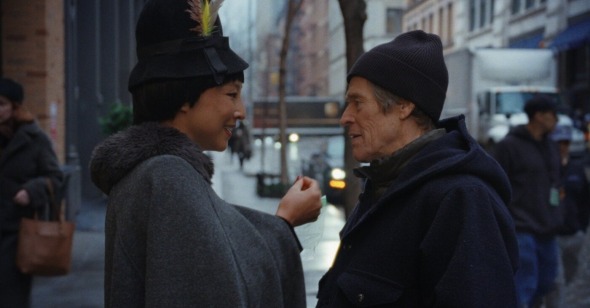
Burch transposed Schnitzler’s tale from Vienna to modern-day downtown New York, in part to satirize the privileged strivers whose artistic ambitions may exceed their actual talents. But while Schnitzler took an acidic view of the cultural milieu he was observing, Burch and Jones teamed up to create a more nuanced and bittersweet character study. Just as Jones built Diane around Mary Kay Place’s career-best performance, which captured the simmering depths beneath Diane’s eternal hospitality, Late Fame draws power from Willem Dafoe’s seemingly effortless embodiment of an artist who wants to believe in the newfound adoration he is receiving, at the same time that he has the wisdom to know better. He is sparked by the attention and seductive power of the actress Gloria, played by Greta Lee in an exuberantly theatrical performance very different from her quiet star turn in Past Lives.
Kent Jones grew up in Massachusetts and moved to New York in the early 1980s; he brings a strong personal connection to the worlds of Diane and Late Fame. Jones has been an essential part of the film world since his arrival in New York, working in many capacities for Martin Scorsese (as production assistant, archivist, screenwriting partner, and co-director of several documentaries), as a film critic, programmer for Film at Lincoln Center, and head of the New York Film Festival. I talked to him recently about what now seems to be a full transition to film director, a goal he has had since his arrival in New York.
Reverse Shot: You have a 35-year working relationship with Scorsese. Has your time with him helped prepare you to become a director?
Kent Jones: Seeing Taxi Driver at 17 really pierced my core. And then New York, New York, and Raging Bull. Through sheer happenstance I started working in his office. I always aimed to direct films; that was what I wanted. I was writing criticism, looking at film from one angle. The more I went into it, the more I wanted to penetrate what it actually was from the outside looking in. But I vowed to myself that were I to make a fiction film, I would do it without leaning on Marty.
After I made Hitchcock/Truffaut, my mom died. I was writing Diane, and realized later that the two had to do with each other. When I started directing it, there was a moment on the second day of production when I was just sitting down, and I felt like I don’t know if I can do this. I don't know if I'm up for it. And then a light went on in my head, and it was just sort of like, it doesn't matter how I feel. I just have to do it. That was great. That's a big part of it. Sounds simple, but it isn't.
RS: I went to film school with Hal Hartley. He really seemed like he’d become a director. He had a kind of self-confidence. I always felt that being a director requires a certain kind of personality.
KJ: I did have one thing that was foundational, which is a real appreciation of acting. My first wife was an actress. And she and I were in an acting group together for a while. I grew up around a lot of theater in the Berkshires, and got very interested in acting through that experience. I read a lot of plays. And Marty and I made the Kazan film [A Letter to Elia] together. A lot of critics that I know and a lot of programmers that I know say “I don't understand acting. It's a mystery to me.” That's a running theme.
RS: Both Diane and Late Fame are really built around the performances. Very often, films by first-time directors are more focused on formal concerns.
KJ: I would put it another way: for me performance and behavior and gestures in the frame are cinematic elements. I'm glad that I didn't start earlier because I would have made films exactly like what you're describing. And the actors would have come to me and said, what should I do? And I'd be like, I don't know, just stand here and, you know, take three steps closer. I’d be making cinephilic films.
RS: On the surface, Diane and Late Fame are very different. But there are threads that hold them together. They’re about aging, about being alone versus being part of a group. How do you see the films relating to each other?
KJ: I don't, but maybe I will. I know what you mean, but I'll let others decide. For Late Fame I was attracted to the idea of doing something that originated not with one other person but with two other people; Arthur Schnitzler and Samy [Burch]. And not necessarily in that order because I preferred Samy’s script. I first knew about her because of May December.
RS: What did you prefer about Samy’s script to the novella?
KJ: It's not as harsh. There's a harshness to the Schnitzler. What was interesting was preserving what's frank versus what's harsh. When Willem at the end says [to Winn, a young admirer], “You don't read mine, I don't read yours,” that's just being frank. He's not being brutal, he's just being brutally honest. But he's just saying to Winn, it's an illusion to think that you can look at me and divine something from me. That is definitely something I related to in terms of what I've seen people do around Marty.
RS: Treat him like a Saxberger?
KJ: I've just seen it over and over again with him and with other directors, where younger people approach them. Like at Q&As, they'll raise their hand and they don't really have a question. They just kind of want to plug into you and get some of what you have. I've seen it in extreme ways with Marty.
RS: That line, “You don’t read mine, I don’t read yours,” is in the novella, but there it plays more as satire…
KJ: …than something sort of sad. And Willem's reaction is that it just makes him sort of sad in a way. Listen, there's so many different movies that could have been made from that novella. And a lot of people were thinking about it, as it turns out. It's interesting, because it was found not that long ago. It's easy to picture Billy Wilder making a film of it, since they're both Viennese. He would have made a hilarious movie and a brilliant one. I love Billy Wilder, I just don't gravitate in that direction.
RS: I think the film teases out the insecurity of all the characters in different ways. Greta Lee’s character is even more important here than in the novella.
KJ: I didn’t know Greta before I went to see Past Lives. I was amazed because I felt the movie wouldn't have held together without her. It needed that kind of concentration and focus and energy. Being quiet is a very, very difficult thing. Then I saw Russian Doll and I was like, “Oh, she comes out of comedy. Even better.” Mary Kay Place came out of comedy and Andrea Martin, too. So I was excited and we met, and just immediately joined forces. Then she and my wife, Carisa Kelly, the costume designer, started working together and she came up with that outfit for when Gloria sings “Surabaya Johnny.” We were talking about Sternberg as a visual reference, and she was so excited to sing that song.
In the script, the character was supposed to do a strip tease, at a kind of Bushwick-ish place. And I said, that doesn’t sound like a great idea. I’d rather have a sort of echo of a gay bar that doesn’t exist anymore. And I thought, maybe singing “Surabaya Johnny.” And she said, “Stop talking. Once you’ve said it you can’t unsay it.” And she just immediately got to work, and it was great. I just loved her. In the novella the way that Schnitzler deals with her character is much harsher. They’re all kind of charlatans in the book.
RS: She gets the comedy about how Gloria is putting up a front, and you can see through that. And the sexual chemistry is so interesting between her and Willem.
KJ: Or the lack thereof. There was this really interesting comment from a programmer from a film festival. I won't say which one or who, but who rejected the film. But she said, the thing about the movie is that ultimately none of the characters connect with each other and they all go their separate ways. Accurate. [laughs] You know, if that’s a criticism, I don't know what to tell you, but if you want movies where everybody connects with each other and has a learning experience…well, I am very interested in the idea of delusions, and Saxberger’s delusion just builds.
RS: Saxberger and Gloria don't actually connect that way, but she excites him. I don't know if he would have agreed to write a new poem, but she just happens to be there when it’s suggested, and it felt like he agreed to it to impress her, and to recapture his youth.
KJ: My friend Peter Gizzi, whom the film is dedicated to, called me one day during COVID and said, I just had this feeling, I was listening to Steely Dan in the car. And the energy that I felt when I was 17 came back to me. And he said, I'm just going to chase that feeling. And I just thought that's great and a little sad because he'll chase it and then it'll run away from him because it's ephemeral. And I felt like that's at the heart of what this story is. I mean, who wouldn't? Everything inside Willem is saying to him, oh, come on. A kid read your book and he's coming to you and he's telling you you're a hero. But who would resist it? He can sort of go back and forth.
RS: Knowing it’s BS but thinking maybe it’s true.
KJ: Yeah and I mean, you know, the minute that Greta’s character says to him, you must have been beautiful when you were young, the air starts to go out of the tire a little bit.
RS: Quite a moment, yeah. Because that's not what you want to hear. For both Willem and Greta, the roles offer chances to reflect on where they are in their lives and careers.
KJ: At a certain point when it was coming down to casting, there just wasn’t anybody else. I don't buy anybody else as a poet. He played Pasolini, but more than that, it's part of his being. I think the particular training he had as an actor, the origins of his acting career coming out of the Wooster Group. And his temperament, it just seemed like it had to be him.
RS: Who wrote the poem that Willem reads at the end? You?
KJ: Yeah. It was a very long process getting there. Samy’s original draft has a poem there. Samy said that it was just a placeholder, that poetry is not her thing. And she had something called “Evening Moods” that was tuned in to the Schnitzler style. I just thought, what would have come out of somebody of that era? From that era? And then my friend Pete said, why don't you write something? And I thought, it has to relate to the character. It can't just be a poem. And it has to hit like the New York school. It has to hit the right note. It also has to be legible to an audience that is not necessarily conversant with the New York school of poetry. So it can't be too abstract. And I borrowed imagery from a lot of different places for it. The Treasure of Sierra Madre and [the song] "Paper Moon," The Odyssey. That's something that a poet like Frank O'Hara would have done.