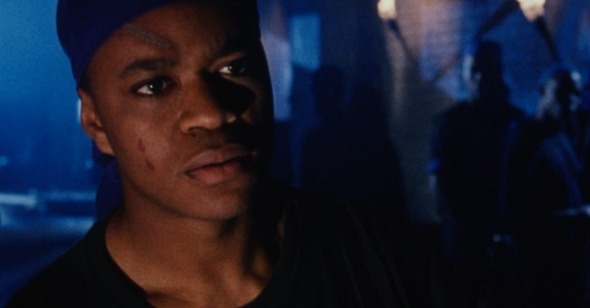
Little Fires Everywhere:
An Interview with Ngozi Onwurah (Welcome II the Terrordome)
By Jourdain Searles
In 1995, Ngozi Onwurah’s Welcome II the Terrordome became the first British film made by a Black woman to receive theatrical distribution. The film takes place in a dystopian world where Black people struggle in a slum nicknamed “The Terrordome,” hunted by corrupt police officers, racists, and a white supremacist government. Deeply affected by the hate crime murders of Black teenagers Rolan Adams and Stephen Lawrence in London in 1991 and 1993, respectively, Onwurah wanted to make a film that shed light on her country’s violent bigotry towards its Black citizens. Not much has changed today. Inspired by Spike Lee’s seminal Do the Right Thing, she crafted a visceral film that fearlessly depicts violent resistance.
Onwurah began her career as a filmmaker with the 1988 short Coffee Coloured Children, which explored the difficulties that come with being a child with a Black father and white mother. Onwurah (herself the daughter of a Nigerian father and white British mother), felt driven to interrogate her own biracial identity in her films. Another early short, The Body Beautiful, explores the relationship between a Black daughter and her white mother. (The star of that film, Sian Ejiwunmi-Le Berre, also has a role in Terrordome, as Chrisele, a kindhearted woman suffering from drug addiction.) Her debut feature, Terrordome, tells the story of a family and a community torn apart by economic hardship and racial prejudice. The narrative is bookended by the fable of Ibo Landing, an important piece of Nigerian folklore Onwurah first heard as a child. In the legend, the Ibo people reject slavery, choosing death instead.
At the center of the film are two mothers, one Black and one white. Suzette Llewellyn plays Angela, a Black mother searching for her young son who has snuck out after dark. On the streets, where the gangs fight each other and the police, no one is safe, especially not the children. When her child is killed, Angela snaps and begins to fight back. Saffron Burrows plays Jodie, a white woman in love with a Black man and pregnant with his child. She lives in the Terrordome with her boyfriend Spike (Valentine Nonyela), a drug dealer and gang member. But when Jodie’s racist ex-boyfriend finds her, he attacks, killing her son while still in the womb. This too is based on a real event that occurred in early ’90s Britain. But along with this despair, Onwurah shows us resonant moments of resistance and hope for a better world. I had the privilege of speaking with the director about her radical vision upon Janus Films’ 2026 restoration and re-release of the film.
Reverse Shot: What was it like working with the Black actors on this film, considering how painful the material must have been for them?
Ngozi Onwurah: Obviously, Welcome II The Terrordome was shot 30 years ago, right? Now, the safeguards people have on set for actors revisiting trauma… It’s much more ingrained in what is expected and how you deal with things. I think we were right at the beginning of doing that kind of thing, and so we were just feeling our way through it. So, what you've got to understand is, in Britain, Black people are a very small minority of the population, much smaller than it is in America. I think in America, you guys are maybe 13 or 14% of the population? In England, we're about 2 or 3%. So for Black actors there's very few roles, especially roles that people want to really get stuck into. So, when Terrordome came along, there was really an excitement amongst Black actors in Britain we approached. It's also a small world: I was already friends with a lot of the actors and had worked with them before. Brian and Suzette and Valentine, they were all really established Black actors, some of the few that were making a living as actors. However, they all signed up to do Terrordome immediately. And nobody got paid. It wasn't even just that nobody got paid. People had to pay to be in it. Like, we couldn't send drivers to pick them up. They had to pay for their tube to come to set, and things like that.
There was a lot of discussion, especially with Angela's character, because she was going to be the person trying to keep the family together. Her son disappears, she can't find him, she finds him dead. She decides to kill people. So there's a whole range of emotions and storytelling there. We did mine a lot of historical and current news about things that had happened to Black people, and how we thought we'd feel if it had been us.
Now you would have more safety rails and context about how you would support people. Poor Suzette, she's been in four films of mine! And the things that have happened to that woman… As a director, I must say “Imagine the story of this woman, and this happened to her.” You're just asking them to go to those places of pain, and then you move on to the next scene. We talked a lot to each other, but we’re not psychiatrists or therapists.
RS: What was it like working with Saffron Burrows on her character? It's one of those characters where you're watching it, and you're wondering: does the actor know the enormity of what she's representing historically in this context?
NO: Saffron is still one of my best friends. And she was 17, so she was really young. And the thing is, she was a top model. She was earning serious money as a model, so every time she came on set, she was losing money. Now, she grew up in a neighborhood in London called Hackney. And there's a joke in Hackney where you say, “What do you call a white woman with a white baby?” And you say “a racist” because it's one of those neighborhoods where white people embraced Black culture. She went to a school with lots of Black people. Her boyfriend was Black. But she isn't Black, and she knows that. Not only is she not Black, but she's also a tall, blonde, beautiful woman, right? White woman. But she was aware that she was carrying the weight, not only of her character but also the symbolic role as well, of a white woman in that story, in that landscape.
She knew from the get-go where the ultimate scene was going to end. It was going to end with having the fetus beaten out of her. And she was going to go through that, because she knew that the whole way. I hadn't quite decided at that point that she was going to be so completely abandoned. The script was written in three parts, because it kept getting bigger. So I still hadn't quite worked out what was going to happen to her at the end. She was going to go through all that, and she was going to be left to bury her fetus by herself without her partner, and without any of the community that she'd now gone to after having given up her own community.
Jodie’s character is based a little bit on my mum. My mum's white, and I’m always thinking about where white women fit in the story, and is there space for them to work towards the solution? So, she knew that. She was absolutely open to it in a way that was unbelievable. In the scene where she has to bring the baby back to bury him, I wanted her to be really raw. So I asked if she would stay up all night so that she would come to set really kind of jagged. And, it was just brilliant. She was great.
RS: There are so few films, even now, that have this look, this feel, this honesty and brutality. How did you come up with the look of the film?
NO: We were film students when we were making the film, so we were very ambitious. But the essential thing was I wanted it to be really cinematic. Especially in England at the time, a lot of Black films were ridiculously low budget, the scripts usually had to be about urban deprivation and brutality and that kind of white savior thing involved in it. So a lot of it was always handheld, it was always this feeling that the aesthetics didn't matter as much as the story. Getting the story out was what mattered. And I don't mean, like, in The Wire, where it was a part of the story; it was because it was quicker and easier, and that's what the budgets allowed you to do.
And then there was this lack of experience and lack of patience and lack of willingness to light Black skins the way they deserved to be lit. You know, this is shot on film. Fuji was balanced for Asian skin. Kodak was balanced for white skin. Black folks who have the biggest range of skin color, you can go from light to black-blue, and if they were in a scene with a white person they would always light for the white person, and the Black person would end up with this sort of, you know, teeth and eyeball kind of aesthetic, standing next to them. So I wanted really light black skins. I wanted them to look beautiful. I wanted the film to feel cinematic. I almost bit my own nose off because I almost banned handheld from the set. It's like I didn't want that feeling that we were just grabbing it. I wanted to feel like this was a cinematic world that they were living in, because there was a lot of story in the dressing of the set, there was a lot of story in the background.
It was bookended by the story of Ibo Landing. I wanted Ibo Landing to feel very poetic, because it's based on a legend and a myth, and also to feel historical, because those moments are meant to be real in The Terrordome. Are they real? Is it dystopian? Is it purgatory? There's a very cinematic world that exists in the Terrordome, whereas Ibo Landing was supposed to be the anchor, and I wanted it to look very different. African storytelling is very elemental; it's got a lot of fire in it, it's got a lot of water, it's got a lot of wind, and I wanted to really incorporate that into the aesthetic. So there's a lot of fire everywhere. The light from the fire provides light in contrast to the fluorescent lights or neon signs.
RS: What was it like screening this film in 1995?
NO: We had very different experiences based on what the audience was and where we were. So, the first couple of screenings we had in London were just fantastic, because they were friends and family and people we knew. And then as we started to have a few press screenings, the kind of questions that were coming at me afterwards were a lot to do with violence, and violence not being the answer. Was I saying that violence was the only way, the solution to the problem? So there was this feeling that I presented this world where everybody was just really angry, and everybody was taking revenge, and they were excluding the white woman, they were abandoning the white woman, and was that my solution? And so it was this idea that I should come up with a solution, a palatable solution. Instead of just going with my characters: this is what happened to my characters, this is how they felt, and this is how they responded to it, and that's logical. What you're saying is there has to be an add-on to that, where I, as a member of that oppressed group, have to give my oppressors the solution to the problems, right? I can't tell the story without also having the solution. I don't know the solution. I still don't know the solution. But that doesn't mean I have to stay silent, or it doesn't mean I don't get to be angry until I come up with a solution.
So that was the response in England, and it was varied between white audiences, and when we showed it in only Black places, it was a completely different response. In America, it was different, because America is just intrinsically a more violent country.
RS: Usually when there are films like this, it feels like, for a white audience, there's this idea that the film has to hold you at the end. In the end of Kathryn Bigelow’s Strange Days, also released in 1995, Angela Bassett is beaten by police, but she survives. It was such a stark contrast to your film. I just had to really take some time afterwards to fully come down emotionally from Terrordome. I wonder if there's going to be a difference between the way the white audience felt then and now, considering how little has changed.
NO: I think if you make a film that doesn't allow a white audience to find themselves they have to be completely and utterly absent from it, right? So, take Moonlight, which is a classic. The difference between the response to Moonlight and If Beale Street Could Talk was quite telling. The white folks in Beale Street weren't good, and there wasn’t much space for them. Whereas with Moonlight, you could watch it as a voyeur. Oh, this is a Black world, let me in it. And so that was interesting also in Sinners, because in that film, there wasn’t any redemption. It was death for the white characters. If you look at Hidden Figures, if you look at so many of them, there still has to be a white savior, there still has to be room for a white character to have a place in the story that isn't just being bad, or being the one that gets left behind.
I don't know how they're going to feel about what happens to Jodie, because Jodie is a good white woman. She's a white woman who's thrown her lot in with Black folks, and she has been abandoned. I'm interested to see whether that's mentioned, because in England, that was mentioned a lot.
I made a film called Coffee Coloured Children. And in the end, I said this line about, oh, the man I love might be white, but the father of my child will be Black. Oh my god, the blowback I got from white people about that line! So it'll be interesting to see how white audiences will view Jodie's storyline, and if Jodie's storyline will be the predominant storyline, or whether they'll see the other stories as all being even, and that's the end of each of those different stories. Angela and Jodie are both mothers who have lost their children. One's still alive, the other dies, but I still think Jodie is the character that a lot of people believe lost the most.