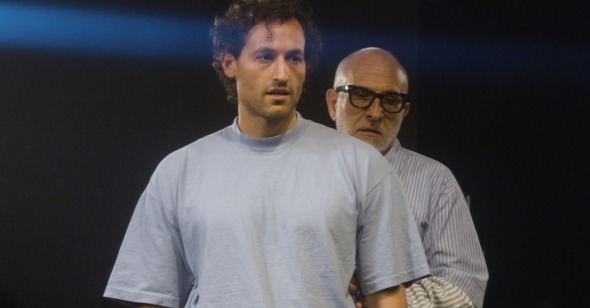
I Want to Destroy You:
A Conversation with Charlie Birns and Shonni Enelow
on The Whole World Is a Lie
In The Whole World Is a Lie, a documentary directed by Charlie Birns, a filmmaker named Charlie Birns asks his former acting teacher, Tony Greco, to let him film his class. Charlie had a spiritual breakthrough in the class several years ago, he explains to a doubtful Tony, and wants to figure out how the acting techniques that Tony teaches––which draw directly from his teacher Lee Strasberg and the “method”––led to that awakening. Tony agrees under the condition that Charlie must be a participant in the class, not an observer. So Charlie and his film crew pay the class fees for a group of real students, lightly adjust the basement room in the Gene Frankel theater where Tony has taught for decades, and attempt to capture the experience of the class on film. But something quickly goes awry: the acting students are suspicious, then hostile; Charlie isn’t good at following Tony’s directions; Tony and the students become irate at Charlie’s open-ended creative process. The film’s first half builds to a series of confrontations between Charlie and the actors. At one point, one of them tells Charlie, with earnest intensity, “I want to destroy you.”
The Whole World Is a Lie, which opens with a Zen koan (about the expanded length of a truly rigorous search for meaning), intercuts this rising dramatic action with interviews with spiritual teachers and metaphysicians who act as a Greek chorus for Charlie’s investigations into the meaning and mysteries of life; it also intercuts scenes with Charlie’s father, whose “self-made” uptown-and-Hamptons wealth underwrites the film, a privilege that the filmmaker, to his credit, does not attempt to obscure. Over the course of the film, we learn this relationship is more complicated than it seems. His father’s alcoholism and drug use was the source of continual, frightening domestic conflict during Charlie’s childhood. The title of the film was a kind of catchphrase of his father, who, Charlie insists, would regularly come into his bedroom at night and repeat it to his son. By the end of the film, we hear the phrase as a cynical cliché, a touchstone of childhood trauma, a celebration of theater, and a genuine metaphysical enigma all at once. If the whole world is a lie, how could we possibly get to the truth?
Four years ago, when he started making his movie, Charlie Birns reached out to me and asked for an interview on the topic of method acting. I was intrigued by his combination of irony and credulity. But as we taped the interview, I started to feel like I might be debunking his belief system, and was unsure how he was taking it. I think many common assumptions about acting are historical and contingent: for instance, the idea that motivations are clear and knowable and that expressive communication of them is the ultimate success for an actor, which is a basic tenet of method acting. It’s a belief––that expressing your emotions honestly is the actor’s job––that drives the actors in Charlie’s film to say things like, “I want to destroy you.”
Though I was a little concerned Charlie would cast me in his film as an antagonist to method acting, our interview wasn’t in the final cut, which I’m glad about, because the film says more interesting and unsettled things than I could have said myself. Although the film clearly frames the cult-like commitment of the actors to a dubiously authoritarian teacher, it doesn’t make fun of them, and the final sequence––in which Charlie tries to restage his childhood memory of his father in his bedroom, saying “the whole world is a lie”––ultimately seems to me to make an argument about the efficacy of performance as a method of self-knowledge. I jumped at the chance to lead the talkback after its world premiere at MoMI’s First Look festival. In keeping with the open-ended structure of the film itself, the talkback, rather than a staid experience of the filmmaker’s authority, became a theatrical event when one of the actors in the film broke into the conversation to continue the film’s conflict. After that, I wanted to talk to Charlie again.
Shonni Enelow: The film lends itself to an iterative conversation, so let’s talk about the talkback—especially the moment when the actor from the film spoke up. What do you remember about that?
Charlie Birns: Some of the people asking questions were being antagonistic toward the students in the class. At a certain point, someone spoke up in their defense. I recognized the voice, but the person had shaved his head since I’d last seen him. It was Nicholas, an acting student from the film. He said, “I’m Nicholas, second-year student,” which is how he’s identified in the film. And then he performed his line from the film.
SE: He said: “I still want to destroy you.”
CB: And I couldn’t tell if it was sarcastic, tongue-in-cheek, or what. But it brought an aliveness to the Q&A. Then he asked something like, “Tony calls you vaguely thick in the film—do you still feel that way, or has something changed?”
SE: Do you remember what you said?
CB: I said something like, “Over the course of filming, maybe I didn’t break through the way I’d hoped.” But over years of editing—confronting the footage, constructing the film—I do feel I’ve gained clarity. And then I said something like, “It’s hard to tell how thick you are from the inside.”
SE: Then this other person in the audience came to your defense and attacked the actors, saying she’d never seen participants on a project be so rude and demanding toward an artist.
CB: She was collapsing the distinction between fiction and documentary. She said she’d never heard of an actor speaking that way to a director on a set. I had to step in and say, well, I wasn’t really directing—that’s the slipperiness of the film. And it was all showing up in the Q&A.
SE: What really struck me in the actor’s comment was that he brought up Willy Loman. He had this weird moment, which I think was in reaction to me saying something about how one of the main emotional expressions that this kind of acting tends to bring up is anger. Because I do think the method has a particular dramatic arc, building up to an explosion of emotion, and in the film it’s anger. And then someone in the audience said, “Well, anger is the easiest emotion for an actor to play, so of course they do anger.” And then Nicholas broke in in response to that, and he said something like, “Hey, wait a minute, we do anger because what do you think Willy Loman was trying to express?” That was his go-to example. That really lodged in my mind. I feel like that was so symptomatic of what the method actually is, the fact that it comes from this very specific moment of American drama and American culture. That's why I think the sort of Jewishness of the film is so important. It's a generational thing too with your dad. He's not a Willy Loman because he's successful, but he could have been. So that actor who's this 30-year-old, like, blond white guy citing Willy Loman as the example of what this acting is really trying to do and accomplish––it’s very revealing to me.
CB: Yeah, I mean it's amazing to see the world through the lens of these texts from 70 years ago––
SE: Exactly.
CB: And to use them as justifications for behavior. And you could say that's actually the epitome of the work they're trying to do is to activate these plays, these plays that need actors. Like, plays like that don’t exist till actors bring their soul to them. To bring up Willy Loman in that moment actually reveals an incredible dedication to what Tony is trying to offer them.
SE: Right. That’s one of the fascinating elements of the film for me, these actors learning a method that comes from a specific cultural moment—a very particular moment of tension around masculinity, assimilation, upward mobility—but they’re learning it as if the technique has no history, no content to it. There’s no real sense that it comes from somewhere. And then you have your dad, who does come from that world in a way. The ways he does and doesn’t conform to the method are really interesting.
CB: The review in Reverse Shot mentions my father as a method actor. How Tony and my father are both playing versions of themselves in the documentary.
SE: Yeah, that’s how I felt. That line from your dad, “The whole world is a lie”: I'm acting, you're acting. We're all acting. At least that's how I interpret that line. Like, this is all a performance. It’s like he's avowing, but also at the same time, like, disavowing it, you know, in the way that he disavows that he said that to you when you were a kid in the film. He disavows himself as a performer.
CB: My family at the screening kept asking whether I’d given him a script, or how he came up with the lines. He said: “improvisation.”
SE: He’s just a good actor.
CB: Which brings me to that Meisner line: acting is the ability to live truthfully in imaginary circumstances. To me, that’s the whole thing—the “whole world’s a lie,” the film, the spiritual ideas, even the construction of documentary. How do you locate something truthful in a constructed, artificial paradigm?
SE: Method acting has its answers. And you play those out in interesting ways, especially in the scene work with [the actor] Rosalie. She’s not wrong when she says you’re not doing a good job in your scenes together. There’s one moment that really stuck out: Tony trying to pull a truthful reaction from you and then have you say the line “I love you.” And you refuse—you say you can’t say something you don’t feel. The technique wants a spontaneous response and a performed line simultaneously, and you hit that contradiction head-on.
CB: In early rehearsals I was throwing that line away, saying it easily, readily. The refusal in that moment is complicated. There’s something truthful about admitting I didn’t want to be, I think I say, “I don’t want to be full of shit.” But from another angle, it’s an unwillingness to take a risk. The moment is constructed as a kind of a climax, as a breakthrough. But I think it’s a complicated moment. The character’s truth, in that instant, is the refusal.
SE: The film offers these various ways of completing the sentence: “The whole world is a lie, so…” So what? The whole world is a lie, so be a liar. Or is it, the whole world is a lie, so tell the truth. Or is it, the whole world is a lie, so you don’t have to participate. Or what?
CB: That phrase gets renegotiated throughout the film through the lens of spirituality, psychology, a cynical man from the Lower East Side, and through acting. The phrase gets recontextualized through performance at the end. Rather than having a fixed meaning, it’s transformed—softened, made comedic, made tender, made grandiose. For me, the real question is: if the whole world is a lie, how do we behave? How do we find meaning? The film doesn’t answer it. It’s the big question.
SE: Do you have a sense of what that phrase meant for your father? Is it like, “Don’t be played for a fool”?
CB: Just last night at dinner I asked him: how do you feel about this phrase that you coined being out there? He said, “We’re going to have to retire it in a few years.” I said, what comes next? He had no idea. It’s genuinely slippery—in the film, when I ask him what he means by it, he says, “I never said that to you.” Then: “Well, you were already in college when I said it.” I said, “No, I was a kid.” He said, “Yeah, but you just wanted me to get out of your room.” It’s constantly changing. Superficially it’s about the system—corruption, salesmanship, distrust. But I think there’s a deeper spiritual vision he has that he doesn’t let himself express authentically.
SE: What’s the spiritual worldview that could be attached to it for you?
CB: The film is a search to uncover that. If the central authority figure of my childhood is offering this phrase as a teaching tool, repeating it constantly, what am I to make of it? How do I move forward? For me, it became a search: externally looking for clues, for teachers: Erving Goffman, Buddhism, Vedanta, astrologers, psychics, really going everywhere. Is the world a lie? How do you make sense of that? Tony’s class seemed to be a place where truth was pursued within a context that acknowledged the “play of life”—Hindu philosophy talks about life as a play, too. I found in his class a container, a vessel, a cauldron to explore that. In terms of conclusions? I don’t know if there are any. There’s something about truly not knowing. Bonnie, in the film, says, “The sperm doesn’t know where it’s going, but it knows it’s going.” That’s part of the paradox. The film starts with a koan, a paradoxical statement you can’t resolve. You can only choose how you orient within it.
SE: Part of what fascinates me is the idea of acting studios as spaces away from the audience, but it’s an inherent contradiction because acting directs itself to an audience. You need the audience in order to turn away from them.
CB: One of the issues when the class mutinied was: how can we be private with these cameras here? Tony jokingly calls it “the Tony Greco Little Theater.” But for him, everything is the play—the people in the gallery watching are part of the play. Nobody is outside it. So when Tony says at the start, “I do what I do in that basement for a very specific reason,” he’s entering a space with a topsy-turvy logic.
SE: And you set up these cameras in that space, which he’d initially framed as an opportunity, something to work with. But then it becomes the obstacle.
CB: That’s what I find so fascinating about the climactic conflict being about the lights. The very thing he framed for the class as the opportunity of the project became, for him, the barrier to having his room. He points to lights that had been in that theater for 20 years. “Are these my lights or your lights?” But there’s something that complicates that moment: you hear him, just before, say, “Let’s have a conversation on camera. I want this filmed.” He’s simultaneously seeking the camera and expelling it.
SE: There’s that incredible scene where an actor rips paper and burns it because he’s so mad at you. It feels so much like a performance for the camera. But Tony says, “I don’t know what the fuck’s going on.” You feel the centers of authority shifting. He’s no longer totally in control of the space.
CB: The actor says, “I feel like a monkey dancing for you. I want the fucking cameras out of here.” But in the very first scene, Tony says: “We have cameras, and they’re going to affect us.” That’s the opportunity of this session—to work with how the apparatus of filmmaking affects our experience here. The moment where he freaks out is him both acknowledging that effect—which would be a positive value in that room—and also letting the cameras get in the way of what he’s doing. And so his relationship to power and authority became more important in that moment than anything else.
SE: He needed it to be his room again. The lighting was just a ruse.
CB: I can understand the vulnerability he was feeling.
SE: There are moments where you’re clearly immersed—really in the class, really going through the acting—but then moments where we’re very aware of you as a filmmaker stepping back, organizing and framing it. I think that’s why it feels like an investigation of realism as a dynamic.
CB: That was the central tension. Are you a student or are you the director? There was a safety in being able to move between those roles. Thematically, it’s like metacognition—you’re in it, but you’re also thinking about thinking. Films I love like Symbiopsychotaxiplasm, Synecdoche New York—recursive, reflexive turtles all the way down. My Jungian therapist calls the film “psychoactive.” The drama in it was also outside of it—editors coming and going, quitting, real stakes. It’s hard to concretize in a comfortable way, even for me. When I walked down to the Q&A, I think I blacked out. This was the first time the film had ever been seen. Now I had to sit in front of people who’d watched it for 90 minutes and be accountable, have a position.
There’s a moment in the film I was telling my girlfriend is my favorite acting moment in the film, for myself as an actor—when the second class comes in and I’m talking to this actor Chris, who says the whole project is “very solipsistic.” I’m saying to him something like, “I’m just trying to finish the film,” and watching it I think: wow, he’s really going through something. There’s a clip of Ethan Hawke talking about how the best performances are ones where people have real stakes in their real lives. At that moment, I had real stakes. If this project didn’t work out, what would I have done with the last five years? I was 35. Now I’m 39. I’d spent so much of my life on a film that felt like an utter catastrophe in so many ways.
SE: This Dutch scholar Elly Konijn wrote a book called Acting Emotions where she interviewed professional actors to try to actually answer the question of whether they’re really feeling it, whatever the character is supposed to be feeling while they’re performing. What she found was: you’re definitely really feeling something, but what you’re feeling is the stakes of what you’re doing—the real emotion that motors the character work. She calls it “task-emotion,” and it’s from the action of acting.
CB: And it’s inflected with emotional memory—it doesn’t have to be, but it can be. The real feelings I have right now informing this conversation, or some trauma from when I was eight entering it somehow. In the film, a lot of the critique of me from Tony is about over-intellectualization—that I’m stuck in my head, not following my impulses. He says, “You won’t allow yourself to listen to your body.” “You’re stuck in this idea of Charlie.” “You’ve done all this intellectual work, but I don’t see you putting it into your actions.”
How do you see this training in relation to being a person? Like, for example, there's a 21st-year student in the class. She's been in the class for 21 years. She's not in the class for an acting career. She's in the class to explore something about what it means to be a person or how she is a person. And that's why I took the class. So how do you conceive of those impulses?
SE: Yeah, that’s a good question. I think at its best––although I don’t really know if it’s ever at its best because part of what it’s doing is staging scenes of power and conflict, so I’m not sure that’s ever wholly benevolent or positive––but I do think there’s something about realist acting that can make us aware of layers of experience that could enable a different kind of relationship to the roles we play in our lives.
CB: Layers of experience?
SE: Yeah. Right now, we're sitting over coffee and babka and I'm very aware of being in my house, but I'm also thinking of four years ago when we were here, and I'm aware of feeling a kind of sympathy and solidarity with you. Method acting at its best can bring awareness to the real feelings that we all have in relation to others and how we're using them or not using them.
CB: You’ve talked a lot about emotional blocks in relation to Strasberg's work, his method. Like this goal of getting through emotional blocks, right? Is that similar? Is that part of the experience of recognizing different layers?
SE: Honestly, I think that's a really specific historical, gendered, ethnic thing. Like, this whole idea of blocks and repression comes from this mid-century American idea that we're all repressed and we need to, like, let loose. I don’t see that in the world today. I don't think people are actually that repressed. In fact, if anything, people should maybe be a little more repressed, think more about how they're affecting other people, you know. So that feels to me like this weird historical relic. At the same time, actors do need to be in their bodies in a way that most human beings are not. So I get the physical training element, but I think the whole Strasbergian idea that we're in some way hobbled by our repressions is this mid-century Freudian, American, also Jewish male thing. Those kids in that class do not seem to me like people who struggle with a lot of repression. That doesn't feel to me like their problem.
CB: I think the film presents that dynamic as one lens on reality. I don't think it’s the only lens. You're saying it’s an outdated lens. It might not be a relevant lens.
SE: At the same time, it still seems to work for people. They like the idea of getting over their blocks. It’s clearly doing something for people. I studied the Strasberg archive for my book, and this version of method pedagogy seems very much in line with it. Though Strasberg was meaner. He monologued. You really feel the tension in those tapes, the hostility. He's very circuitous, he doesn't really make sense. Tony seems like he’s pretty direct. Whereas Strasberg talked in circles constantly.
I want to go back to the end of the film, when you try and then give up on restaging a scene from your childhood with your dad. What I see in that scene is a recognition that staging––acting––will always fail to get at the truth. And the fact that you’re trying to stage a scene from your childhood––a memory––just emphasizes that further. But then there is, kind of surprisingly, this moment of emotional truth that comes out of it: a private moment of real connection between you and your dad. It felt to me like the film was saying that such a moment of emotional intimacy could only happen in the context of an attempt to stage, and a failure of staging. You had to create this apparatus to push against in order for something true to emerge.
CB: That scene was shot for a completely different purpose. I just wanted a close-up of him for a dreamlike sequence. So, the bed is disheveled, deflated, it’s like a primal scene. The lights are on. All the theatricality has been disassembled. If you notice, the crew is really uncomfortable, they’re looking away, as if what’s actually happening between us is too intimate for them to witness—even though we’re in a theatrical space.
SE: It’s the contradiction at the core of realism: how do you construct something that feels like it isn’t constructed?
CB: And can’t be predetermined.