A Quiet Place:
An Interview with Sho Miyake (Two Seasons, Two Strangers)
By Robert Daniels
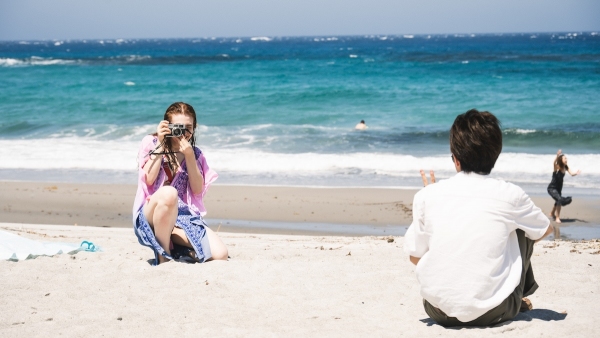
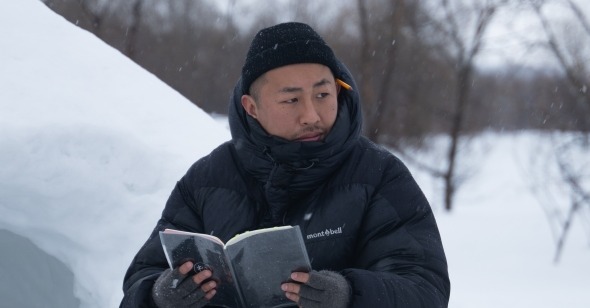
Split into two parts, Two Seasons, Two Strangers, Sho Miyake’s Golden Leopard winner at the 78th Locarno Film Festival adapts a pair of Yoshiharu Tsuge mangas: A View of the Seaside and Mr. Ben and His Igloo. The first half cross-cuts scenes of Li (Shim Eun-kyung) penning a screenplay and the filmic rendering of her writing. The Korean expat imagines a young man (Takada Mansaku) and a vacationing woman (Kawai Yuumi) meeting at a summery seaside town. The pair engages in intimate conversations, swapping their respective memories. Two Seasons, Two Strangers’ second half begins when this film within the film ends. Li is no longer writing; she’s with the movie’s male director for a post-screening Q&A. The audience peppers her with questions and comments, such as her former mentor calling the film “sensual,” which reminds Li that she can’t control how a male director adapts her words for the screen. Li decides to change that. Armed with a camera, she ventures to a ramshackle wintry inn owned by the melancholic Benzo (Tsutsumi Shinichi) to find her own images.
For Miyake, the quiet narrative contours of Two Seasons, Two Strangers demonstrate a continued interest in lonely characters, particularly women, that began with his debut, Payback, and found greater shape in the forlorn two-hander All the Long Nights. His classical style, which crystallized with his modest Slow, Small but Steady, about a deaf female boxer, owes much to Yasujirō Ozu and can sometimes belie the liveliness of his soulful reflections. As the platonic relationship between Li and Benzo deepens, Miyake’s aims become apparent. The stillness of his framing allows the audience not to be distracted by a harsh whip pan or an elaborate tracking shot, but instead to focus on the characters’ joy, sadness, and surprise.
I spoke with Miyake with the assistance of Japanese-English interpreter Monika Uchiyama over Zoom about his minimalist camera, appreciating life’s small moments, and centering women protagonists.
Reverse Shot: This is one of a few adaptations you’ve done. When you’re translating books and mangas to the screen, are you making visual choices first or narrative ones?
Sho Miyake: Whether the visual elements come first or the words come first, it really depends on the particular scene or project. I work in a very varied way. The one thing that is consistent throughout my works is the process of location hunting, or even prior to location hunting, just walking around trying to find where the story is going to take place. It's through that process that these ideas about the visuals and the words really start to come together. I feel like my works come to life not solely through the images or words, but really through this preproduction process, through this kind of stretch before the sprint.
RS: Your films have an exceptional sense of space, in which the setting informs these characters, like the gym in Slow, Small but Steady. What’s your approach to marrying place with people?
SM: It's really hard to put it into words, but with this film, I think there's some importance in what it means to stand very still. Because for instance, there are so many different road movies throughout cinema history. In those movies you see people walking very long distances, and you'll depict that by panning the camera and following along with the characters. But in this film, it's really all about standing still. A character will look to their left, look to their right, look at their surroundings, and I wanted the viewers to also experience that moment along with the characters so that not only are they seeing the character, but they're also taking in the landscape.
Just in my day-to-day life, if I’m walking through the city at a very quick pace, I feel like I'm missing out on a lot of details. I might not notice that the flowers are blooming. Likewise, being in a movie theater and sitting still for a time allows a viewer to really be able to appreciate those small movements. I want to evoke a kind of surprise from these small moments to distract from the repetitive sense of the everyday, which can become very boring and also very psychologically tiring. If we can notice the small changes, then that might help us appreciate that every day is a little different. Monday is different from Tuesday, which is different from Wednesday.
RS: From what I understand, the original manga is in black-and-white. Why did you opt to shoot in color?
SM: For a period, I did think it would make sense to shoot it in black-and-white, just like the manga had been. But upon visiting the island that we shot the summer portion in, it's just that the color of the ocean was so vivid and beautiful that when I looked at the upcoming weather, it seemed like we were going to get some really beautiful days. At that moment, I knew that we had to shoot in color. I eventually also thought that we'd be able to create more contrast with the monochromatic winter portion of the story by shooting in color as well.
RS: I figured you might’ve considered black-and-white first since your first two films, Playback and Good for Nothing, were shot that way. Interestingly, your last two films were shot on 16mm. Why did you decide on digital here?
SM: There are two reasons. The first is very practical. I needed to shoot in the ocean, and also in these very cold climates that featured winter scenes. For those, it would be very hard to shoot on film. The second reason was more of an aesthetic choice. With film there's always going to be that graininess—even when you are photographing a very still shot, that grain is alive and moving. With digital, on the other hand, if you stop and don't move the camera, and if there's nothing moving in the scene, it really does look like a photograph. Everything is completely still. It's almost as if it's dead. That kind of still texture seemed very apt for adapting a manga into a film.
RS: Li as a character kind of follows your last two films—All the Long Nights and Slow, Small but Steady—in terms of being centered around women. In the early part of your career, your films were male-centered. What’s been drawing you to stories about women?
SM: It's hard to say why, but I think it has a lot to do with the actors that I've been connecting with. I just happen to have encountered these incredible actors who are women. Of course there are many wonderful male actors too, but it just so happened that I encountered these women actors who have made me want to collaborate with them. But I haven't tried to make sense of why that is. As a filmmaker, I don't think of my starting point as wanting to make films for self-expression. I'm trying to figure out what I don't understand. The more that I make films, the more I don't understand. So, when I think about my process as being something of discovery, of trying to learn something new, then it would make sense that because I'm not a woman, I don't understand their perspective. There are more questions for me. Perhaps that could be a reason why I'm drawn to women characters.
RS: Your films also witness these women trying to find ways to control their own stories, whether it’s through boxing in Slow, Small but Steady or the point-and-click camera Li has here.
SM: I think the similarities for me between the two characters of Li and Keiko are that they try to be more honest to themselves. They also try not to ignore the various frictions in their respective lives. If they're 90% satisfied, but 10% unsatisfied with their life, they're the types of people who really want to get to the bottom of what that 10% is and why they can't be satisfied. Perhaps for Keiko, the answer to that is boxing. For Li it's screenwriting or any other ways of expressing herself.
RS: In that regard, I’m intrigued by the casting of the Korean actress Shim Eun-kyung in a Japanese film. Was that casting a conscious choice to further instill a sense of isolation in Li?
SM: I don't think I was trying to depict any kind of isolation based on one's nationality. It's really about each person's lived experience, like when they feel like they don't fit in the society that they're in. I think that's a big theme of the film. Earlier I talked about that idea of being 90% satisfied, but then there’s the 10% sense of dissatisfaction with one's life. These characters are the types of people who wouldn’t pretend to be happy just because everyone around them was extremely happy and lively. They're not going to go along with everyone else. They're going to really consider why they're not feeling the way they feel like they should be feeling. For instance, let’s say Shim's character happened to not be Korean; if she were Japanese, I think she would still feel the same kind of isolation.
RS: Your films always find a shred of hope. That is, these stories could make for darker films in someone else’s hands. Is optimism an important part of your filmmaking?
SM: I think hope is an important aspect. Yoshiharu Tsuge, who wrote the manga, was a person who tried to depict a lot of despair through his work. When I was spending years reading his mangas, there were moments when I was getting pulled toward that despair. But I also think that Tsuge was making a lot of creative progress through these depictions of despair. I think the act of creation and being able to produce something creatively is a way of taking a step forward, even if the themes of the work are not particularly optimistic. For myself, as a filmmaker, I want viewers to be able to come out of the theater not feeling any particular way per se, even though I think that you can come out and feel a lot of hesitation after watching my films. Instead, I want people to be able to see the world in a new way. So, hope or happiness might not be the right term. But it's about having a new perspective, being able to see the world in a new way, hear sounds in a new way. That kind of fresh outlook is something that I want people to leave the theater with.