Past Is Prologue
An Interview with Annemarie Jacir (Palestine 36)
By Monica Castillo
Annemarie Jacir’s historical epic Palestine 36 transports audiences to a time and place most of us have rarely ever seen on screen. Melding archival footage and a tense story of resistance under colonial tyranny, Palestine 36 follows both Palestinians and British characters as the colony reaches a breaking point over oppression, land loss, and abuse. As a revolt forms in opposition to colonial rule, characters question their capability to bring about change and wonder if they should join the revolution. Looking to squash dissent, the British military responds with cruelty as tensions rise on both sides.
Jacir painstakingly captures a sense of the past—a sense of memory for a time that has been systematically suppressed by the forces of imperialism. In reintroducing this chapter of her country’s history for others to discover, she reclaims it from the confines of history books and scholarly journals.
Jacir spoke with me about her research into Palestine of the 1930s, recreating the past, and bringing this nearly forgotten history to audiences today.
Reverse Shot: What inspired you to tell a story about Palestine in this particular period?
Annemarie Jacir: I was inspired by that critical moment of the revolt which began in 1936 and ended in ‘39, and which was really the first mass revolt against British colonialism. It was an incredible moment in the history of Palestine and really the beginning of an organized national movement for liberation. I was always interested in this period, and I'd read a lot about it. There's something really modern about it—people's lives were changing everywhere in the world in the '30s. I wondered why there was nothing ever made about it, and that's what started the whole process for me.
RS: Could you tell me a little bit more about that research process, digging deeper into the details about the period and what was going on at that time?
AJ: I heard about it a lot from my parents and my family [who were] always talking about how the British did this and the British did that and cursing the British. I only realized as an adult the really violent side of the British presence, not only in Palestine but also in most of the countries they colonized. Part of the story that was left out was the Palestinians talking about the revolt, how we organized the longest strike in history, and we did this without talking about the trauma of it. I went down a rabbit hole of reading Palestinian accounts, academics, British, and Israeli writers talking about this period.
The final part of the research was the archives, the photographs, and the film reels that the British were making. They colonized what was happening. To see images of my country before it was destroyed was very intense. To see places that don't exist anymore and to see people before they became refugees, those images had an impact. I consider that part of the research because they really implanted something in me, and that stayed with me in the writing. I also used that archive very much in the production of the film. Working with my costume designer, my art director, and production designer, we were always referring to the archives [because] we wanted everything to be correct.
RS: When did you decide that you wanted to incorporate the archival footage into the film itself?
AJ: When I wrote it into the script, it was always meant to be in a way that was not to show this is what it used to be, but more that this is the world of the characters. This is what Jerusalem looks like. This is the way the village looks. This is what soldiers look like doing pat-downs. I don't have the kind of budget that I could fill the streets of Jerusalem and have VFX and do all the things to create this, but it's so important to see that world. I insisted that we would colorize it, but in a way, I didn't really know what it was going to look like. I just blindly insisted with the producers because after October 7th—it was a financial disaster for the film. So they said, "I don't think we're going to be able to afford to colorize the footage." I said, “No, that's one thing that we have to do.” If you see black-and-white footage in the middle of the film, you will be taken backwards. The audience will think, “Oh, we're going back in time.” Now that I think about it, colorizing the footage was also a way to reclaim it. That's us, that's our land, those are our people, those are our grandparents, our relatives, that's our lost country. I feel when I show it to Palestinian audiences, everybody is like, "Oh my God, I didn't know this is what Palestine looked like. That's our Palestine."
RS: You mentioned the research also informed your approach to production design and costumes. How did you achieve those period details on a budget?
AJ: We all live in Palestine. I'm here, I live here, my production designer lives here, my costume designer lives here, my props master, the location manager, we're all here. That meant we could take time to find all the locations. It was more than a year of actual prep. We had to restore that village, and we did it in a way that villages were built then. We're not going to use concrete. We're actually going to do it as if we are building a village in the ’30s. We are doing the farming terraces as they used to do. We got a bunch of men who build terraces, and they’ve been doing that for generations and generations. This was our chance. There is no film about the ’30s in Palestine before the Nakba in 1948. There's some kind of responsibility in that.
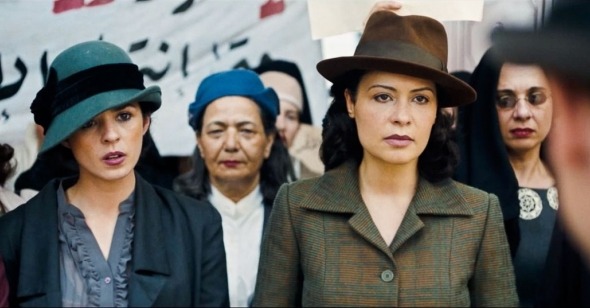
Every village in Palestine has a [specific] costume. You could tell where somebody's from based on the dress. We created a village that was a mix of two different villages. We took traditional things from a village in the north and traditional things from the village in Jerusalem, the actual villages, and we created something that is in fact fictional but based on the real story of the dress and the embroidery on the dress that has a meaning to it—the colors have a meaning, the design has a meaning.
RS: Filming Palestine 36 became incredibly different as you navigated the war and got your production back on track after a long pause. How were you able to recover and finish the film?
AJ: It was like everything fell out. We lost everything. All of that work was gone, and it was really, really devastating. We felt unable to talk about it because what was happening in reality was so much worse than trying to make a film. All our preparation was in the garbage, but there's a genocide going on now. What's there to say? I didn't talk about it for many months, except to keep saying, "We're going to get back on track. Let's just wait, let's just see, and eventually we'll be able to do this the way we wanted to do it.” Months went by, and it became clear that we were not going to be able to do it. We'd lost the location, that village that we restored, there was no way we could film there anymore.
Six months have gone by, people are going to ask for their money back now, people are going to pull out. I was lucky that none of the financiers ended up leaving us because that would have been more of a disaster. On the other side of it, it was like, we have to do this because this is what we do, we're artists, and we believe in this. We've been working for years to tell this story. I think all of the team felt very strongly that it was important before, and now even more important, that we do this. It was something to keep hope and a way to insist that we will try to do what we set out to do, no matter what.
RS: While the film is set many decades ago, it feels just as timely today. Were you thinking about the past and how it relates to the present when writing the script?
AJ: We make period films, but we're never living in the period. The audience knows and has the hindsight of what we know today. Some people tell me the very beginning of the film and the archival footage [makes them] cry because they know that all changes ten years later. When I wrote the script, I felt like this was the beginning of the revolt, and it never really ended because Palestinians are still struggling to be independent. Yes, the revolt was crushed in ’39, but then there's ‘48 and then there's a revolt in ’67 and then ’69, and then ’87 there's the new uprising.
I say it never felt like something of the past; it felt very relevant. It feels like my daily life living in Palestine, all the systems of occupation that I live in, none of it is anything new or original. It's all set up by the British. It's one of the first things that I saw when I was looking at the archives: all the endless images of Palestinians' bodies being searched at checkpoints, their books being checked, their fruit baskets being opened, their hats lifted, and their hair checked. I felt really depressed when I saw it because that's my everyday life, that's the life of my parents, that's the life of my grandparents. When has it ever ended?