Stronger Than Diamonds
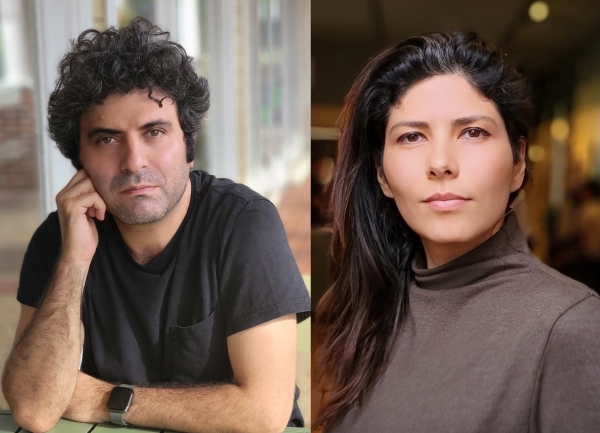
An Interview with Sara Khaki and Mohammadreza Eyni
By Monica Castillo
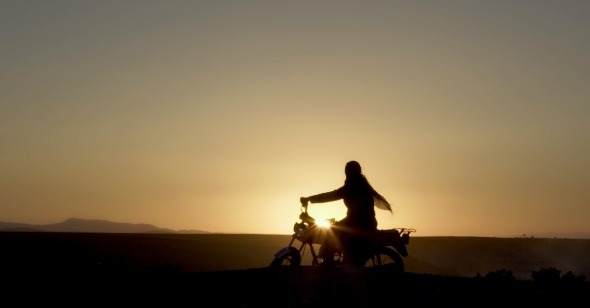
Like the hero in an Old West tale, Sara Shahverdi mostly rides alone, skimming across the dusty terrain of northwestern Iran on her father's motorcycle, living out her freedom as a retired midwife without a husband. She's unlike anyone else in her family or her village, and despite their puzzled looks at her custom clothes and independent behavior, she wants to do what's right for the women in her region. When Shahverdi runs for a local council seat, she gives speeches about breaking outdated traditions and encourages girls to stay in school and pleads for their parents to give their daughter a chance at a different future than theirs. However, once she wins her election, the real work begins, as do the personal, social and bureaucratic challenges that come with it.
Sara Khaki and Mohammadreza Eyni’s documentary Cutting Through Rocks uses a cinema vérité lens to capture the highs of her historical achievement and the lows of men challenging her position in the community. At times, her rage boils over at the many injustices burning her from both in and outside of her family, but her strong will cuts through stubborn old ways. Shahverdi’s outspoken and determined spirit make her a fierce subject to profile, and Khaki and Eyni portray her as a woman of action (speeding into the distance on her bike or fearlessly arguing with dismissive men) as much as words.
Khaki and Eyni spoke with me about the monumental task of editing down years’ worth of footage, showing a side of Iran rarely seen onscreen, and their bittersweet feelings over the film's success in the wake of the violence back home.
Reverse Shot: When did you first hear about Sara Shahverdi?
Sara Khaki: I was born and raised in Iran, and I grew up witnessing so many women like Sara in my family and my extended family, essentially people who—against all the odds and with a lot of setbacks—were trying to push forward. I moved at a young age to the States, and having moved there as a woman of color, as an immigrant, there were a lot of things that I witnessed that I realized that the idea of injustice is really a work in progress, especially the gender injustice. I had these questions in mind, and then I also wondered, what about those people who never left their communities, who never left their countries? How are they coping with these injustices? Through extensive research, I came across Sara's story: a wonderful person who lives in the northwest of Iran and the only female motorcycle rider in her region in the beginning. She had been a midwife and delivered 400 kids, and now she decided to run for a council seat. That was when I contacted Mohammadreza, and I said, let's go there together. I was in New York, and Mohammadreza was already in Iran. We had worked together remotely on another project.
Mohammadreza Eyni: This time, we decided to make a film for a bigger screen. We wanted to find the right visual language to make a cinematic film. This was a very special story for me as a male director who's coming from the community—this is a Turkish Azeri-speaking community. I have witnessed a lot of similar stories, but for me as a male director, making an intimate vérité documentary film was not possible. I needed someone like Sara, a female director, to work with and get access to the places that otherwise would not be possible. We entered the village together, and we didn't know that we were going to spend eight years working on this film, with seven years visiting the village for production…
SK: And one year editing.
ME: And one year editing. Each time we spent [in the village] it was for 40 days, or 70 days, or 90 days. It was a long time to feel and experience all the layers of the film to see how Sara is fighting to win a council seat, to create more space for women and teenage girls, and how she faces so many obstacles in the community. We wanted to also have the perspective of the men and her opponents. What do they think about her as a leader? We wanted to be patient with our story to experience the change in the dynamic between Sara, her fans, teenage girls, women, opponents, men, and everything that was related to our story.
RS: After so many years of filming, how did you edit down all that footage into the version of Cutting Through Rocks we see today?
SK: Mohammadreza and I had been editors, so I kind of felt that editing and storytelling needed to go hand-in-hand, especially when we are in production. So, every time we would come back from production, we would revisit the material, see how we did, what is this story, how the story developed. We would aim to edit at least two moments from that production trip. Then, at the end of the production, after the seven-year journey, we had an assembly. But it wasn't until we got into the groove of editing that we realized that we really had to take a step back and dive deep into the raw material and with a lot of curiosity and openness to see what we really had captured. I think storytelling is an ongoing process. It shifts and evolves in different, surprising ways that no matter how many times you reflect and think about it, it surprises you.
ME: I want to mention that in the process of making the film, we got married. So, while editing the film, we were living in the same apartment in Berlin. For us, it was like entering a cave, being away from friends, colleagues, families, just focusing on the editing. We had two separate editing stations, so both of us separately worked on different scenes for the entire day. Then at the end of the day, we'd get each other's comments on what we were working on. The day after, we switched the scenes that we were working on. This gave each scene a few chances to be seen, but from different perspectives, different aspects, and bringing each scene a fresh idea. Our film is about equality, and while making this film, we wanted to practice that equality.
RS: Could you share more about your collaboration with Sara and working with her as the center of your documentary?
SK: Since I got ahold of her number, I really wasn't sure how she would take my call. But as I was curious about her, she was curious about me. She wanted to find out what about her intrigued me, and that became a very deep conversation. At that time there was no WhatsApp, we would just call over landline phones. When she said that she's running for a council seat, the idea became more and more possible that I would drop everything in New York and reunite with Mohammadreza to go to this village together. There were a lot of moving pieces that needed to happen to make this possible. Even though I'm from Iran, I never traveled to the northwest. The fact that Mohammadreza is from the region, understands the nuances of that culture, and how the whole world works helped tremendously. We walked into this village not planning to start shooting. We just wanted to be there. We wanted to meet these people. Even if our goal was to only meet Sara alone, that would've been enough. But she welcomed us to her house, to her family, to her mother, to her brothers. As soon as Mohammadreza started talking in Turkish Azeri, suddenly there was no barrier. It was a friendly conversation where there would be some laughter and some possibilities of working together.
ME: It is a very essential question for each documentary filmmaker. There should be a mutual understanding about the film. Filmmakers should understand that it is their real passion to work on their story because they don't know how long they're going to work on the film. Both of us always mention in our master classes or panels with cinema students to choose a subject that you really like for your projects because you are not sure how long you are going to spend on the project. Better to choose something that's very close to your heart. If the film's character or characters don't feel comfortable with their directors, it’s not possible to make an intimate film. It's not possible to make an honest film. To make a film like Cutting Through Rocks, we needed two Saras, behind the camera and in front of the camera. I saw that they had a lot of conversations, even some stories that didn't end up in the film. But these conversations are necessary for mutual understanding, for exploring the ideas and layers of the film. Those conversations gave us understanding about Sara’s character.
RS: What has it been like to release a film about Iranians advocating for change in light of the governmental crackdown on its citizens?
SK: We wanted to tell this very complex and nuanced story in a simple way so that both an audience who is sitting in the capital city in Iran and an international audience would understand the voices of the culture. When the film was released, we were hoping that we would receive a lot of interesting feedback, but we did not expect the amount of positive feedback we received from both Iranian people and people abroad. That was really an honor to witness. Towards the end of last year, everybody in Iran, particularly in the village where Sara lives, saw the trailer. They've been reading the news about the film and about Sara, and they have so much more respect for her. Some of them, including the opponents, want her back in office. Now Sarah kind of smiles and says, okay, I feel like my goal was to break this wall that no woman was ever elected in the northwest of Iran, but I did it. Now there are so many more women wanting to run for a council seat in the region. That's why she says, this is great, but I don't need to do this again.
But recently, I'm going to call it the chaos that's been happening internally in our home country—it's been a very emotional and heavy experience for us as Iranians these days. Ever since we've been screening the film the past few weeks with Iranian audiences, it's been extremely emotional, even more so than before because they see themselves. When they see Sara on a big screen, they say that we see ourselves on a big screen. When they see that these young girls are riding a motorcycle at the end of the film, they remain positive and hopeful. They leave the theater feeling that this one individual made a difference in her community. This resilience and this perseverance will stay with us and will make us feel hopeful for the future of our country.
This is the first Iranian documentary feature to ever be nominated for an Oscar. When the news came out, our hearts were filled with sadness. Of course we were happy to hear this, but it's been really difficult to celebrate it. When the news came out, it coincided with the internet shutdown. So even Sara didn't hear right away that the film was nominated. Through conversations and landlines, we asked our family members to get a hold of her to call us so that we could share this news with her. It's been quite a challenging journey.