Bonding Time
Esther Rosenfield on 007 First Light
In the history of licensed video games, there may never have been a greater match between studio and property than IO Interactive and James Bond. For the last ten years, IO’s Danish developers worked on their magnum opus, Hitman: World of Assassination, a trilogy of stealth puzzle games wherein the master assassin Agent 47 jets around the world to snuff out rich and powerful targets and uncover their conspiratorial associations with a New World Order organization called Providence. The Hitman game play like spy thrillers, with Agent 47 navigating the intricacies of each map using disguise and social engineering rather than gunplay.
Who better, then, to bring James Bond back to video games? The Bond franchise is as storied in cinema as it is checkered in gaming. For every beloved entry like the Nintendo 64’s GoldenEye 007, there are several notorious trainwrecks. It has been historically difficult for games to capture the attraction of a Bond story—technological limitations have often rendered video game narratives flimsy, and general player taste leans so regularly towards action and gunplay. Even GoldenEye 007 consists almost entirely of first-person shooting. This kind of action is, traditionally, only one ingredient in the Bond movie stew. Where are the Bond games with spy craft, covert investigation, or flirtation with beautiful women with ridiculous names?
Such elements finally come to the fore in 007 First Light, IO Interactive’s long-gestating reintroduction of Bond to gaming. Rather than directly adapting existing Bond films or Ian Fleming novels, First Light is an original narrative, an origin story for a Gen Z Bond. Almost nothing was written by Fleming or filmed regarding Bond’s youth, except that he was orphaned at a young age and recruited to MI6 out of the Navy. The youngest Bond on film was seen in 2006’s Casino Royale, which opens with the moment he becomes a 00-agent. Going back further, to explore his pre-spy days, is a curious decision.
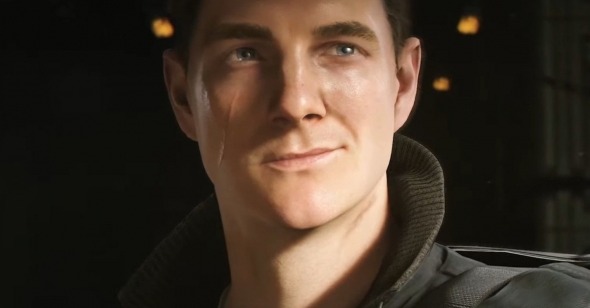
First Light makes a strong case that Bond needed this kind of reset. The Pierce Brosnan and Daniel Craig films struggled to find a place for Bond post-Cold War, half-heartedly opining on the relevance of human spy craft in the age of technology or the challenge of locating explicit national enemies in a War on Terror context. IO Interactive’s Bond, played by Patrick Gibson, is young enough to have a birth year starting with a 2; there is no awkward chafing between him and a world where drones and artificial intelligence represent existential threats.
Things kick off as Bond, a lowly Navy aircrewman, is the lone survivor of a downed helicopter on a small Icelandic island where some international mercenaries are trying to steal a crashed satellite. At the radioed direction of MI6, Bond does impressive impromptu spy work—he is later whisked away to become the newest addition to a recently rebooted 00 program. Familiar faces like M, Moneypenny, and Q are here, though the real highlights are the original ones: Bond’s fellow recruits, brainy rich girl Cressida and brutish blond Monroe, plus the program’s instructor, a gruff retired agent named Greenway played by Lennie James. The latter is a standout—having a youthful Bond deal with the skepticism of a grizzled superior is a dynamic that pleasingly plays against the more assured Bond with which players will be familiar. First Light mostly avoids irritating prequel-bait, landing its few overt lore references with aplomb; the given reason why Bond grows up to order his martinis shaken, not stirred, has stimulating implications.
First Light most surprises with its writing. Even the best Bond video games have more or less eschewed cinematic storytelling, instead draping a thin veneer of narrative onto a gameplay-forward experience. Narrative was never IO Interactive’s strong suit, either. The stories stringing together their assassination sandboxes are background color for the puzzle design of the spaces themselves. First Light rather ambitiously aims to stand alongside the films, a playable Bond movie rather than an ancillary spinoff. Against all odds, it succeeds. First Light captures Bond in the broad strokes—the smirking charisma, thuggish brutality, sexual dynamism—as well as the world of glamorous travels and larger-than-life villainy he inhabits, and it does so without displaying the meek embarrassment of the most recent films.
First Light would make a great Bond film, but the video game medium has more complicated demands. IO Interactive hasdesigned itso that the player switches between various gameplay modes which simulate the rising and falling action of a movie. The standout segments are the ones that borrow most heavily from Hitman. Each of First Light’s main levels has periods where Bond is let loose in a large location and mustuse spy craft to accomplish objectives. An early mission sees him inside a Slovakian hotel while it hosts a prestigious chess tournament, trying to track down a mysterious assassin. Since he’s undercover, he has to use social engineering and stealth to track his target through the hotel’s restricted areas. IO Interactive has left segments like this refreshingly open-ended, with numerous ways to solve any given situation and little explicit direction.
First Light doesn’t give you full access to its maps at any point; even if you know Bond’s investigation eventually leads him to a specific hotel room, replaying the mission doesn’t allow you to skip straight there. It’s an understandable restriction—First Light rewards skill expression and creativity, but above all it is trying to convey the legible contours of a James Bond story. Its open-endedness asserts itselfnevertheless. You can get the four-digit code to open the hotel’s laundry room from multiple sources, but you will need to enter the laundry room no matter what. While it can be frustrating to run up against such explicit limitations in player choice, the developers have done a good job of disguising them. On my first playthrough, I can hardly remember a single moment where I felt meaningfully restricted. You can even flow in and out of specific opportunities at your discretion. At multiple points I found myself abandoning the pursuit of one plan to seamlessly begin another one.
The second mode of First Light gameplay is the stealth sandbox, big open arenas that Bond must attempt to traverse without being spotted. Because the Hitman games are oriented around sneakiness first and foremost, Agent 47 has terrible combat capabilities. If you get spotted in Hitman, 47 will die to gunfire almost instantly.Hitman’s design encourages you to remain unseen. First Light takes the opposite tack. While it’s possible to complete these segments without breaking stealth, the game is designed around engineering situations where Bond will be spotted and must frantically beat down whoever saw him before things spiral out of control. Bond’s fighting form is fluid and agile, not unlike the combo-heavy beat-’em-up approach in the Arkham games. He’s not a superhero, of course—he can only take so much punishment—so First Light lets him improvise. In the course of a fistfight, he can grab bottles or wrenches in the environment and toss them in people’s faces, or fire off flash bombs or lasers at enemies. It feels as though you’re choreographing a great action scene on the fly. The developers put a lot of work into making these emergent encounters exciting, so while they give you tools to maintain a stealthy playthrough, they tip the scales toward outbreaks of chaos. First Light, at every moment, encourages you to just keep going.
Nowhere is that truer than in the third gameplay mode: the big set piece shootouts. When things start getting serious, Bond’s license to kill is activated (he’s just a trainee, after all), announced by way of a brassy, Bondian musical sting. These are bombastic blockbuster sequences full of explosions the player is encouraged to run through without thinking too much about it. These bits largely feel obligatory, the kind of thing that has to be here because Bond movies have explosions and shootouts, and while you are clearly intended to rush through them to create a cinematic effect, their difficulty can mean frequent engagement-breaking restarts. IO Interactive wants to strike a balance between Uncharted-style bare-minimum interaction and the friction of a fully playable fight, and they don’t quite hit the mark. The best license to kill segments are smaller-scale shootouts that resemble something like Hotline Miami in three dimensions, with Bond constantly repositioning behind cover, tossing empty guns at people’s heads, and doing instant takedowns. It’s a rewarding rhythm when the game lets you settle into it, but too often it doesn’t have enough faith in the player to make their own gunplay fun.
Where First Light seems to understand Bond best is how it goads the player into being a bit of a troll. Bond can be effortlessly cool, but he’s also a rascal, a smarmy instigator, always ready with a raised eyebrow and a quip. First Light induces a playstyle that is in this spirit. Don’t just sneak past a guard, shoot a laser in his eyes. Drop a ceiling fan on his head. Shoot him with a dart full of rat poison. Push a big shelf on top of him. Turn on a vacuum cleaner to lure him near an exposed wire and then electrocute him. Grab him by the collar and literally toss him off a roof. Anyone can make a game about being a cool action hero. IO Interactive excelsin this more impish mode, making worlds designed for mischief.
When MGM called for pitches to revitalize Bond’s presence in gaming, IO Interactive put Daniel Craig’s head onto Agent 47’s digital model and showed them an otherwise unaltered Hitman mission. First Light is most successful when it fulfills that promise, of an evolved Hitman game wearing a 007 skin. It falters when trying to be palatable for a wider audience. The most egregious example is Bond’s AAA game chattiness. He simply will not stop muttering to the player about where to go and what to do. Far too often, moments of exploration and discovery are interrupted by irritating voice-over saying something to the effect of “I should really get back to the mission.” This kind of handholding is industry-standard for games of such large scale—as soon as the credits roll and you’re directed to the surprisingly bare-bones “tactical simulation” mode, where you can replay alternate versions of missions and encounters, it becomes clear what First Light has given up in its pursuit of blockbuster success. The Hitman games are so open-ended that their maps and missions can be remixed infinitely. First Light is an immaculately crafted experience, but the concessions made in service of commerce number a few too many.