Text of Light No. 7
Conditions May Apply
by Jordan Cronk
It’s safe to say that in 2026 a majority of cinephiles watch more movies at home than in cinemas. Especially for those living outside major metropolises, the act of filmgoing has become, at best, a fitful activity. For reasons both personal and professional (and despite living in Los Angeles), I too only sporadically watch movies as the people who made them probably intended. And while I tend to agree with Richard Brody’s assertion that streaming has benefits distinct from the theatrical experience—in the way that the modern cinema, as he wrote in The New Yorker, “presents experience in intimate dimensions that are […] better suited to viewing in private”—it also leaves the viewer much more susceptible to external forces.
Over the past few months, I’ve watched several films that got me thinking deeper about this issue, and in particular how it relates to experimental cinema, which is far more dependent on the conditions of its presentation than narrative filmmaking and yet is rarely seen in the proper context, let alone format. Some of these titles I streamed at home; others I viewed with audiences at festivals. One I watched at a museum; at least two of them I saw twice, weeks apart and in very different environments, and had a unique experience each time.
Krakatoa
Dir. Carlos Casas
Seen at Play-Doc, April 30, 2026, and on Vimeo, May 9, 2026
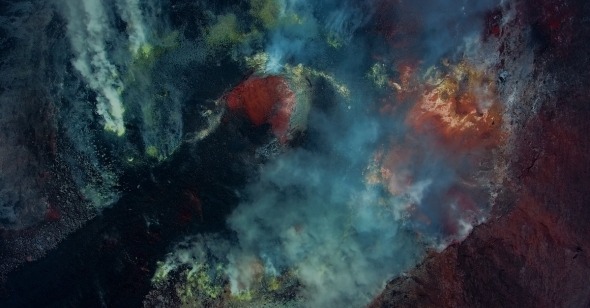
Having missed Carlos Casas’s Krakatoa at the International Film Festival Rotterdam, I was happy to see that it was screening a few months later at Play-Doc, another European festival I regularly attend—and in an expanded cinema version to boot. In this case, encountering the film first in a gallery setting, with “live Foley, musical improvisation and real-time editing,” per the festival’s catalogue, proved instructive for a work of speculative fiction built around ideas related to sound, spectacle, and the volatility of the natural world. While ostensibly centered on a Javanese fisherman (played by Roni Herliansyah) who is swept away by a tsunami following an eruption of the Krakatoa volcano (a gloss on the original 1883 tragedy), the film takes shape sensorially rather than narratively, with the fisherman being deposited on a remote island where he then embarks on a journey into the molten depths of earth.
At just 40 minutes, this iteration of Krakatoa is an enveloping experience. Casas, a Spanish-born artist and filmmaker, has a versatile visual sense, with wide, symmetrical images of the fisherman’s bamboo boat and the surrounding sea quietly setting the stage for the psychedelic abstractions and approximations of roiling, substratal phenomena that eventually overtake the film’s quasi-folkloric opening. In the live setting, the aural elements of the film are especially dynamic, as sound designers Nicolas Becker (who won an Oscar in this department for 2019’s Sound of Metal) and Armand Lesecq swarm the ear with swelling ambience, furious resonance, and enough ricocheting frequencies to induce synesthesia. I happily stood for the entirety of the performance, behind a couple rows of people seated on the floor, and to see and hear the multicolored light and stuttering drones bounce around the venue only added to the three- dimensional feel of the event.
Knowing that the theatrical version of the film was significantly longer—79 minutes, or about double the length of what I had just witnessed—I was curious to see how it played without the bells and whistles. What I discovered when I watched this version of Krakatoa the following week on my TV was a mannered and far more monotonous movie than anticipated. For one thing, the longer cut adds almost nothing to the already threadbare story beyond protracted scenes of the protagonist either milling about his makeshift raft or, later, wandering the island in the wake of the tsunami. What’s more, it draws attention away from the formal qualities of the film and puts the focus on the stylistic touches—the color filters, exaggerated camera angles, and portentous music cues—that in the expanded version feel like logical accoutrements to an immersive encounter rather than devices to keep the audience involved. Where the images in the live version act as a kind of visual guide for the auditory explorations of Casas and his sound team, in the theatrical version they labor under the weight of film’s themes. In this context, even the score feels overdetermined.
NOTE: Krakatoa screened in New York at Museum of the Moving Image this May as part of First Look 2026.
Birth of a Nation
Dir. Stan Douglas
Seen at the Geffen Contemporary at MOCA, April 3, 2026
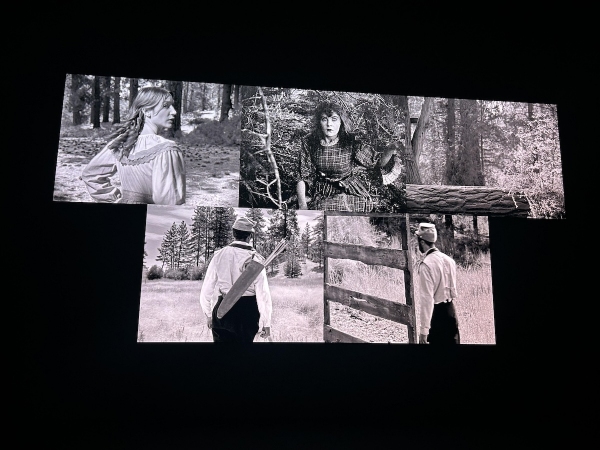
A highlight of the Museum of Contemporary Art’s superlative MONUMENTS show, an exhibition pairing decommissioned Confederate statues with works by 19 artists, Stan Douglas’s five-channel video installation reimagines a pivotal moment from D. W. Griffith’s notorious 1915 feature through a selection of scenes from the original film and sequences that restage the action from the perspective of two new Black characters. Across 13 minutes, both the infamous scene in which Flora, a white woman, is stalked to her death by Gus, a Black army captain played by a white actor in blackface, and Douglas’s reinterpretation of that sequence (and its aftermath) unfold simultaneously in five frames split between two rows.
Considering that my exposure to Griffith’s ahistorical epic over the years has been primarily piecemeal, with sequences variously excerpted and studied in college film courses or seen in any number of documentaries about cinema, it seemed appropriate to reencounter the film in this form. I watched Douglas’s version three times as people shuffled through the Geffen’s white-walled viewing space, each time focusing on a different narrative strand, which either way you approach it ends like the original sequence does, with Gus being lynched by the Klan. Opting to reframe rather than revise the character’s fate à la Tarantino, Douglas depicts Gus as a racist hallucination of the white characters. Here, Flora throws herself off the cliff unprovoked, in a fit of paranoia over Gus’s mere presence, while the infuriated white locals project their deep-seated prejudice over the incident onto the two new Black characters, who, like Gus, are both freedmen and Confederate captains.
Arguably more troubling than even these scenes are the quiet moments where Douglas lingers on an empty room or an unpopulated field, sites of past or possible violence that are fraught with meaning and the kind of ambient dread associated with horror films. (It’s been years since I’ve seen Griffith’s film, but many of these segments from the original appear to have been slowed down and then recreated or echoed by Douglas in an opposite channel.) Watching among waves of largely white patrons in a museum space with its own history of institutional racism only added to the poignancy. Indeed, if Douglas’s piece, in the words of the exhibit’s wall text, “prompts the question, in what ways is our present accountable to the legacies of slavery,” then the group dynamic of the installation format, as well as the work’s physical location, is at least as important to its presentation as any of its textual interventions. The fact that the piece wouldn’t work in any other context is part and parcel of its power.
Forever…Forever
Dir. Johann Lurf
Seen on Vimeo, February 22, 2026, and the Jeonju International Film Festival, May 7, 2026
Forever…Forever, a new short by Austrian filmmaker Johann Lurf, premiered in the Forum Expanded section of this year’s Berlinale, where its 65mm images were projected on 70mm. Due to a scheduling conflict, I wasn’t able to see the film at the festival, so I was eager to catch up with it when I got home, even if it had to be through a Vimeo link. Pressing play and already regretting the missed opportunity to see the film in its proper format, I was met with the following message: “This is a low-resolution preview with a reduced number of audio channels. A screening in cinema is the only way to experience this film as intended.” Great, I thought, before proceeding as planned; after all, my initial encounter with all but a handful of Lurf’s 20-plus films has been via streaming link, and that includes 2024’s Revolving Rounds, a 3-D short that Lurf co-directed with fellow Austrian Christina Jauernik that I’ve only seen at home and in two dimensions, but which I still consider among the most conceptually rich experimental films of recent years.
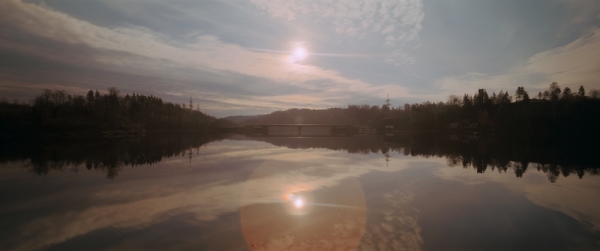
If Forever…Forever eclipses anything that Lurf has done to date, and I think it does, it’s an open question (at least for me) as to just how strong of a work that it is, as it’s risen in my estimation with an equal but opposite force between that first viewing online and a second one a few months later in Jeonju, where I did see it in a cinema but not in 70mm. Like a lot of Lurf’s work, Forever…Forever is a landscape film, but that’s officially an inadequate term for what he’s accomplished with this 21-minute marvel, which is less an earthbound document than a monumental transcription of celestial motion. Shot from a fixed perspective with a specially designed camera over the course of 22 months, the film presents a time-lapse view of Austria’s Ottenstein Reservoir, a deceptively tranquil setting that holds untold wonders above its lakeside surroundings.
Beginning like a stolen moment from James Benning’s 13 Lakes (2004), the film quickly accumulates an internal energy as the morning mist clears and the sun swiftly rises, summoning an array of meteorological movement, all of which is mirrored in the water below, along with the trees, rocks, sheds, and telephone poles that dot the distant shoreline. Then, just over two minutes in, darkness descends and a smattering of lights appear in the distance, creating an imprint of the horizon out of these now invisible structures, including a bridge that sits at the center of the frame. From there, Lurf lengthens the exposures so that days and nights begin to pass in a manner of seconds, turning otherwise imperceptible occurrences—drifting clouds, streaking stars, the movement of the sun and moon—into a dazzling display of atmospheric skywriting, all while the color palette changes in conjunction with the seasons and a storm of alien tonalities echo in a quasi-melodic manner reminiscent of the iconic five-tone motif from Close Encounters of the Third Kind.
Given the sheer scope and majesty of Lurf’s vision, it’s no surprise that these sci-fi associations translated more acutely in my theatrical viewing, where the film’s cosmic elements were able to unfurl on a much larger canvas, with louder and more overwhelming sonics to complement the visual fireworks. So while the film works at scale, there are clearly degrees to its power, dimensions to its splendor, and possibilities inherent to its presentation that even the artist’s most ambitious prior works haven’t fully exploited. Not so here: utilizing every inch of the 65mm frame, Lurf transforms the unassuming rhythms of the natural world into a pulsating panorama of activity that I have to believe the human eye can only fully register in the film’s native format—meaning that, even after two viewings, there’s still more for me to discover in the depths of this spatiotemporal wonderland. Until then, I’m happy to continue exploring its surface pleasures in whatever way is available to me.
NOTE: Forever…Forever will screen in New York at Film at Lincoln Center this fall as part of the Currents section of the 2026 New York Film Festival.