The Loneliest Girl
Matthew Eng on Sissy Spacek in Carrie
Carrie screens at the Museum of the Moving Image on July 25, 2026, as part of De Palma: Summer of Suspense.
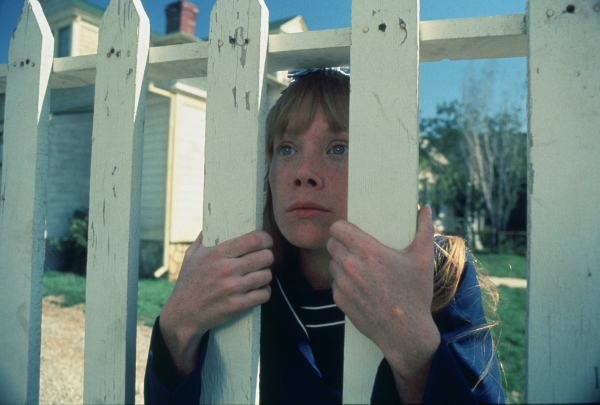
Sissy Spacek auditioned for Carrie (1976) in a pale blue sailor dress that her mother had paid someone to make for her daughter in the seventh grade. She was 25 at the time and had skipped a well-paying commercial shoot for a headache reliever to film a screen test that the studio brass at United Artists had attempted to cancel, until director Brian De Palma intervened on her behalf. As Spacek tells it, this was more an act of kindness than of confidence; the two were casually acquainted through Spacek’s new husband, the production designer Jack Fisk, and the actress had served as a (self-described) “worthless” set dresser under Fisk after losing out on Jessica Harper’s role in De Palma’s 1974 musical Phantom of the Paradise. Spacek’s performance as cinema’s most adorable accessory to murder in Terrence Malick’s Badlands (1973) had earned her praise though not a range of meaty parts; she did most of her acting immediately after on the small screen, then considered second-class. When De Palma told her that she would be better off doing the commercial, Spacek became hellbent on getting the role of Carrie White, the doomed, telekinetic teenager first introduced in Stephen King’s 1974 debut novel of the same name.
On the morning of her test, she refrained from showering, streaked globs of Vaseline through her long locks. Once on set, she steered clear of the hair and makeup people who insisted on touching up her appearance. She kept in mind someone she knew from her adolescence in small-town Quitman, Texas, a reclusive classmate who dressed solely in dowdy hand-me-downs and whose sweetness shone through her high-strung habits. “It made you want to save her,” Spacek remembers in her 2012 memoir, My Ordinary Extraordinary Life. After the film was processed, Spacek waited in the car as De Palma, Fisk, and others screened the tests with the producers. It was Fisk who broke the news to Spacek that the decision to cast her had been a unanimous one.
My critical faculties largely escape me when considering Spacek, an actress whom I tend to regard with profuse and uncomplicated adoration. “You felt a core in her that you trusted,” Malick has said of Spacek’s work in Badlands. “It wasn’t all performance. You felt in safe hands with her. And you could imagine that her life goes on off-screen.” Time has not remotely diminished this assessment of Spacek’s peculiar magnetism. Her participation, however brief, in even the most trifling films and series can be a balm, a stabilizing force for narrative and viewer alike. Although I wonder now if this all-consuming affection that Spacek so effortlessly summons has perhaps narrowed the imaginations of casting directors, who have lavished far more sizable opportunities on her peers in recent years. Spacek has not had the 21st-century resurgence that Meryl Streep and Diane Keaton experienced via middle-of-the-road comedies. She has strangely, if blessedly, circumvented the Ryan Murphy Termagant Factory that has ensnared Jessica Lange, Kathy Bates, and Glenn Close. In the quarter-century since her slow-burning “comeback” performance as a flinty, grief-choked Maine mother in Todd Field’s In the Bedroom (2001), Spacek has seldom been called upon to essay a lead role of equally unsentimental substance—or any lead role, for that matter. Instead, she has mostly played maternal figures of meager screen time to A-listers such as Charlize Theron, Julia Roberts, Michelle Williams, and Jennifer Lawrence, the latter of whom wore a Dior t-shirt of a coronated Carrie White during joint press junkets with Spacek for Lynne Ramsay’s Die My Love (2025).
Our love for Spacek may have limited our collective ability to envision her as more than a beatific, wisdom-dispensing presence. Surely she can still claim the center of a film by signaling the turbulent depths beneath a stoic facade, as Mary Kay Place did in Kent Jones’s Diane (2018), or, conversely, reach the heights of gonzo greatness that Amy Madigan traversed as diabolical Aunt Gladys in Zach Cregger’s Weapons (2025). After all, few have made a more iconic impression in the realm of horror than Spacek, whose Carrie White has been endlessly imitated and circulated. “Early in my career, I thought that making it in the business meant appearing on the Johnny Carson show,” Spacek writes in her memoir. “These days, a mark of success is having one of your characters tattooed on someone else’s body part.”
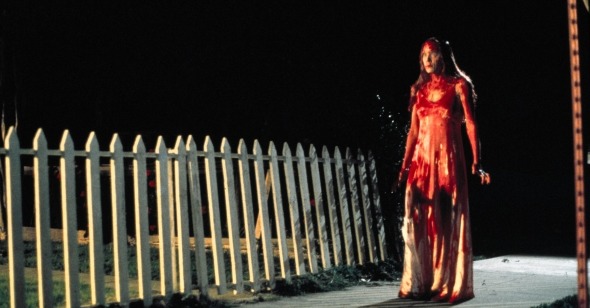
Carrie itself might hold the key to Spacek’s enduringly endearing appeal. She is a singular star who has always seemed at once of this earth and flung out of space, the ineffable made incarnate. Pauline Kael compared the freckled, five-foot-two actress to a frog, a fetus, and a changeling in the same adulatory review of Carrie where she wrote, “I don’t see how this performance could be any better.” Spacek’s bloodstained, ramrod-straight body is the film’s signature image, though what endures in my memory is not so much the havoc that Carrie unleashes as the warmth radiated by Spacek. Her surplus of sensitivity, her alien tenderness, deepens the film and gives it an emotional immediacy that it would not otherwise possess. Watching Spacek in Carrie can only be compared to the brilliant micro-expression that quivers across the face of Betty Buckley, undervalued in estimations of De Palma’s film for her immensely sympathetic performance as Miss Collins, Carrie’s lone defender. As Miss Collins forces Carrie to stare at herself in the mirror and appreciate the beauty that she keeps buried beneath a bulwark of hair, Buckley’s face slides from doting regard to wincing worry. She sees what we see: a creature too gentle for this or any world. It is the same sensation one feels when beholding so many of Spacek’s characters, but none more than Carrie. She makes the heart flutter and tautens the protective impulse so that we want to reach through the screen and shield her from harm’s way.
But her Carrie is also an intensely crafted performance, borne of a process that Spacek was still refining at this nascent stage of her career, only a few years after she had chosen to defer her dream of becoming a singer-songwriter in the vein of Joni Mitchell and give acting a shot. She had been introduced to Lee Strasberg’s conception of the Method while residing with her cousin Rip Torn and his wife Geraldine Page in Manhattan, and although her instruction at the Lee Strasberg Institute was short-lived, she had absorbed some of its techniques, most notably sense memory, and drew on them at liberty. Fisk’s presence on set was a comfort, especially when it became clear that De Palma intended to disregard the no-nudity clause written into Spacek’s contract. In the opening sequence where Carrie gets her period for the first time while showering in the girls’ locker room, her husband was perched at her feet, squatting out of frame with the fake blood that needed to be poured into her hand. (When De Palma told her to play this scene like she was getting hit by a Mack truck, Spacek internally ran through Fisk’s remembrances of being struck by a car as a child.)
Spacek delighted in playing against the no-holds-barred maximalism of Piper Laurie, who achieves Grand Guignol indelibility in fewer scenes than memory might suggest as Carrie’s fiendishly fanatical mother. But for the most part, Spacek alienated herself from the ensemble. As Nancy Allen, Amy Irving, John Travolta, and the other actors cast as Carrie’s tormentors bonded on set and partied off it, Spacek holed up in a dressing room decorated with religious paraphernalia. Inside, she blasted classical music and pored over the Biblical etchings of the French illustrator Gustave Doré, whose epic, eldritch figures she aspired to replicate in Carrie’s physicality with its mixture of fearful frenzy and spellbound solidity.
It is the latter trait that typifies Spacek’s performance in the film’s most technically virtuosic sequence, in which a prettified Carrie attends the prom with the hunky athlete Tommy Ross (William Katt) and gets drenched with a bucket of pig’s blood upon being crowned prom queen. Carrie proceeds to dispense with her classmates and teachers in a nearly stock-still trance, a state of chillingly calm concentration that allows De Palma and his collaborators to whip up a homicidal maelstrom that pivots around Spacek’s widening eyes and swiveling head, the surrounding activity enhanced by slo-mo, split-screen, and some of the director’s most sinuous long takes. Little is required of Spacek here beyond stamina and precision, but it is doubtful that the whiz-bang wonderment of prom night would mean anything were it not for the emotional arc that the actress has traced beforehand. As the massacre nears, Spacek plays Carrie less as a latent demon child than as a lifelong wallflower of quite ordinary shyness who is slowly unfastening herself from the perimeter of the room and stepping bashfully into its center. (In a sweet bit of irony, Spacek had been a drum majorette in high school and was actually popular enough to be elected homecoming queen in her senior year.) Just as devastating is the post-prom comedown as Carrie sits naked in the bathtub, a sob rippling her body after scrubbing the porcine blood from it. There is no dark underbelly to her radiant, credulous sincerity, and it is this choice of Spacek’s, her prioritization of genuine feeling, that ensures that Carrie is both a rip-roaring chiller and a tragedy about a young girl who kills the classmates that she just wanted to like and befriend her.
Carrie made Spacek into a household name, as much for her performance as for the evident physical and temperamental transformation required for a sweet-faced, tomboy-leaning twentysomething to become a maleficent teenage terror. “Like De Niro, when she makes contact with celluloid, there’s a transformation,” raved De Palma of his leading lady. Spacek earned her first Academy Award nomination and hosted Saturday Night Live a month later, merrily twirling a baton in a majorette’s leotard during her opening monologue. That same year, Spacek would send Carrie’s naïveté through the trick mirror of Robert Altman’s 3 Women (1977), mutating from lamblike misfit to gum-snapping vixen. She graced the covers of Interview, whose editor Andy Warhol interviewed her himself, and Newsweek, which made Spacek the face of an issue devoted to the “Year of the Actress” and proclaimed her to be “the most promising of all” the decade’s burgeoning female stars. De Palma’s film guaranteed Spacek a career, but it is Spacek who guaranteed De Palma’s film a place in the pop-cultural firmament and a poignant afterlife. Somewhere along the line, Spacek decided that it was not enough that Carrie White suffer and slaughter for our consumption, but that her ache become something undeniably potent, a hope-starved sorrow capable of seizing the viewer and sending a silent wail down the spine. She wants us to know how it feels.