Falling Down
Dan Schindel on Baby Steps and the games of Bennett Foddy
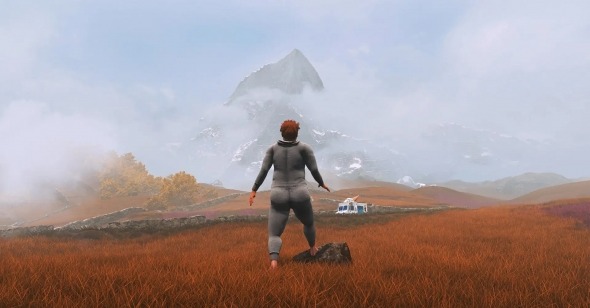
Many games, especially blockbuster titles, open with tutorials on how they work. Bennett Foddy’s Baby Steps (2025) obliges the trend. After the player character, Nate, is magically transported from his parents’ basement to the bottom of a mountain, onscreen text tells you to use the control stick to move—an almost insulting instruction. But then, when you tilt the stick, Nate pitches forward and faceplants.
Developers Foddy, Gabe Cuzzillo, and Maxi Boch have pranked you. In most video games, movement is straightforward: sticks, arrow/WASD keys, or mouse clicks direct your character, who automatically does all the work. But Baby Steps turns walking into an in-depth mechanic. When playing with a controller, you manually input Nate’s every step, pressing the left or right trigger to raise the corresponding foot, using the right stick to position that foot, then releasing the trigger to plant it on the ground. Mouse and keyboard controls are even more painstaking: You select a foot with a key, raise and lower it by hitting the spacebar, and move it with the mouse. But it’s not just a joke; Foddy’s work seriously interrogates our expectations for games and the nature of challenge through their off-kilter control schema.
Baby Steps brings to life “The Centipede’s Dilemma,” the poem about a centipede who can effortlessly crawl without tripping until a toad asks how she does so, whereupon she overthinks everything and can’t stop stumbling. It is easy to overextend the reach of Nate’s foot and do a ruinous split. Or not step far enough and watch his inertia send him to the ground. Or misjudge your balance on an incline and eat shit. Or place not quite enough of a foot on a ledge, slip, and fall all the way to the bottom of the mountain, your hard-won progress erased in an instant. Across the different environments, there are precious few checkpoints. And in complete defiance of the rules of open-world games, there is no map to consult. It goes several steps beyond the ways Death Stranding has the player actively consider their balance.
If this sounds incredibly difficult and frustrating, it is. But do things get easier as you internalize its mechanics? Sort of, but not really! Even if you get good at walking, the ragdoll physics on which the game is based will continue to plague you. They are deliberately imprecise, and there’s no guarantee that moving in a certain way will produce an identical outcome each time, even in the same spot. Baby Steps keeps you on your toes—and heels, and the balls of your feet, and sometimes the arches.
Nate (voiced by Cuzzillo with a stammering whine) is a 35-year-old “failson” who has so much trouble walking because he’s spent years atrophying on his basement couch. An ordinary person being whisked away to go on an adventure in a fantasy world is a popular storytelling trope (it’s become so common in anime that it now constitutes its own genre, isekai). Baby Steps thoroughly discards any wish-fulfillment aspect of this idea, often through more gameplay-premised gags. As Nate continues to pratfall his way across this world, he steadfastly refuses any aid from its denizens in ways calculated to make players scream. In one good bit, an NPC kindly offers a map, and a standard open-world mini-map briefly appears in its expected place in the bottom-right corner of the screen, only to vanish when Nate declines it. His insistence on adhering to masculine ideals of self-sufficiency contrasts sharply with his physical ineptitude and general haplessness. The themes of masculine pride are reiterated in this other world by the fact that most of the inhabitants are humanoid donkeys, who often go bottomless with very large penises waving about.
This puckishness is characteristic of Foddy’s games, going back to his 2008 breakout hit QWOP. One of the icons of the late era of Flash-based browser games, QWOP tasked players with having an Olympian run 100 meters. You control the runner’s thighs with the Q and W keys and his calves with the O and P keys. This setup is not merely unconventional by gaming standards but hideously unintuitive on its own merits, forcing your brain to work against its natural directional associations to activate the runner’s muscles in the proper sequence. QWOP became a viral hit because it’s incredibly funny to watch people fail, to not make it more than a quarter of a meter before the paper-doll-like runner pretzels himself. But it is possible to master QWOP, and the current world record for running those hundred meters is 45 seconds. (Usain Bolt’s world record for the 100-meter dash is 9.58 seconds.)
Over the years, Foddy followed up QWOP with more Flash games, each a variation on its concept. In 2011, there was GIRP, a climbing simulator in which the handholds on a cliff face bear letters. Holding that letter’s key will make the climber reach for and hold onto it, while you make him swing his body with the mouse. There’s a kind of mimesis between the climber’s positioning and the way you contort your hand to the needed keys while not letting go of the ones you’re already holding down. In 2012’s CLOP, you make a unicorn run with the H, J, K, and L keys, each controlling one of its legs. The game situating its point of view in parallax with an equine recalls Sallie Gardner at a Gallop, updating Muybridge’s motion study for the internet.
The stakes raised with 2017’s Getting Over It with Bennett Foddy, which challenged players to ascend a mountain of detritus using a hammer, awkwardly waving it around with a mouse or trackpad. The controls are finicky and the results unpredictable, and even the smallest mistake can send you plummeting back to the start. In voiceover, Foddy consoles/encourages/taunts the player with a variety of philosophical quotes about failure whenever you fall, like the pseudonymous poet Atticus’s “She smiled in defeat, with unconquerable eyes.” Getting Over It was another hit in the “rage game” genre, just as (if not more) popular as a subject for livestreaming than as a game in its own right, with millions watching videos of internet personalities playing it to drive themselves to frustration.
There have always been games renowned for their difficulty. Sometimes, this quality is an unintentional outcome of poor programming or playtesting. Other times, it’s built in based on commercial concerns. The Lion King (1994)was made as challenging as possible specifically so it couldn’t be beaten within a rental period, pushing consumers to buy it instead. Increasingly, high difficulty can be a significant part of a game’s selling point. The surging popularity of titles like Fromsoft’s infamously punishing, unforgiving oeuvre have cultivated an almost masochistic trend of gamers who hunger for a challenge, who respond to any qualms about accessibility or reasonableness with cries of git gud(“get good”). The appeal is elemental: the greater the challenge, the greater the satisfaction of overcoming it.
Foddy’s works disrupt traditional notions of difficulty. Fundamentally, making a game harder tends to come down to allowing the player a smaller margin of error. Foddy also does this, but not in timing enemy attacks or taxing your reflexes. Instead, he makes players approach controls in a way orthogonal to how most games do. Despite how unusual this is, the player’s learning curve in adjusting to this difficulty is not too different from internalizing the rhythms of attacking, parrying, and dodging in a game like Elden Ring.
Foddy consistently affirms that he is not a troll (or at least, not just a troll), and that this learning curve is an organic part of his work. In a recent interview with The New York Times, he says that “when I’m making games that are intentionally frustrating or annoying or boring … I’m trying to do that in a way that people will derive pleasure from. Why do people continue to do things that make them unhappy? I think that’s maybe the great mystery of being a human being.” He further states that he wants to awaken people’s “latent love of punishing choices.”
But Baby Steps also incorporates a narrative that asks players to reconsider that love. Even as the player surmounts difficult terrain or accomplishes optional side routes, the lack of affirmation from the game denies them the usual power fantasy and asks them to consider what challenges they think are “worth it,” and why. Baby Steps is actively antagonistic, often accompanied by a mocking, antiheroic nursery-like plunking soundtrack. Since basic things like going up a down escalator are daunting tasks, the very notion of big challenges begins to seem absurd. This comes to a head in the final area, which poses a choice: Surmount a cliff either by embarking on a wickedly complicated route called “the Manbreaker” or just walking up a long spiral staircase. There is zero reward for doing the Manbreaker, but if you take the stairs, one guy will force Nate to call him “lord.” Is it really worth it to navigate that treacherous cliff just to say you did it?
Baby Steps and Foddy’s other works highlight the arbitrariness of game accomplishment by setting deliberately absurd goals for players, turning mundane things like running a short distance or walking up a hill into ordeals. But this in no way negates the real sense of accomplishment to be had in meeting these objectives. It’s just as valid for someone to get a sense of reward out of beating the Manbreaker as it is for them to get it from beating Malenia in Elden Ring. The oblique controls in Foddy’s games force the player into a state of hyper-awareness. Whether they bounce off the challenge or get over it, they must rethink their physical relationship to a game, and in turn what they get out of beating it.
I bowed out of Baby Steps around two-thirds of the way through, unable to escape a sandy cave no matter how many times I tried. I was at peace with this because my own relationship with games is not premised on being especially “good” at them. My reflexes aren’t quick and I chafe at too much repetition. Most importantly, I have less time in my life than I used to. With most games, giving up like this would leave me with a sense of incompleteness, of dissatisfaction. But not in this case. While Foddy’s games may taunt your efforts, they don’t mock you. Even if you fail, you’re in on the joke.