Machine Tooled
By Katherine Connell
Klara and the Sun
Dir. Taika Waititi, U.S., Sony
“We’re modeled from trash,” declares a character at the solemn climax of Never Let Me Go, Nobel Laureate Kazuo Ishiguro’s novel about clones raised to adulthood, then harvested for their vital organs. Set in an alternative England during the 1990s and narrated by a clone reflecting on her childhood at a specialized boarding school, the book is backdropped by the rigged systems created by neoliberalism in Thatcherite Britain. In 2021, Ishiguro’s Klara and the Sun revisited the human/nonhuman divide, asking who gets entitled to a ‘good life’ and how such a thing is defined. Its titular narrator is a solar-powered humanoid robot—an AF, or artificial friend–who becomes the childhood companion for a wealthy girl with a life-threatening illness. Both stories end bleakly, with their nonhuman protagonist surrounded by garbage while awaiting death, kept company only by her memories.
Taika Waititi’s screen adaptation of Klara and the Sun is trash of a different kind. A film based on a thoughtful novel about AI shouldn’t feel generated by it. Reducing the book to a ceaseless sequence of flatlining quips and sentimental swells, Waititi’s rendition is his worst offering to date. The filmmaker whose early work like Boy (2010) and What We Do in the Shadows (2014) held sweetness and acerbity with confidence has been on a steady decline for more than a decade. Confusing in its aesthetic worldbuilding and tonally erratic, Klara and the Sun feels helmed by an absentee boss. The choice to transform Ishiguro’s contemplative novel into a quirky dramedy seems bizarre, but taking source material in unexpected, even contrary, directions could make for a worthwhile anti-adaptation. That’s not the case here. The film is childish in its reluctance to approach anything that was difficult in the novel. Though its narrative proudly centers big feelings—grief, love, fear of death—their hollow articulation through tropes, jokes, and platitudes only amounts to the simulacra of these emotions.
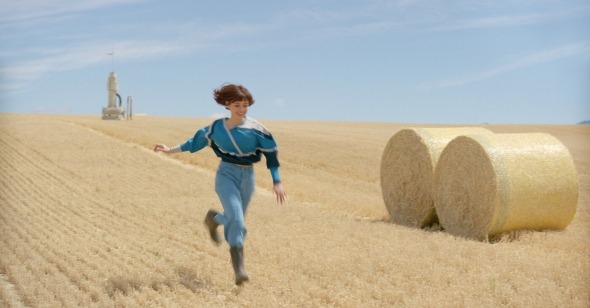
Waititi’s version builds its structure by stacking key events from the book. Klara (Jenna Ortega) is an AF housed among others of her kind. The Manager (Natasha Lyonne) begrudgingly cares for her charges, who we learn are older models of the higher-tech B3 iterations sold across the street. Unlike her peers, Klara is peppy, curious about everything, and—from the get—obsessively attuned to the beauty of humanity. She’s Agnes Varda meets Willow Rosenberg on acid, a gamine ingénue who uses words like “super duper.” Fueled by the sun, she worships its life-giving properties as a framework for making meaning from her strange socialization. When Klara gets a turn to peacock in the storefront window, she woos apathetic teenager Josie (Mia Tharia) with silly mime movements. Josie’s mother, Chrissie (Amy Adams, out of place in Hunger Games-esque business casual and frequently huffing a kazoo-shaped vape), is a tough customer, but her daughter wins out. Though leaving her own flock saves Klara from an early fate of being “melted down for parts,” she soon steps into more complex familial dynamics.
In Ishiguro’s novel, human characters are verbally resentful and borderline abusive to their AFs, a detail that recalls the way the clones of Never Let Me Go are looked upon by their caretakers with fear and occasional disgust. It’s a powerful motif illustrating how people can react when subjugation that benefits them is made visible. In Waititi’s film, these scenes are played for laughs. During the film’s opening montage at the store, the Manager irons a shirt directly onto the chest of an AF. From the moment Klara steps into her new “home,” Chrissie and her housekeeper Melania (veteran Waititi scene-stealer Rachel House) drop disses like it's their job. When indoor tensions escalate, Chrissie drives Klara to a waterfall and tries to drown her. Gross-out comedy supersedes lingering in uncomfortable but revealing tension: it’s all water under the bridge, or rather, projectile vomit from Klara’s innards before they quickly smooth things over.
Part of the problem might be adapting this book in the first place. Klara lands clunkily in the current moment where questions about the “humanity” of AI are out of touch with more urgent political concerns regarding environmental destruction, intellectual/artistic theft, data ownership, legislation, and the corporate mythologization of billionaires. A film that follows the question “can AI feel?” with “and can’t we all be friends?” is pursuing the wrong lines of inquiry, and different ones than those posed by the novel.
Waititi’s Klara yokes to a subgenre of movies more interested in broad-stroke philosophical musings about artificial life than engaging the horror show that has become our actual moment. Mainstream cinema is still struggling to find new stories to tell outside the narrative parameters set by Blade Runner (1982) and A.I.: Artificial Intelligence (2001). Aside from the predominance of media about people having sexual and romantic relationships with humanoids, there’s a growing number of films about grief and family, wherein a technologically simulated spouse or child is introduced to replace the dead and mitigate loss. Black Mirror’s “Be Right Back” (2013), Replicas (2018), Swan Song (2021), After Yang (2021), and most recently Sheep in the Box (2026) are all notable riffs.
These films of varying quality repeatedly say the same thing: you can’t cut corners when it comes to grieving. At the same time, they also present the possibility of loving—or at least accepting life with—the robot. Much like the somewhat exhausted discourse around “elevated horror,” these films instrumentalize grief as a marker of conceptual seriousness that mitigates their sci-fi leanings. They are family dramas about interpersonal issues first, and as such rarely apply the same level of interrogative depth to our entanglements with technology.
Klara and the Sun is another addition to this category. Josie—whose family is still mourning the death of her younger sister—is sick because her mother opted to put her through a fictional genetic procedure that provides children with artistic and intellectual advantages. As Josie nears probable death, Klara’s purpose as her potential replacement becomes clear. “Grief makes you crazy,” Chrissie tells Josie, apologizing for a series of desperate delusions that make up Klara and the Sun’s denouement. So can algorithms, as can be observed either through doomscrolling viral AI slop melodramas about anthropomorphized fruit or the more concerning phenomenon of AI-induced psychosis. A tepid franchise that still toes the line about “living with” AI, M3GAN at least understands this.
Most dramas about the robot changeling child ignore harsher but more banal realities—like parents sitting in front of chatbots asking how to raise their kids. Ishiguro’s poignant but dismal final passages of Klara and the Sun activate readers towards critical reappraisal of the world around them. Waititi insists on a happy ending that encourages the viewer to simply hope for the best, a conservative and ultimately dangerous fantasy.