Heavy Lifting
by Eileen G’Sell
New York Film Festival 2026:
The Only Living Pickpocket in New York
Dir. Noah Segan, U.S., Sony Pictures Classics
Pickpocketing in New York today has got to be a crapshoot. On the one (speedy) hand, there is more wealth than ever; more one-percenters idling in Patagonia puffers, more Fendi-fettered undergrads glued to their phones. On the other, affluence less often takes the form of fresh greenbacks or a gilded object worth swiping. Back pockets seldom bulge with cash, fat wallets are swapped for Apple Pay.
In an age when billionaires fuel political decisions and class inequality has hit its highest in thirty years, the prospect of snatching a few bucks from a real live human feels almost quaint, a relic of a simpler time. Openly nostalgic, Noah Segan’s sophomore feature, The Only Living Pickpocket in New York, is deeply indebted to such mythos—when the prospect of upward mobility excused flouting the law and grit was its own social capital.
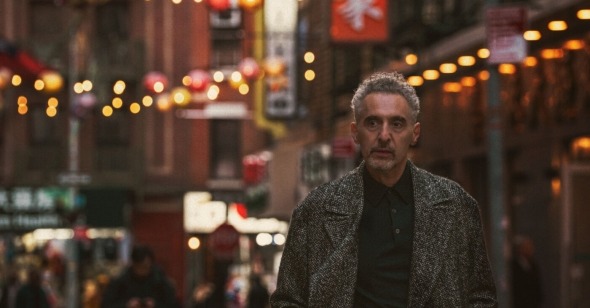
With the urgent pace of a Safdie production sans the graphic violence, Pickpocket jolts forward like a rusting express train. Harry (John Turturro), a professional thief and aging luddite, has a Thomas Jefferson at the ready for anyone with a nickel of influence. For reasons unknown, his wife, Rosie (Karina Arroyave), is in a nearly vegetative state, requiring 24-hour care. Early on, Harry filches a gym bag from the muscle car of sneering young man named Dylan (Will Price); what he finds inside sets off a chain of events that even a seasoned criminal can’t weather alone.
When pawnbroker pal Ben (Steve Buscemi) assesses Harry’s stash, he plugs the stolen USB key into an ancient desktop computer, cluing Dylan—who is (surprise!) part of a high-ranking crime family—to the location of the loot, much of which was passed along to a Chinese druggist in another part of town. Confronted by Dylan’s Gen Z posse at his flat in the Bronx, Harry has to retrieve the USB in a number of hours; if he doesn’t get it back in time, Rosie’s fragile life is in the mafia’s hands.
The strength of Pickpocket lies in its ability to pay homage to Harry’s New York. Shot entirely on location, the film’s cinematography jives with the city rhythms. The camera tracks Harry darting down sidewalks, jaywalking across traffic, jumping from borough to borough like his life depends on it (as it does). An energetic jazz score accompanies his quest, another nod to’70s New York that puts Harry’s present-day exploits in the league of canonical antiheroes. At times, the extent to which the movie insists on its protagonist’s inner virtue distracts from the film’s power. Harry needs a reason to risk all to retrieve the lost USB, but pinning it all on Rosie feels farfetched—as does the likelihood that, after abandoning his first family, Harry would devote himself to tending a woman who cannot talk back (though, to be fair, many men still prefer that). Rosie registers less like a character, and more a narrative device to render Harry more sympathetic than he needs to be. No matter what role he plays, Turturro is always likable. Does Harry really need a mute wife for viewers to root for him? It’s more exciting—and, arguably, more relatable—to take his side when he doesn’t have any objective beyond his own day-to-day grind.
Similarly, some of the characters in Harry’s network seem less like persuasively contemporary humans than a conglomeration of stock traits. Sure, pawnshops can seem frozen in amber, but a business owner like Ben would probably boast at least a dated laptop. So, too, is a Chinese grandmother running a vape shop (Lori Tan Chinn, best known for her comedic role in Orange Is the New Black) presented as risibly tyrannical. Even Harry going without a cellphone feels like a rich person’s romantic idea of how a sketchy working-class guy might live; low-income folks are much more likely to rely on their phones on account of lacking broadband internet at home.
At its worst, Pickpocket caricatures the present by conflating it with a past more imagined than real. But at its best, Pickpocket reveals the intricate moral calculus required among the most economically marginalized to survive. The film also acknowledges the small ways in which New Yorkers take care of each other when they really don’t have to, from the neighbor across the hall who regularly checks on Rosie to the wily panhandler willing to do Harry a solid (if for the right price). The transactional nature of these exchanges doesn’t expose the city’s mercenary nature so much as reveal how often, in real life, people who help other people out expect nothing in return. When Harry heads to his estranged daughter’s place in Queens, he asks a local to borrow their phone. In a Yankees cap and androgynous attire, the person hands over their smartphone and seems nonplussed by the drama of the conversation that ensues. The person’s generosity and patience enable Harry to check on Rosie and ultimately ensure her well-being. It’s a small moment, with no cash incentive, and it speaks for what so many continue to love about New York.
“Even if you’re alone, you don’t have to be lonely,” Harry tells a young man he spots lifting wallets in a subway car—after whispering a few pointers on how to steal more effectively. It’s a passing of the proverbial torch, and one that implicitly suggests that this young Blackman faces the same challenges that Harry does. While such an assumption is unfounded, their brief solidarity represents something bigger that feels very true—no matter what decade you’re hustling in.