Playing for Keeps
by Shonni Enelow
New York Film Festival 2026:
The Diary of a Chambermaid
Dir. Radu Jude, Romania/France, Film Movement
Every bourgeois mother (even a precariously bourgeois or semi-bourgeois one) who is not a complete idiot knows that the role comes with a certain amount of cognitive dissonance. You can think of yourself as a basically good person and still push your kid to the front of the line. You can be kind to the caregiver who takes care of your kid and not think at all about her kid, somewhere else in the world, whose mother has to go to a different country and work menially for you so you can work more prestigiously––even though, of course, you know the terms and conditions very well.
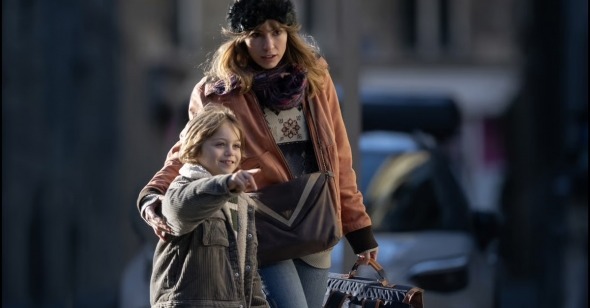
But everyone here (the privileged, guilty mother; the accommodating nanny from somewhere the mother’s country exploits) is role-playing. In Radu Jude’s The Diary of a Chambermaid, set in Bordeaux, France, and Moldovia, Romania, Gianina (Ana Dumitrascu), the nanny and housekeeper of a self-satisfied French academic couple, is actually intense, frank, self-aware, as we see in the scenes where she talks to her Romanian family; she’s also capable of contempt, as we learn in the opening scene when she curses under her breath. But in scenes with her employers, she’s deferential, grateful, and nervous, playing up her intimidation as a form of flattery and also defense: “I don’t know,” she repeats, when they try to enlist her as a character in the social theater of their dinner party. As meek as her performance is, it’s also a deflection, a refusal to participate, or at least a refusal to rehearse the script they’ve given her.
Radu Jude’s films, terse and angry as they are, are buoyed by crackling performances by women. These women are often themselves performers: Angela, in Do Not Expect Too Much from the End of the World, has a web video alter-ego as a manosphere blowhard; she also performs for the Austrian executive who comes to Bucharest to oversee the video project she’s working on, showing herself to be polite and accommodating when she’s actually furious and disgusted. Gianina in Diary of a Chambermaid is an actor in an avant-garde university production (they always cast “amateurs and migrants,” the professor tells her friends) of Octave Mirbeau’s novel Diary of a Chambermaid (famously adapted for the film by Luis Buñuel in 1964). Jude intercuts play rehearsals with scenes of her life as a nanny and maid and video footage that her daughter sends her from Romania. This theater performance in period costume surreally exaggerates the exploitation of her actual life while also bringing out its camp––and kink––dynamics. But we learn that this is Gianina, not Dumitrascu, acting in a scene where the director (Illinca Manolache, who played Angela in Do Not Expect]) tells her she was chosen to make it more authentic, “commedia dell’arte, grand guignol, amateur…Ubu Roi style.” Rather than a commentary on the character, this is a performance by the character, and through it, Jude invites us to see the other ways Gianina performs. The earnest hypocrisies of the university theater company are recognizable, if unsubtle. (In my experience, bourgeois university students know a lot more about sanctimony toward the “underprivileged”; faced with Gianina, they’d probably be more terrified than brash.)
In Jude’s films, people perform, but his films also sharply demarcate coerced performances (like Gianina for her employers, and the disabled worker in Do Not Expect, who is paid to perform in a safety video that may or may not ruin his chances at compensation) and aesthetic performances, like Angela’s for her videos, and Gianina’s in the play. But people also film things other than performances: the chicken videos captured by her daughter’s cell phone camera; the snuff video from a Russian soldier’s helmet camera that the French family friend shows his friends at the dinner party in the middle of a political argument (the French intelligentsia’s social sport of discuter) about the war in Ukraine. And Jude punctuates the busy intensity of social relationships with moments of devastating documentary stillness––in Do Not Expect, this was the sequence of makeshift memorials beside a Bucharest highway; in Diary, it’s a sequence of almost-still images of post-industrial rural decay that underscores Gianina’s storytelling of a Romanian fairytale to her child charge.
The film’s emotion accrues each time we go back to the video calls with Gianina’s daughter. Pressured into staying with her employer’s ailing mother during the Christmas holiday, Gianina can’t go home as she promised her daughter she would, and we finally learn the real effect of that absence. Jude’s film closes with painful and unresolved images of both mother and daughter’s loneliness, and the promise of a continued cycle of aspiration and disappointment. Dumitrascu’s performance as Gianina, like Gianina’s internal performances as “the chambermaid,” finally seems both knowing and alarmingly guileless. After all her subordination and despair, we are finally confronted with a character who is happy, at least superficially, to gather up the crumbs from the first world’s table.