Closing Karmic Cycles
By Đăng Tùng Bạch
New York Film Festival 2026:
9 Temples to Heaven
Dir. Sompot Chidgasornpongse, Thailand, no distributor
The mystery of karma casts a veil over 9 Temples to Heaven, the fiction feature debut of Thai filmmaker Sompot Chidgasornpongse. When sixty-something businessman Sakol (Surachai Ningsanond) hears an ominous prophecy that his elderly mother will suddenly pass away, he springs into action. Assembling nine members of his family to visit and make merit at nine temples across Thailand in a single day, Sakol hopes for his mother’s health to improve in karmic exchange for his dedication. However, as the extended family’s pilgrimage goes on, tensions slowly simmer as Sakol’s eldest son Tor (Sompop Songkampol) cannot hide his resentment for the family’s superstitious patriarch.
Before making his own films, Chidgasornpongse had worked as an assistant director on various projects by Apichatpong Weerasethakul, who is also a producer on 9 Temples to Heaven. Unlike Weerasethakul’s transcendent, spellbinding works, where reality and dream dissolve into one another, Chidgasornpongse’s film is largely grounded and plainspoken. 9 Temples to Heaven spins off from the road-trip genre, delivering a meditative family drama in the process. The central characters’ journey becomes a microcosm of modern Thai society—fraught with conflicts between generations, as well as between secularism and organized religion. The film demonstrates how Buddhism holds significant influence over both the daily lives of Thai people and the country’s politics.
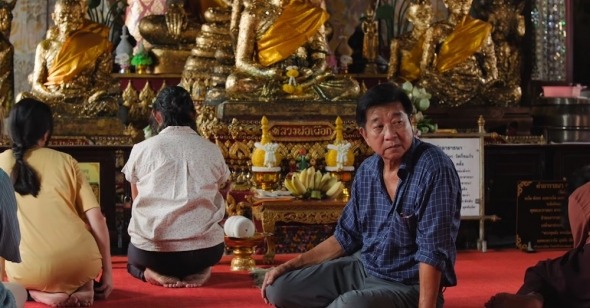
Drawing on the sensibilities of his 2017 documentary Railway Sleepers, Chidgasornpongse embraces a naturalistic and subdued visual language for 9 Temples to Heaven. In contrast to the film’s formal modesty, the Buddhist temples it captures are as lavish as they are monumental, all adorned with richly decorated upturned roofs, gilded ornamentation, and colorful ceramic tiles. The film doubles as a captivating architectural travelogue, showcasing the grandeur of Thailand’s Buddhist structures and, by extension, their enduring authority over the country. Here, Chidgasornpongse, a former architect himself, guides the camera to glide across the prayer halls and traces the intricate murals that embellish the sacred space. Bizarrely, one of the murals depicts a Buddhist deity scrolling through a smartphone. Chidgasornpongse barely lingers on the image, perhaps emphasizing how this seemingly absurd iconography is an ordinary part of modern Thai society.
The documentary-style depiction of the temples is mirrored in the monks’ matter-of-fact dialogues, which often can seem just as strange as a Buddhist deity on a smartphone. A monk recounts the story of a Burmese bodhisattva who died by self-immolation but transcended the pain through meditation, underscoring its supposed cleansing power. The family, however, whisper among themselves that the bodhisattva was actually Vietnamese. Through this inaccuracy, Chidgasornpongse undermines Thai Buddhism’s claim to infallibility and cautions against placing absolute faith in its teachings. The monk, oblivious to his mistake, then advertises the temple’s youth camp, which offers a meditation competition. As the family makes merit at different temples, Chidgasornpongse introduces monks of varying ages and backgrounds, juxtaposing those who offer genuine wisdom with those driven by commercial gains. At one point, the film enters a temple repository, where the excess of devotees’ offerings sitting on tables contradicts the Buddhist teaching of modesty.
Deliberately paced,9 Temples to Heaven patiently peels back the layers of its many characters, revealing their inner lives either through absorbing conversations or quiet but haunting gestures. The cast of mostly first-time actors bring[s] natural charm and chemistry to their performances, convincingly portraying a squabbling but endearing extended family. Ningsanond, an award-winning Elvis Presley impersonator in Thailand, plays Sakol with calm authority, characterizing the patriarch as dedicated but close-minded. Opposite him, Songkampol, also a musician, channels his onstage charisma to play Tor as an arrogant and snarky young man. Despite the laborious efforts to fulfill his filial duty, Sakol rarely checks in on his mother throughout the trip. Tor, by contrast, remains tenderly attentive to his grandmother regardless of his ambivalence about the pilgrimage. When the journey takes its toll on her, Tor and his brother, Koon (Poon Sirapob), recite the Buddhist sutra she once read to them as children. However staunch his rejection of religion, Buddhism remains woven into Tor’s life.
Neither Tor nor his father can escape the karmic cycle. Beginning the pilgrimage to prevent his mother’s prophesied death, Sakol himself suddenly falls ill. Wandering through a temple, Sakol stumbles upon a murky pigpen, a startling sight that evokes Buddhist concepts of reincarnation and karmic rebirth. Releasing animals from slaughterhouses is an act of merit in Buddhism, but are they truly free when remaining confined in dark spaces on temple grounds? 9 Temples to Heaven poses delicate questions, inviting viewers to meditate not for spiritual cleansing, but on Buddhism’s influence over Thailand and the legitimacy of the religion’s moral authority.