Face Facts
By Lawrence Garcia
New York Film Festival 2026:
My Wife Cries
Dir. Angela Schanelec, Germany/France, no distributor
In the opening scene of My Wife Cries, a construction worker, Thomas (Vladimir Vulevic), sits in an office waiting for his crane to be repaired. One of the two women working there offers him coffee. After leaving the room to wash a cup, he remarks that they should get a sink installed. He is then told that his wife called, information that doesn’t seem to bother him any more than the thought of the crane. Unable to reach her, he sits and drinks and waits, conversing with the two women about not much in particular. Eventually, one of them remarks that he looks worried, and asks if he is thinking about his wife. “Then I must always look worried,” Thomas replies. “I’m completely as normal.”
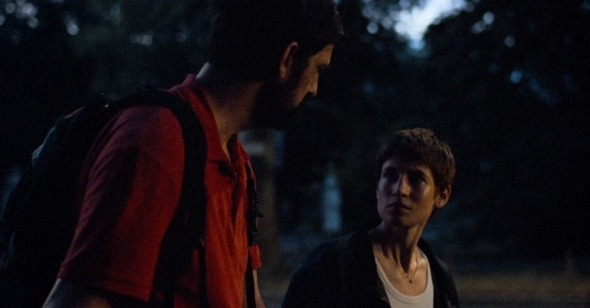
With just this scene, Schanelec establishes that My Wife Cries, her eleventh feature film, will focus on formal concerns familiar to us since the earliest theorizations of the Kuleshov effect: the principles of montage which relate one image to another, and the presumed link between offscreen space and the legibility of pose, gesture, and facial expression. It is no coincidence that much of this opening sequence plays out in a shot that isolates Thomas from his interlocutors, the frontal composition and sparse decor recalling the central image of Schanelec’s earlier I Stayed in Berlin All Summer (1994). And apart from a brief moment where Thomas shares the frame with the two women, the scene plays out entirely in singles, always activating our awareness of persons and events that we are unable to directly see. Eventually, Thomas leaves the construction site to find his wife, Carla (Agathe Bonitzer), on a park bench by a hospital. She has been in an accident, she says. Distraught and unable to explain further, she breaks down crying and then curls up in his arms to rest. For as long as the shot lasts, we are placed in Thomas’s position, asked to inhabit the perspective articulated by the film’s title. We can clearly see that his wife is crying. But what might she be feeling? How much can we read in another’s tears?
Throughout My Wife Cries, Schanelec activates these questions by continually pulling apart word and image, language and gesture. In a strategy which recurs across the film, rigorously composed tableaux, where the characters are suspended in silent contemplation, alternate with sequences of extreme verbosity, where they give voice to the full spectrum of their emotions. Thus, after a wordless passage during which Thomas and Carla make their way home, we are treated to two back-to-back, lengthy walk-and-talks during which Carla relates the confused emotions she felt after Thomas refused to continue the beginner dance class they had taken the year before. Having been forced to attend the advanced class alone, she describes the discomfort of the first session, when she had to partner with the instructor, and then the pleasure of pairing up with a university student for every class thereafter. She had thought about the student, David, every day since the class ended. And when he contacted her the day before to see if she would consider accompanying him to look at a place in the countryside, she accepted—only for the drive to end in a fatal accident. David had died, and Carla’s plan to leave Thomas and start a life with him was cut short. Before Carla’s story has even concluded, Thomas abruptly collapses by the side of the road, clutching his temples. “My head is exploding,” he remarks. Carla wonders if he is perhaps suffering from hypoglycaemia. But whatever the cause, it registers the shock that Thomas is experiencing—not just at the knowledge that his wife was on the verge of leaving but also at his failure to read all that she had been feeling.
In her previous films, Schanelec has tended to employ montage to scramble basic narrative coherence, often refusing the usual certainties of time, place, and character. In Marseille (2004) and The Dreamed Path (2016), every cut threatens to dissolve the intelligibility of any sort of storyline, as if the films were unmaking and remaking themselves as they went along. My Wife Cries does not engage in narrative gamesmanship of this sort. The film instead observes a small network of interpersonal relationships and emotional fractures without raising the possibility of further, Resnais-like ruptures of space and time. The apparent simplicity of its construction should not, however, lead us to think that the film is without mystery. It is significant that the film’s most intense and conventionally dramatic events are visually elided, placed in the margins, communicated only by verbal report or logorrheic reminiscence. Robert Bresson, in his films, often depicts transformative events while, via rigorous direction of his “models,” simultaneously suppressing conventional facial and gestural signifiers of psychological or spiritual revelation. Schanelec pushes this Bressonian approach even further. Refusing to even visualize these critical moments, she questions the pervasive assumption that to show more is necessarily to allow for a more certain window into a character’s experience. In My Wife Cries, we do not experience, or even see, what the characters experience, but are made constantly aware of the limitations of our own perspective.
Schanelec’s cinema has long engaged with various theatrical traditions: consider the reworking of Chekhov in Afternoon (2007), the children’s rendition of Hamlet in I Was at Home, But… (2019), and the inspiration of the Oedipus myth in Music (2023). And in general, My Wife Cries recalls the theatrical convention of placing the action in the interstices of scenes, allowing the drama to unfold via rumor, report, and retelling. If there is a specific tradition to which the film might be compared, however, it is what Diderot in the late 18th century simply called the drame—also known as the “serious comedy,” the “domestic tragedy,” or the “serious genre.” Positioned against the traditional genres of comedy and tragedy, which were associated with the sufferings of royals and the lower classes, respectively, the drame sought to portray the lives of contemporary individuals in a serious and broadly naturalistic manner. Rather than a new, self-contained genre, it was to be an altogether new approach to dramatic framework, where it could no longer be assumed which subjects or actions even count as tragic or comic.
My Wife Cries inherits this theatrical discovery insofar as it, too, approaches the task of staging—the composition of tableaux—without prescribing the significance of any action or pose in advance. Early on, Carla, having finished at the kindergarten for the day, chats with Laszlo, a father waiting for his son nearby. When he leaves, a co-worker of Carla’s informs her that Laszlo is a well-known writer, who was in the running for a Nobel Prize. As she takes in this information, the film cuts to a shot of Laszlo walking away through the greenery, as if to ask us if we could ever see this fact in his gait or manner. My Wife Cries is replete with such moments—instants when the film becomes a veritable experiment in the readability of gesture.
The final images of My Wife Cries depart from the urban and domestic spaces in which the film largely unfolds. By this point, the only narrative development of which we are certain is that a new sink has been installed in the construction office. A woman slumbers on a large boulder and wakes up to comb her hair; a writer works beneath a makeshift hut, his infant son playing nearby; a group of friends frolic by the seaside. Carla, for her part, sits on a restaurant patio alone—perhaps having left Thomas, perhaps still planning to return to him. As she eagerly eats her meal, she watches another restaurant patron, a man with a scar lining his face, attack his plate with similar gusto. The film ends on her silent gaze. But unlike the immortalized face of Ivan Mozzhukhin, now familiar from various studies of Soviet montage theory since Kuleshov, we are not—or ought not to be—so certain that we can read in her visage hunger, grief, desire, or any other complex of emotions. The necessity of reading the face of another becomes a formidable task once more.