Body and Soul:
An Interview with Jacqueline Lentzou
By Jordan Cronk
New York Film Festival 2026:
A Day in the Life of Jo: Chapter Phaedra, Greece, no distributor
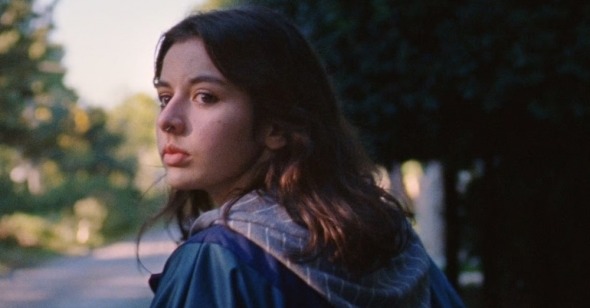
A film as idiosyncratic as its title, Jacqueline Lentzou’s A Day in the Life of Jo: Chapter Phaedra is a bold leap for the 37-year-old Greek director. A coming-of-age tale inspired by a real-life incident in 2008 Athens in which a teenager was murdered by a police officer, the film uses this tragic event less as a tool to make a political statement than as a device to explore more existential questions related to dreams, fate, and the porous boundary between the body and soul. Shooting in 16mm with Belgian cinematographer Grimm Vandekerckhove—best known for his spellbinding work with director Bas Devos—Lentzou conjures an appropriately oneiric atmosphere for this shapeshifting story of a rebellious young girl named Jo (Evita Andriopoulou) whose sudden feelings for her female classmate Phaedra (Anastasia Gouliamou) suggest a personal epiphany that never arrives—at least not in any traditional form.
A Day in the Life of Jo is a difficult movie to describe, both because of the way it unfolds and its manner of storytelling, which, three quarters of the way through, takes one of the boldest left turns in recent cinema. Suffice to say this isn’t your typical portrait of adolescence, despite how deftly the film depicts the extreme rush of emotions familiar to being young. Nor does it bear any of the fussy hallmarks of post-Lanthimos Greek art cinema. If anything, it veers a bit too close to twee at times, but Lentzou is skilled enough, even at this early stage (this is just her second feature following 2020’s Moon, 66 Questions), to steady the tone and take command of the film’s emotional register when it matters most. (It helps, too, that she has a keen ear for music: experimental saxophonist Colin Stetson did the score and there are several pitch-perfect needle drops.) With a striking combination of confidence and wide-eyed wonder, she’s able to tap into a kind of radical vulnerability that makes the film’s metaphysical aspects feel like an honest reflection of a filmmaker maturing in real time. It’s exciting to think where her imagination might lead her next.
I sat down with Lentzou following A Day in the Life of Jo’s premiere at the Venice Film Festival, where it won the Best Director prize in the Orizzonti section, to discuss astrology, inner landscapes, and the relationship between images and emotions.
Reverse Shot: My initial reaction to the film, not knowing at first that it’s inspired by a real event, was concern for the person who made it—I assumed something traumatic must have happened in your life. What prompted you to want to look back on this incident now, and how much of the story is tied up in your memory of when it occurred?
Jacqueline Lentzou: The shooting occurred when I was 17 and graduating high school. I was really shocked by it. I live in the neighborhood where it happened. Even now, on every 6th of December, which is when it happened, there’s riots and fires. So it's impossible to forget. It's not that I only just remembered it. No one in Greece has ever forgotten. It's a huge collective trauma to our society.
What really sparked the idea for the film was a realization I had during the pandemic, when we were in lockdown and Athens was overrun by police, that no one ever investigated the true life of this young boy. It just became a piece for news and newspapers—for people on TV to talk about and discuss justice. But no one really cared about the actual boy that got murdered. So I said, okay, I'm going to make a film which focuses on the life of a teenager that is about to be murdered in the same way. The only thing that I kept completely true to the real incident is the random way that the girl is murdered. Everything else is absolutely fictional, out of respect for the actual boy and to the family. I would never try to make a film based on an actual event like this. I would never do that to the mom.
RS: I’m curious how you came to your filmmaking style, specifically your approach to framing. In your films, bodies and objects are often shot in close-up, while your compositions often move between abstraction and legibility.
JL: Someone recently asked me a similar question, and I had to think about it. I think it all comes from my childhood shooting with an Hi8 camera. Back then I didn't know how to shoot. I was just experimenting. But I was in love with my camera. I had asked for it when I was eight. At first, I was just filming my grandmother and my dogs, and I would move around them and shoot from very close. It’s interesting: I’ve watched some of this material as an adult and I sense a strange affinity between the images and my emotions, which is the same way I feel when I make a film. So it's not a conscious decision. I also have a huge dislike for stagey things. Because I see the artificiality. I can hear the director speaking. I can’t access work like this. It's very hard for me. So I think a fluid, intuitive approach is truer to the way I see things in my head before I go on set.
RS: Do you write or map out these things before shooting, or do you just keep them in mind as you work out individual scenes?
JL: I’m a filmmaker from Greece, so I work with a small budget. I write everything, and I have all the good intentions to shoot what I wrote. However, because of time or scheduling or issues with a location, it’s not always possible to do what I wrote. So what do I do? Do I cry? No, I adjust. I adapt. Because of this, the core idea cannot be the style. It's never the style. The style is on top; instead, let’s go to the heart of what we want to shoot. Why do we want to frame the actors like this? Let’s say, when I wrote a specific scene, I was thinking that the mom should be high up in the frame and the daughter should be down low. So now I have to go back and investigate why. And when I have the answer, then I can go to the location and adapt the idea. That said, I do hope—I cross my fingers—that for my third feature I’ll have to do less adapting and be able to shoot more things that I wrote.
RS: But I wonder if that adaptability is one of the things that lends the film its energy and unpredictability.
JL: It’s possible.
RS: There’s a spontaneity to the film that feels true to life. I’m thinking specifically of the scene of the mom breaking down while dancing, which is impressionistic in style and expressionistic in performance.
JL: It’s interesting you say the word impressionistic to describe the style because I absolutely love impressionist painting. When I was young and I started visiting galleries abroad, I remember being in front of a Monet and just crying. Looking back, I think that the Hi8-filtered memories of my childhood are very close to the smudgy look of certain impressionist paintings. It’s totally my inner landscape.
RS: How autobiographical are the fictional elements in the film?
JL: Well, like Jo, I was a 15-year-old only child in a broken home. My parents split and lived in different cities, which made going back and forth even harder. But I grew up with my mom, who is an amazing person. Not an amazing mom. But a very good woman. She’s really kind and she did her best. So all of this really derives from my own experience. But otherwise there’s not much else autobiographical in the film. I’m really done with this way of working. I think with Moon, 66 Questions, I gave all the autobiography I could, and now I'm done. But, of course, I knew that there are many girls feeling exactly the same way as Jo, and have these particular relationships with their moms—when you’re that age, you have these weird, complicated things that burden you. Like, why do I feel bad? Oh, because of my mom. I think this applies to many young people.
RS: I’m wondering if you can tell me a little bit about the music—both the score by Colin Stetson and the folk and indie-rock songs that you use throughout the film?
JL: I met Colin when we were on a jury together in Ghent. We really clicked; we like and dislike the same things. It's kind of ridiculous. So we became good friends, and I went to see one of his concerts in Athens. But I was afraid to tell him about my idea for the film because I had asked him before how much he got paid for Ari Aster’s film [Hereditary, 2018], and I knew I could never, ever pay him anywhere close to that. So I was hesitant to ask him, but one day I told him that I was making a very low-budget film, and that it would be a huge honor if he would consider writing something for the movie, even if not a full score. And he said, “Yes, of course.” It was amazing. I think his music works perfectly in the film. I could never think of any other music in those scenes now. The way he works with the saxophone and the other instruments, it’s all about the relationship he has with his breathing. And that’s totally key in the film. It starts with a last breath. So it’s all intertwined on a very subliminal level.
As for the songs, I guess I just adore music. Music is everything to me. I wish I played an instrument, but I don't. And I sing very badly. So I was glad that we could have all the songs because of how expensive they can be. I'm happy that my producer understood how important it was for me to have these particular songs. None of them changed. They were written in the script. And it’s funny: when I told the dancers that I wanted this Life Without Buildings song for the tap-dancing scene, they said, “This song would never be used for tap dance choreography.” And I’m like, “Let's try it anyway. How hard can it be?” I love that scene. Initially it was much longer, but my editor encouraged me to keep it shorter, because I could watch them dance to that song for the full four minutes.
RS: Did you send Colin the scenes he would be writing the music for?
JL: Yes, I sent him the whole passage. And then I sent him a first draft edit of the ending, with the weird shots of the city. There's also some of his music in that scene—very subtle.
RS: How did you go about conceptualizing the last section of the film, with the subtitles and amorphous visuals? That’s when the film really opens up for me.
JL: Have you seen this short film I made called The End of Suffering (A Proposal) (2020)? It’s about a girl who has a panic attack and starts to get contact from Mars. In those scenes we used subtitled dialogue like we do in this film. So the idea was somehow innately in my head. It kind of reminds me of myself, like when I’m thinking of something, but I have other things on my mind. It’s sort of like subtitles in my head.
The visuals came through firsthand observation. I had a very traumatic incident in my personal life in 2022, which pushed me into meditation. So, I was meditating a lot and looking inside myself, and one day after meditating I opened my eyes and there was a light from a glass reflected on the wall. And I thought, there’s something there. It can become something. Like, it’s real. I feel like it can talk. And that’s how the night beings in the film book shape. It’s just water and sunlight shot with a mirror. It’s not VFX. It’s all handmade. I hate visual effects. I hate AI. When I see fakeness in cinema, I want to puke. Unless it's overdone on purpose. But when it tries to imitate the real—it’s just like, no. We have eyes. We see what you are doing.
RS: I guess it’s safe to say you’re into astrology?
JL: Yes, I’ve been into stars since I was five. I don’t know why. No one else in my family is. They make fun of me. I learned in therapy that I was hurt by being an only child. And when I first read the astral card, I felt seen. I shaped my whole life around it. I was like, my mom cannot understand me, my father doesn’t care, I’m alone and have no one, but the stars are there. It became a refuge for me as a child and helped me expand my imagination. However, when I grew up, I started taking it more seriously. And you know what? Some things really make sense. This is not to suggest that people should start digging into astrology. But don’t totally disregard it or judge it, either. Because we are really part of a huge ecosystem. We think we know everything, but we really know nothing. And I think it's very honest and humbling to at least be open to the mysteries of universe. That's all—not to close the door and say it's not logical or it doesn't make sense. I mean, really, what does make sense?
RS: It’s interesting that you came of age as a cinephile when the New Greek Cinema was flourishing, and yet your films bear almost no relation to those films. Did you have any affection for those movies?
JL: Not really. I find them pretty pretentious. I decided I was going to make films when I was 14. It was a Sunday and I went to the video store. My mom was at her boyfriend’s. I was alone and I took Elephant by Gus Van Sant from the rack because I really liked the cover. I would never read the descriptions on the back of the cases. But I took it and I really don't know what happened. I just felt like, this is your job.
But even before that, I was always watching cinema. I was watching things that were not for my age, because I only had the television for company. So I watched super violent stuff, and I was exposed to things I probably shouldn't have been. But I wasn’t exposed to art house cinema until Elephant. My influences are really American independent cinema, to be honest.
RS: But clearly also other things. We’ve already talked about music, painting…
JL: I love photography too. I love Man Ray. I love Duchamp. For me, Duchamp is the best artist that has ever lived. I could cry thinking about him. If you’ve seen his interviews or heard him talk—just how he approached life. It's like he knew something we don’t. Do you know the story about MoMA and his painting To Be Looked at (from the Other Side of the Glass) with One Eye, Close to, for Almost an Hour? I think it was in Buenos Aires and it had to travel to America, and it arrived broken. And the people at MoMA told him how sorry they were that it was damaged. And he was like, “That's amazing. It’s what the painting wanted to have happen to it.” And I’m just like, what a fucking genius. Instead of complaining or getting angry, he embraced it.
I think the reason I like all these people—John Cage and Arthur Russell are two others—is because they were in communion with something invisible that I don't understand. But in their art I can sense it. Cinema can be very pompous—very controlling, very I will show you. I don't like that. True art for me—what touches me and what moves me, what resonates with me, is something that's much softer, without being weak. We have to stop associating words that don't have any association with each other, just because we were taught to. We’re taught that you have to be tough and strong, and if you're soft, it's a weakness. No, it's not. If you're sensitive, it's a weakness. No, it's not. It's the contrary. If you're super sensitive, you see more. You're more open to music, to art, to nature, to everything. Without being overly romantic, we know that the world sucks, but we have to survive while we are here. And life has insanely beautiful parts. It's a complex thing.