Moon for the Misbegotten
By Jawni Han
New York Film Festival 2026:
Possible Love
Dir. Lee Chang-dong, South Korea, Netflix
In the early 2010s, Lee Chang-dong set out to make a narrative film in response to the violent police crackdown on striking workers who fell victim to cruel corporate restructuring. (Although the director has not named the incident in interviews, the most likely inspiration would be the SsangYong Motors Strike of 2009.) He ultimately walked away from the project, concluding that it was not his place to tell this story, but the idea continued to haunt him. Then in 2022, Lee released his first short, Heartbeat, about a boy named Cheol who suspects his depressed mother (Jeon Do-yeon) is about to commit suicide and cuts school to save her. The source of her despondency, the short gradually reveals, has to do with her laid-off husband (Sul Kyung-gu), engaged in a sit-in protest on a tower crane. Lee initially believed the short was the best he could do with the material, but he changed his mind upon hearing his former student and now co-screenwriter Oh Jung-mi’s suggestion to juxtapose the couple’s story with that of a documentary filmmaker recording their plights. Together, they revisited the draft that Lee penned more than a decade ago and incorporated the documentarian’s strand to make the director’s ethical concerns part of the story.
The resulting effort, Possible Love (2026), is his most narratively ambitious film in scope since Peppermint Candy (1999) and a testament to Lee’s prolonged ethical deliberation both as an artist and the son of a utopian socialist father. Structurally, it is similar to A Single Spark (1995), which Lee wrote the screenplay for prior to his directorial debut in 1997, in juxtaposing labor struggle with creative pursuits. A Single Spark’s writer, working on a biography of Jeon Tae-il, the martyr of the Korean workers’ movement who self-immolated in protest of despicable working conditions at garment factories in 1970, is now replaced by documentarian Ye-ji (Cho Yeo-jeong) pointing her camera at Ho-seok (Sul), a dispirited laid-off welder scarred by the experience of a failed strike, and his more upbeat factory worker wife Mi-ok (Jeon). The three initially meet at a funeral for Ho-seok’s former colleague lost to suicide, where he objects to being captured by Ye-ji’s camera. With the consent of the union at Ho-seok’s old workplace, we learn, she is working on a documentary about corporate restructuring and labor. Observing Ho-seok’s erratic behavior and how his mere presence makes other attendees uncomfortable, she intuits that there is a compelling story to be told here.
Ye-ji begins by approaching the more amenable Mi-ok, who quickly opens up to the filmmaker about her and Ho-seok’s lives. Until the film’s climax, it is primarily through Mi-ok’s words and the brief news footage of police brutality unleashed on protesting workers that we piece together their respective class backgrounds, how they first met as teenagers in a rural town, and what transpired during and after the strike. For the first interview at a cafe, Mi-ok recounts her childhood memory of observing her mother washing cars for a living and being mesmerized by the light reflected off the water coming out of a hose. Ye-ji interrupts and asks her to repeat the same story on camera; the second time around, we “see” Mi-ok’s recollection. Similarly, when she shares an episode from her late teen years about a decisive moment in her relationship with Ho-seok in the third act, we only begin to see this memory once Ye-ji’s camera starts rolling. What may initially seem like flashbacks are actually the filmmaker’s imaginative reconstructions disguised as the subject's memories. This simple yet brilliant sequencing order foregrounds a pressing question that Ye-ji, married into wealth, has to reckon with: does she really understand these people or is she feigning it to ventriloquize her own desire through their stories?
Over the course of Possible Love, we see intriguing connections develop among Mi-ok, Ho-seok, Ye-ji, and her generationally affluent husband Sang-woo (Zo In-sung). The latter, the most impenetrable of the quartet, conducts his business in English and is characterized as a generous patron of the arts by one of the production assistants. Mi-ok seems in equal measure alienated from and fascinated by the other couple’s casual display of wealth. She admires Ye-ji’s luxurious outfits but also advises the documentarian to dress more humbly while on set; when Sang-woo, while driving his Porsche, explains that independent filmmaking derives its name from its freedom from the influence of capital, all she can do is nod along in silence. Undercurrents of sexual tension begin to emerge between Mi-ok and the heir, all while Ho-seok slowly lowers his guard and agrees to go to therapy.
In the film’s second half, Ye-ji invites the working-class couple and their taciturn son, Cheol (Jung Seop), to spend their summer vacation with her and Sang-woo at their seaside villa. Although she presents the invitation as a no-strings-attached offer, Ho-seok sees through her and agrees to sit down for an interview on camera. On the way to the summer house, Sang-woo tells Ye-ji that he admires how she is “method acting” her way into the lives of the have-nots; she recoils and insists that she is genuinely trying to love her subjects. But that social barrier between the two families is made all the more concrete when they arrive at the vacation home. The house’s opulence aside, what really underscores the chasm between them is an old whistle that once belonged to Sang-woo’s grandfather who, it is insinuated, worked as an imperial police officer during the Japanese occupation of the peninsula. The heir explains that he used to blow it to summon his “friend,” an old gardener’s son who is now looking after the estate. This echoes with the fact that Ho-seok named his son Cheol, which means steel in Korean, because he works with metal. It is a sobering reminder that both poverty and prosperity are inherited in our capitalist world, and the villa itself is an architectural embodiment of structural inequality.
The steady accumulation of such potent narrative details and metaphors enriches the thematic layers of Possible Love, and is typical of Lee’s filmography, which is often characterized as novelistic and literary. What do we mean when we call a film “novelistic?” Outside of literary adaptations that remain faithful to their source material, the term is often paired with other nouns, such as scope, depth, and density, to describe a disparate group of works, from A Brighter Summer Day and Happy Hour to Rosetta and Manchester by the Sea. Whether it’s applied to an intimate character study or a film with a sprawling narrative, our use of the word seems broadly in line with György Lukács’s observation that the novel is an attempt to overcome our modern world where the divine is no longer imminent to us and to strive toward the totality of individual life and history.
In the case of Lee, the adjectives “novelistic” and “literary” have been both blessing and curse. Of the elegant narrative construction and deep exploration of fundamental questions concerning human nature found in his films, Lee’s champions tend to chalk them up to his storied past as a novelist. His skeptics, on the other hand, derisively deploy those words to devalue the director as a formalist while still acknowledging his storytelling talent. Although some may protest characterizing his films this way at all, it is undeniable that Lee’s filmography demonstrates his persistent interest in literature. Secret Sunshine (2007) is adapted from a masterwork by Yi Cheong-jun, one of South Korea’s most celebrated novelists. Lee describes Burning (2018), a loose adaptation of Haruki Murakami’s “Barn Burning,” as “the tale of a young Faulkner lost in Murakami’s world.” Even his most genre-inflected work, Green Fish (1997), contains a sequence lifted directly from Han Chang-hoon’s short story “Today’s Fortune.” Furthermore, A Single Spark and Poetry (2010) concern the act of literary creation, and many of the subjects, themes, and motifs Lee often deals with in his fiction carry over to his moving image works: the lives of ordinary people swept up in tumultuous historical moments, the treatment of ideology and history as hereditary matters, and the frequent use of fire as a symbol of cleansing and liberation.
Lee was part of the literary generation that firmly believed in the transformative power of letters and tried to live by Jean-Paul Sartre’s assertion that “literature is, in essence, the subjectivity of a society in permanent revolution.” Despite the unrelenting state violence and surveillance in the name of anti-communism and “social cleansing” under Chun Doo-hwan’s military junta, campus activism persevered and laid the foundation for the June Democratic Struggle of 1987, which marked the beginning of democratization in South Korea. Lee and other writers associated with division literature (a Korean tradition that reckons with the division of the peninsula and the stifling effects of Cold War politics on its people) and committed literature amplified the brave voices of those engaged in non-institutionalized politics. But once the military regime responsible for the Gwangju massacre of 1980, which drove the director to become a writer in the first place, was toppled and the student movement came to a screeching halt in 1991 with serial self-immolations in protest of the conservative government that succeeded Chun’s reign, Korean literature changed course. Choe Yeongmi’s 1994 poem, “At Thirty, the Party is Over,” about living in the ruins of unactualized political dreams, is a compelling snapshot of defeatism hovering over the literary scene at the time.
The decline of the Sartrean conception of literature in Korea was especially shocking to Japanese philosopher and literary critic Kojin Karatani. Citing Korea’s more robust student activism and labor organizing, Karatani held out hope that literature of this kind would continue to thrive in the country, unlike its Japanese counterpart, which, he argues, started to wane with the meteoric ascendancy of Haruki Murakami in the late ’80s and ended with the death of Kenji Nakagami in 1992. For him, Murakami commenced an age of novels as “commodities,” eclipsing literary luminaries like Nakagami and Kenzaburo Ōe, who instrumentalized literature as a force for political projects that existed outside the sphere of electoral politics. But Karatani was still right in that labor movements in Korea persisted throughout the ’90s and into the early aughts, and Lee left behind lettered life and picked up the camera right as the New Korean Cinema bloomed and independent film collectives such as Labor News Production and Jangsangotmae emerged as alternative platforms for workers’ struggles. Filmmaking, for him, was the continuation of literature by other means.
If we can indeed call Possible Love “novelistic,” it is foremost because Lee strives to tap into the Satrean spirit of literature by returning to the issues of labor. Unlike A Single Spark, however, Lee’s latest is less interested in telling a convincingly fictionalized account of the SsangYong Motors Strike and its aftermath than in constructing a network of competing symbolic representations uncovering certain historical and social conditions that haunt it. The summer house built by Sang-woo’s grandfather exposes the inseparable tie between the accumulation of wealth and Korea’s colonial history; the laid-off workers still fear being branded as “commies” by the society that has yet to recover from the logic of the Cold War; Mi-ok’s experience as a seamstress at a garment factory is a marginal improvement on the conditions that Jeon Tae-il protested in 1970. Through its sweeping scope, Possible Love trades the granular analysis of the particulars for a lucid picture of history as a repetitive structure that governs life under capitalism.
But in the film’s final 30 minutes, Sang-woo’s summer home and its adjacent private beach enter as a place where personal histories and desires briefly take precedence over economic and historical conditionings. Ho-seok, finally agreeing to be on camera, shares his trauma and the immense sense of betrayal he feels toward his ex-colleagues who left him in the brutal hands of the riot police; Ye-ji, in turn, gets the footage she has long wanted but is now tormented with the burden of ethical responsibility that comes with bearing witness to the suffering of others. On the beach, the sexual tension that has gradually risen between Mi-ok and Sang-woo culminates in a moment of skinny-dipping in the waters of his own private beach. She temporarily experiences the kind of freedom afforded only to those who own a piece of nature as personal property, while the erotic tension is ultimately thwarted and sublimated in a mock bullfight that ensues between the two. In this fleeting moment of Bakhtinian carnival, the hierarchy turns unstable, and some semblance of social equilibrium takes hold. But alas, reality returns with vengeance, and neither the documentary project nor the interpersonal relationships survive the violent crash of uninhibited desires.
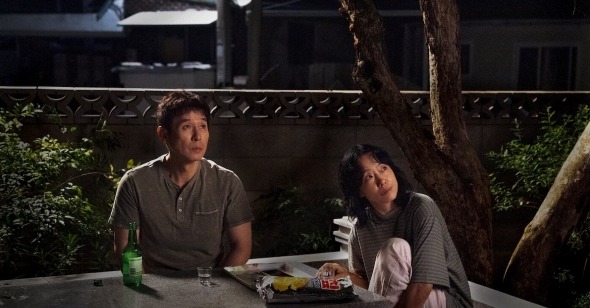
Possible Love concludes with the less privileged couple back home, marveling at the full moon. Earlier in the film, Mi-ok and Ye-ji exchanged memorable episodes from their lives revolving around the celestial body, seemingly experienced around the same time in different parts of the world. While on a romantic date in Wolmido in their youth, Ho-seok told Mi-ok that what his heart contains was just like the moon that they were looking at. Ye-ji, studying in Chicago at the time, worked overtime one night and had to walk back to her dorm with the guidance of the moonlight. They were surely gazing at the same object, but it’s debatable if they really saw the moon the other was beholding. According to one Japanese literary myth, Natsume Sōseki chastised one of his students for translating the English phrase “I love you” into the mother tongue as “aishiteru,” for no Japanese person of that era would say such a thing. Instead, he proposed that “tsuki ga kirei desu ne” (“the moon is beautiful, isn’t it?”) would be a more worthy translation. The moon’s symbolic association with literary translation is significant when considering that in the film, Mi-ok and Ho-seok speak in naturalistic vernaculars whereas their wealthy counterparts’ spoken words almost always sound stilted. Can the language of love be translated from one class to the other? Lee is unsure, but he does not shun that possibility—on Mi-ok’s phone screen, we see a picture of the moon in a message box waiting to be sent.