Get Back
By Justin Stewart
The End of Oak Street
Dir. David Robert Mitchell, U.S., Warner Bros.
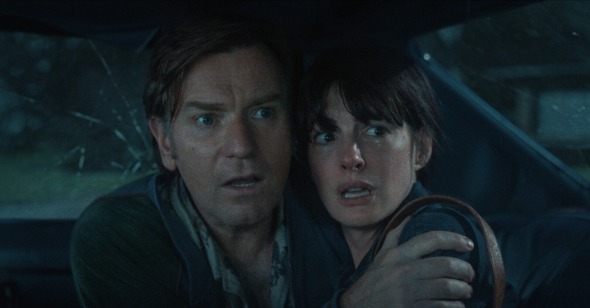
When the logo from J.J. Abrams’s production company “Bad Robot” comes up, followed by opening images of sun-dappled suburban Americana set to Michael Giacchino’s syrupy John Williams-like score, you would not be blamed for nervously anticipating some generic, ersatz-Spielberg on par with Abrams’s vacuous Super 8 (2011). The concern might grow as the craning camera settles into a cul-de-sac’s block party, with its just-so idyllic family contests like a sack race and water balloon toss. But, while there is a loving nostalgia in the setting (a “Turning Japanese” music cue and costumes place it around 1980, while a Tigers sports page clipping and license plates put it in the kind of Detroit suburb where writer-director David Robert Mitchell was raised), and though Spielberg set this particular paradigm, it soon becomes clear that the film isn’t interested in homage or imitation. At the block party, some bickering between married couple Denise (Anne Hathaway) and Greg Platt (Ewen McGregor) presages an anarchic nastiness and cynical streak, which will in turn be humanized by the sensitive performances and a sentimental final reel.
The Platts’ marital rift stems from Denise’s embarrassment that Greg has to deliver pizzas as a (she thinks) secondary job—out of shame, she makes him remove the glowing “Pete’s Pizza” car topper when parked in their driveway. She also does not love Greg’s pulls from his garage whisky bottle. Greg, meanwhile, resents Denise’s palpable unfulfillment, and her hobby of writing fiction in the basement that (autobiographically, Greg assumes) concerns an unhappy wife and mother. The couple’s acrimony trickles down to son Brian (Christian Convery) and Audrey (Maisy Stella), causing the boy to start fights with local kids and the Carl Sagan–reading girl to stargaze and dream of a happier life. Next-door neighbor Mel (The Wolf of Wall Street’s P.J. Byrne) is no sunnier, snapping at Denise that the family dog Starbuck has been digging and defecating in his yard. Radio snippets about “unusual ripples in space” hint at the supernatural events to come that will render all these domestic concerns quaint. The neighborhood is soon hit with strange, intermittent bright flashes of light accompanied by ear-popping whooshes that disrupt the weather, and leave behind anachronistic flora and rhino-sized dung piles.
A prehistoric time is somehow physically encroaching on the present-day environs (or vice versa?) of the Platt’s Oak Street. Concerns over random hot geysers and the new jungle foliage soon give way to the much more immediate danger of gigantic, roaming avian raptors, plant-eating brontosauri and ankylosaurs and, eventually, the inevitable Tyrannosaurus rex. While there are breadcrumbs sprinkled, the escalation to utter mayhem is still jarring, and permanent—except for a few brief pockets of repose, the rest of the film is a thrilling battle for survival. The violence can be shocking in its suddenness, like neighbors unceremoniously decapitated and a carful of family gruesomely dispatched (since it’s not the protagonist family, the empathy is fleeting). The nihilistic carnage is just as likely to elicit laughter as screams. Even established characters are shredded with brutal flippancy, including a major one whose stunning, gory demise prompted the loudest shrieks and cackles at my screening.
It's always a little embarrassing to score how “good” or effective a movie’s special effects are, better suited for old Ain’t It Cool–style message boards than these august digi-pages, but it’s obligatory to note that The End of Oak Street’s visuals are, to my eyes, terrific. As in the original Jurassic Park, there are some models and puppets used for the close shots, but the CGI elsewhere is unobtrusive. Overhead views of the area show how it has been sliced off and raised from the surrounding environs (settling that this phenomenon has not happened everywhere). There’s the Titanoboa, a giant, white, scaly sea snake whose cute face hides a machinery of fangs and a deadly appetite, and which, in one of the film’s tensest scenes, quietly slithers through the momentarily peaceful Platt house as the family moves about unaware. The unwelcome trend of CGI dogs (2025’s Superman too) unnecessarily continues here with little Starbuck, but some vegetarian brontosauri provide the most obvious dose of comic relief (if you’re not the type to chuckle at dismemberment)—when Denise and Greg stumble on two of them mating, Denise asks Greg to pose in front for a Polaroid.
The performers excel too, particularly Convery and Stella as the kids whose teenage angst and anxiety graduate into breathless fear. (When the family picks up a newly orphaned Catholic school-educated neighborhood girl, there is even some romantic rivalry between the siblings, though the orphan is drawn to Audrey—a side plot the film does not explore too closely.) McGregor has fun playing something of a loser, while Hathaway excels at conveying bewildered, nonverbal trauma, especially after one act of violence.
As for Mitchell, his career is following a timeworn path. Out of film school, he made his scrappy microbudget indie (The Myth of the American Sleepover), then a breakthrough success (It Follows, a chilling allegory about teens and STDs also set in the Detroit suburbs), and then, using his new clout, a big-swing “one for me” follow-up (Under the Silver Lake), which garnered enough cult admiration to earn him this big-budget summer multiplex filler (and presumably a fat paycheck). It was remarkable how much It Follows did with an excellent amateur cast and the horror of random people walking towards you at a normal pace. I’ll confess I found Under the Silver Lake’s attempt at a conspiratorial Long Goodbye riff and kaleidoscopic portrait of Los Angeles a trifle annoying, but Oak Street has convinced me it’s due a rewatch. Like Blue Velvet’s famous opening journey from picket-fence perfection into the bug war hell below, Oak Street is about America, the deceptiveness of surfaces (that idealized first look at cul-de-sac)and the paper-thin veneer of civility masking latent bedlam. Zeroing in on one family’s story, Mitchell asks, what if the secrecy slowly torpedoing the Platt marital unit (his covering up career woes, her clandestine literary efforts) manifested not just in spats, tedious divorce and custody battles, but in dinosaur-strewn pandemonium?
Of course, Spielberg himself also had a movie out this summer, and Mitchell’s more get-to-the-point, funhouse style provides a welcome complement (not corrective) to Disclosure Day, in which the (abundant, masterfully engineered) thrills are balanced and sometimes suffocated by reams of David Koepp exposition. The reasons for Oak Street’s supernaturalism are tossed off in the visual of an undulating portal blob, a line or two about wormholes and a (somewhat unsatisfying and plot-hole-creating) news segment. Which isn’t to say Mitchell has nothing on his mind; in the same spirit of his film being about the violence always dormant in America, it might also be about the deficiency of nostalgia, the cruelty and violence that rose-colored reminiscences miss, especially when you go way back.