Moving On
Jawni Han on Take Care of My Cat
The year 2001 was the beginning of an end for what we now call the “New Korean Cinema.” In the mid-90s, a new generation of filmmakers such as Hong Sang-soo, Lee Chang-dong, and Bong Joon-ho made their first films, which reshaped the national cinema. None of their early films were commercial successes, yet these directors were given second and third chances to eventually make their career-defining works. That period of generosity and patience started to dissipate in 2001, a punishing year for those just starting out. Sorum, Waikiki Brothers, Tears, and Nabi are every bit as critically acclaimed as The Day a Pig Fell into the Well, Barking Dogs Never Bite, and Peppermint Candy, but their dismal box-office dampened the filmmakers’ career prospects. The most lauded of the bunch was Jeong Jae-eun’s Take Care of My Cat, the only one that has enjoyed an international rediscovery so far. Thanks to the 25th-anniversary release in the United States via Kani Releasing, American moviegoers can finally experience the film, which critic Shiguehiko Hasumi placed on his list of “feature debuts that shook up the history of cinema” alongside They Live by Night, Fists in the Pocket, and Xiao Wu.
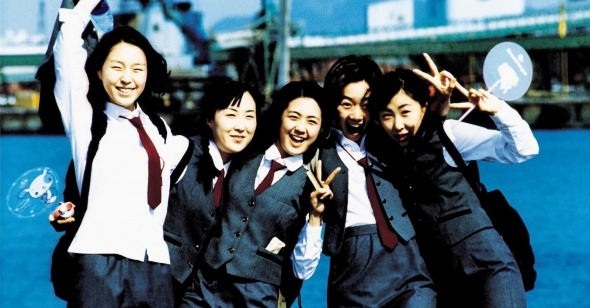
At the center of Take Care of My Cat are five recent high school graduates from Incheon, South Korea’s third most populous city after Seoul and Busan. Ji-young (Ok Ji-young), an orphan living with her grandparents in a dilapidated house on the verge of caving in, is adrift after losing her factory job and wishes to become a textile designer one day. Hae-joo (Lee Yo-won) is the most career-driven of the five, employed as a secretary at an investment firm in the capital. Overseas xChinese twins Bi-ryu (Lee Eun-shil) and Ohn-jo (Lee Eun-jo) sell handmade jewelry on the street of Incheon’s Chinatown. Tae-hee (Bae Doona in her first major role) comes from a comfortable middle-class home but clashes with her parents who display blatant favoritism toward her brother. She divides her time between working at her family’s sauna without pay, volunteering as a typist for a poet with cerebral palsy, and acting as the center of gravity for the friend group. After a deceptively sweet opening scene, wherein the five girls in school uniforms take a group photo on a dock, the film tracks the quintet’s gradual dissolution in a series of vignettes.
It’s hardly incidental that Jeong situates this story in Incheon rather than Seoul. Long imagined as both gateway and periphery—a port city built on migration, industry, and transit, forever negotiating its relationship to the capital—Incheon embodies the contradictory promises of post-IMF South Korea. It is a city defined by departures and arrivals, where container ships, ferries, commuter rail, airplanes, and buses continually carry people elsewhere. For the five women, adulthood is measured not simply by employment or romance, but by the changing routes they take through the city. Friendship itself becomes a question of geography.
As they navigate young adulthood against the backdrop of economic precarity induced by the 1997 Asian financial crisis and the subsequent neoliberal consolidation, they each pursue different priorities, and their friendships begin to fracture as a result. On the surface, it’s the rift between Hae-joo and Ji-young, best friends in high school, that knocks over the first domino: the former’s well-meaning but condescending life advice and lack of appreciation for Ji-young’s birthday gift—a cat referenced in the film’s title—activate the latter’s deep-seated class resentment and insecurities about her place in the world. But the film does not blame Hae-joo, and instead sheds light on external obstacles that get in the way of their friendship. Hae-joo, following her parents’ divorce, moves to Seoul in an attempt to rise above her vocational school background. Ji-young isolates herself from the group as her financial situation worsens, and ends up in a juvenile detention center shortly after her grandparents’ death. Tae-hee, after desperately trying to mediate between the two, realizes that the time has come for them to move on, and suggests to Ji-young, following her detention, that they leave their hometown and start a new chapter somewhere far away.
Disappointing box-office returns notwithstanding, Take Care of My Cat instantly created a cult following upon its release, especially among young Korean women. For them, the film has proved deeply resonant in its mature handling of interpersonal conflicts between female friends, the thoughtful integration of early cell phones into its plot and cinematography, and the characters’ desires to seek reprieve from classism, patriarchy, and the rapid financialization of the South Korean economy at the turn of the century. The film’s endearing use of Y2K digital communications has come to be regarded as one of its defining virtues among its anglophone fans. While it does stand out as one of the handful of films to have successfully incorporated texting into its mise-en-scène, Take Care of My Cat is much more than a nostalgia trip. In his review, Hasumi praises Jeong’s extraordinary talent for capturing the kinetic forces of human bodies, physical objects, emotions, and cityscapes in motion. Even when the characters remain stationary, the director’s “cruelly transparent” camera, the Japanese critic notes, is able to imbue the frame with the currents of their solitude, vulnerabilities, and youthful daydreams: Ji-young stood up in a cafe, Hae-joo smoking in front of a gray building, and Tae-hee lost in literature while camping outside a juvenile prison.
It’s no surprise that a film this attuned to all things on the move utilizes various modes of transportation to articulate a city’s history and textures, and how these shape its inhabitants’ lives. From the opening scene, the cargo ships docked in the harbor and the off-screen sound of the jet engine seem to be of a piece with the quintet’s adolescent days, when all possibilities feel within reach. Over the course of the film, however, this turns into a psychogeographical image of their restlessness and longing for a solid foundation to anchor their dreams on. Hae-joo moves closer to the Seoul office. Ji-young gets on the bus in search of work and escape from her immediate troubles. Tae-hee fantasizes about a nomadic life on a boat. The three dream of leaving Incheon but with different means and reasons. Curiously, the Chinese twins are never seen on public transportation on their own. By the end, everyone leaves town except for Bi-ryu and Ohn-jo, whose family, like numerous migrant workers from China and Southeast Asia we see throughout the film, found home in Incheon through displacement. The cat is left in the twins’ care while Tae-hee and Ji-young board a plane.
Jeong’s use of transportation as a narrative structure recalls another 2001 film, Millennium Mambo, which takes the opposite approach. Hou Hsiao-hsien, responsible for some of the most exhilarating shots of moving trains and speeding motorcycles, omits protagonist Vicky’s travels between Taiwan and Japan. Strangely, aside from the iconic opening scene, most of the scenes set in Taiwan are interior, while the film’s most memorable exterior shots take place in Japan. By the film’s visual logic, Vicky exits Texound Club in Taipei and finds herself on the snow-covered street of Yubari. Hou constructs the archive of Vicky’s private memories by shrinking the distance between Taipei and Yubari with abrupt cuts.
Take Care of My Cat observes in minute detail how its characters orbit around Incheon. If the film feels much grander than the sum of its subject matter and the ambitions of the five girls, it’s because Jeong manages to capture Incheon as a cosmos, its residents planets orbiting around the city, and interpersonal relationships between them the gravitational field. The girls leave Incheon to forge new orbital paths as their family units and friend group erode—in Tae-hee’s case, she extricates herself from it—but the desire to leave might be the only way to stay connected to a city defined by departure.