Style Wars
By Eileen G’Sell
I Love Boosters
Dir. Boots Riley, U.S., NEON
The sway of a tailored, wide-legged trouser. The swish of a circle skirt against a stairwell. The sheen of a cinched turquoise dress—or is it aquamarine?
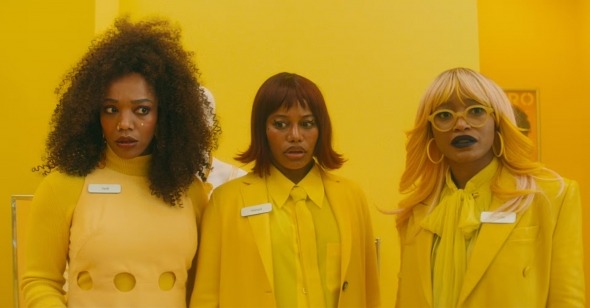
The sumptuous pleasures of clothing don’t start or end with the label but are stitched from a series of banal but glorious bodily encounters. Anyone drawn to fashion likely intuits this truth, and those drawn to fashion tend to also be drawn to movie screens. Prankish polymath Boots Riley is one such figure, but unlike many aesthetes, his penchant for excess accompanies a firm commitment to leftist principles. With its gumball visuals and zany costumes, Riley’s sophomore feature, I Love Boosters, joyfully indulges in sensory splendor—on screen and on skin—while equally insisting on a just world.
“I’m lonely,” Corvette (Keke Palmer) admits to her friend Mariah (Taylor Paige) early in the film, while sitting in the shuttered fried chicken joint in which she squats and schemes. Along with single mom Sade (Naomi Ackie), they form Oakland’s notorious “Velvet Gang”—whose motto “Fashion Forward Filanthropy” justifies their “booster” ambitions: filch clothes from local shops and resell for discount prices. But the thrill of the haul—and the constant hustle—has left Corvette running on empty. Stealing and shilling drip can’t compare to creating her own designs—designs “too weird” to submit to the contest run by fashion titan Christie Smith (Demi Moore), the self-proclaimed “visionary” whose Metro Designer franchise is a steady Booster target.
Corvette needs a purpose, which comes in the form of sweet sartorial revenge. Upon discovering that Christie has pilfered a jumpsuit idea from Corvette’s Insta-feed, she gathers the troops to do the impossible: clear every Metro Designer store in the Bay Area. But first they need to infiltrate enemy quarters. “I just want to take it all home, eat it up, and shoot it out of my eyes,” is the reason she gives for seeking Metro Designer employment—the “it” referring to the clothes themselves. “Give it to me. It’s mine anyway.”
Boosters hyperbolizes the cycles of appropriation within the fashion industry: the Velvet Gang’s urban community admires and desires Christie’s take on the avant-garde, while the designer “fucking making art” blithely rips off Black subculture. A character who functions as a jab at the impractical pretenses of the creative class, Christie lives in a glassy tower slanted at a 45-degree angle; she strains to walk up and down the floor of her own home, as do her browbeaten entourage of Gen Z employees.
Boosters also doesn’t shy from mocking film archetypes. A pinky-ringed parody of a romantic male lead, LaKeith Stanfield plays a mysterious man who, when not brooding over Midnight’s Children, courts Corvette’s affection. But his overwrought pickup lines are mostly for laughs; the real heart of the film thumps between the women of the Velvet Gang and those they come to platonically love outside their tight-knit circle. In many ways, Boosters is as much about kinship networks of support as class-conscious comeuppance.
When a rival thief surfaces in the form of Jianhu (Poppy Liu), a bubbly vigilante teleported from China to fight Christie’s exploitation of garment workers, the gang adopts a fourth member with a more noble immediate cause. Boosters’ femme-tastic moxie and time-travel twist might remind one of Everything Everywhere All at Once (2022), but a more salient influence might be Věra Chytilová’s New Wave classic Daisies (1966), a surrealist smorgasbord that invites us, like the women onscreen, to gleefully consume to the point of exhaustion, all while indicting the larger systems that disempower its plucky heroines.
Like Daisies and Riley’s Sorry to Bother You (2018), Boosters relies on traditional practical effects to achieve its zany vision. But unlike his debut film, made for a meager three million dollars, Boosters spared no expense in crafting its Wonka-hued universe. The film was shot with specialized vintage anamorphic lenses to maximize the visual content available onscreen; to intensify the color palette, cinematographer Natasha Braier manipulated the lens surface, in some cases physically painting their edges. Production designer Christoper Glass incorporated miniatures, matte paintings, and stop-motion animation to achieve a viscerally nostalgic vibe. Even the trippy title font, hand-drawn by children’s illustrator J. Otto Seibold, contributed to this effect—reminiscent of Disney’s animated Robin Hood (1973). Merrell Garbus and Nate Brenner, of Oakland-based art pop duo Tune-Yards, composed and performed the loopy, polyrhythmic score. The end credits span a full ten minutes, revealing the collective labor and creativity celebrated onscreen, and integral to the film’s existence.
“People don't want to be the art,” Christie’s bookish assistant tells her toward the film’s raucous climax. “They want to be artists.” Christie might see her consumers as “human canvases,” but the pleasures of commodity culture pale in comparison to creating something—on one's own or with others. Solidarity in the fashion ecosystem—between the cash-strapped buyer, the midlevel retail staff, and the factory workers toiling abroad—trumps the fleeting highs of shopping every time.
During a spring when union organizers staged a runway show to protest the Met Gala and Everlane fans are livid that the sustainable brand has been sold to fast-fashion behemoth Shein, I Love Boosters’s anti-capitalist credo feels especially timely. In the long run, the film’s appeal will rest on Riley’s singular mix of polemics and pleasure: our eyes may deceive us, but shared delight might lead us somewhere better.