Hell, USA
By Nicolas Pedrero-Setzer
Humboldt USA
Dir. G. Anthony Svatek, U.S., no distributor
Humboldt USA plays May 2 at Museum of the Moving Image as part of First Look 2026.
Alexander von Humboldt was a German scientist who explored South, Central, and North America in a series of expeditions between 1799 and 1804. He was, by all accounts, a great humanist and his extensive research across the then-uncharted wilderness of the Americas has earned him recognition as the “father of ecology.” There are more species and places named after him than any other human being. These include the South American Humboldt Penguin and Berlin’s prestigious Humboldt University. Here in the United States, his surname is everywhere: in parks, museums, reserves. Yet if you were to ask most people on the street about him, chances are they’d reply, “Who?”
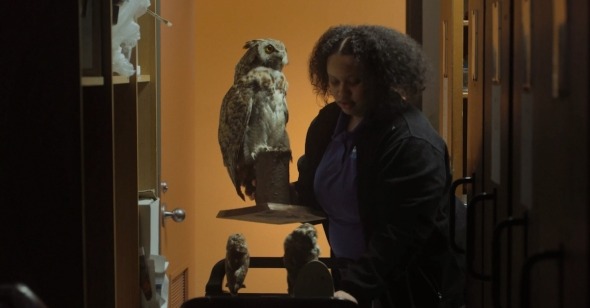
An admirer of Humboldt, documentarian G. Anthony Svatek decided to focus his feature debut on three locations in the United States named after the renowned naturalist: Humboldt County in Nevada; Humboldt Redwoods State Park in California; and Humboldt Parkway in Buffalo, New York. These sites bear zero trace of Humboldt’s influence despite their names. And, perhaps more importantly, these are all places contending with their own environmental challenges, something Humboldt predicted would only worsen with time in his writings about the emergence of industrial factories. In Nevada, Svatek observes the plight of the dwindling big-horned sheep population; in California, he documents a couple’s attempts to create a 3D render of the state park in the (very possible) event it disappears; in Buffalo, he interviews a couple that lives in what’s considered one of the most polluted stretches of land in the state. Although Svatek’s film is constructed as a love letter to Humboldt, it reveals something larger: the state of a nation that has abandoned his wisdom.
Ahead of his travels to the United States, Humboldt wrote a letter to President Thomas Jefferson expressing his wishes to visit. For Humboldt, like many other Europeans of a romantic bent, the United States’ emphasis on democracy and equality signaled the future—an alternative to centuries of small-minded monarchic conventions. Jefferson welcomed Humboldt with open arms; later on, he’d refer to him as “the most scientific man of the age.”
Jefferson makes an appearance in Humboldt USA. At a shopping center in Nevada, there languishes a Jefferson automaton that can recite his presidential address at the push of a button. He stands alongside his peers—Abraham Lincoln, Theodore Roosevelt, Ronald Reagan, and so on—ignored by most shoppers. In what might be the film’s standout sequence, Svatek cuts between these sad automatons and overlaps their speeches so as to produce pure gibberish. It’s a perfect metaphor for a film about forgotten history and a clear example of Svatek’s dark comedic wit. As he cuts between the lonely automatons and the voice-over grows denser, it becomes obvious how distant the U.S. has gotten from its foundational tenets. Propped up to deliver their presidential addresses on demand until they fall into disrepair, the automatons offer a strange vision of a country that appears future-less, its historical highlights transformed into entertainment and its scientific ambition reduced to spooky toys. Later on, Svatek will film a casino in Nevada that loops videos of nature reserves while customers gamble. Few filmmakers have been able to capture American stupidity with such precision.
Another kind of hopelessness presents itself in Svatek’s documentation of Humboldt Redwoods State Park. In one area of the park, Svatek films researchers photographing the forest to create a digital twin that will be fed to machine-learning models. (This process recalls those discussed in Svatek’s 2017 short .TV, in which the citizens of the disappearing island nation of Tuvalu decide to upload a digital copy of their country.) Elsewhere, Svatek follows a ranger who makes TikToks for children about the environmental challenges facing the park. Between the 3D model and the TikToks, Svatek makes it seem as though the park doesn’t exist IRL anymore. Whatever grand natural landscape Humboldt fell in love with in his travels appears abandoned and displaced, only accessible via the Cloud or social media.
Questions of displacement resurface in the scenes Svatek devotes to Humboldt Parkway in Buffalo, where an expressway has replaced the famous green loop that used to connect the city’s two largest parks. It seems that every place in the United States bearing the title “Humboldt” is synonymous with some sort of environmental failure. “Everything is interconnectedness,” Humboldt once wrote in his nature diaries. He penned this to describe symbiotic relationships in nature, his hope being that the maxim would make people more aware of their own impact on the environment. But, in Svatek’s worrisome portrait of the United States, the phrase takes on new meaning.
Present-day America, Svatek argues, is not connected by nature, national pride, or shared ideals. Rather, it is a web of indifference and ignorance: to environmental disaster and of manmade technological damnation. That Svatek never connects any of the discrete chapters in his film is telling and points to how isolated battles against environmental destruction have become. On one coast, an old-growth forest faces imminent danger; on the other, a couple risks lung cancer due to the replacement of trees with concrete. Yet these are separate battles, isolated, much like the kids who tune into the ranger’s TikTok dispatches but can’t hike the same park trails he shows them. Svatek’s documentary, though made with a deceptive lightness of tone, is a tragic one, and it aptly ends with a scene of a middle-aged man who records himself on an iPhone dancing to dubstep in the middle of one of our nation’s most hallowed natural reserves. That image alone should serve as a wake-up call to a new generation of environmentalists… Unless it’s too late.