Behind the Eyes
Hannah Bonner on Little Stabs (Avant-Garde Shorts)
In a 2020 interview with the Los Angeles Review of Books, American avant-garde filmmaker Ken Jacobs reflected on his prolific career, concluding: “my fundamental interest…is [an] expansion of consciousness with all the take-for-granted or ignored ways of the world.” For Jacobs, a contemporary of Jack Smith and Stan Brakhage, filmmaking is a participatory endeavor that actively engages and agitates both an audience’s vision and mind. Sometimes Jacobs challenges his audience’s political consciousness with found footage like in Perfect Film (1985), comprised entirely of preserved TV news discards of Malcom X’s assassination. Other times, Jacobs repositions our relationship to the cinematic image as in Tom, Tom, the Piper’s Son (1969), wherein he rephotographs Billy Bitzer’s 1905 film of the same name, adding camera movement, freeze frames, and other editing techniques to enact an exhaustive analysis of Bitzer’s film while simultaneously constructing his own original work.
While expanding consciousness can be generative, it can also be discomforting, as First Look’s 2026 avant-garde shorts program “Little Stabs” suggests. Deriving its name from Jacobs’s Little Stabs at Happiness (1960), these twelve films curated by Genevieve Yue and David Schwartz encapsulate Jacobs’s “expansion of consciousness” through both visual and aural directives, invitations, or provocations that sometimes eschew looking altogether. Each film wrests us from passivity and unsettles or incites us to question (or forego) the image, the frame, and the aforementioned “take-for-granted or ignored ways of the world.” The programmed films’ capacious approach to the cinematic both celebrates and perpetuates Jacobs’s patrimony.
Georgian filmmaker Alexandre Koberidze’s unsettling The More I Zoom in on the Image of These Dogs, The Clearer It Becomes That They Are Related to the Stars (2023) opens “First Stabs.” Composed of a single shot, the film methodically zooms in on a pixelated picture of two dogs staring through the metal railings of a train station. From the start, the film is, to quote Hito Steyerl, “a poor image.” Nothing is in focus or, to borrow language from the film’s title, “clear.” As the zoom continues, further degrading the legibility of the picture, the image becomes pure abstraction, a blurred division of various colors and shades. Hungarian composer Mihály Vig’s score spawned Koberidze’s short for the Film Fest Gent’s 2x25project, an initiative where twenty-five composers write a short piece of music and twenty-five filmmakers craft a film in response. Vig’s harmonic minor key infuses The More I Zoom with a plaintive quality while the cello’s low register adds an ominous tone. Just over halfway through the four-minute runtime the frame’s composition deepens from beige to browny mauve. The colors are indeed saturnine and planetary as we drift further away from any intelligible understanding of what we’re seeing onscreen, into a depthless, digitized blur.
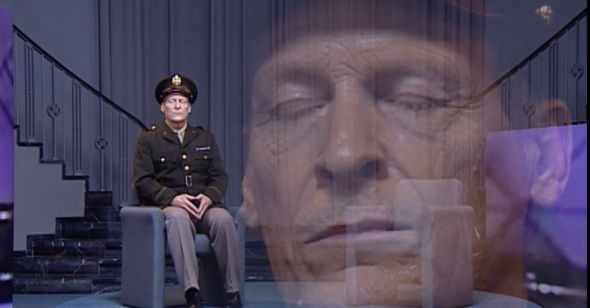
What follows from Koberidze’s atmospheric opening is Jordan Strafer’s disquieting and hypnagogic Dissonance (2024) which takes place on a 1990s talk show stage while a World War II vet leads the audience through a meditation. Staring into the camera, Ray (played by Jim Fletcher) states, “In order to participate in this exercise, you first need to relax yourself. Recall the first home you can remember as a child. And actually look for, and try to visualize, yourself as a little child in that house.” From there, Ray leads the audience (which is also Strafer’s audience) through a breathing exercise, inviting them to close their eyes. As a result, Strafer’s film is a participatory one. If we take Ray’s invitation at face value, the remainder of Strafer’s film is meant to be heard but not seen.
Lewis Klahr’s Orpheus (2024), which closes part one of the program, similarly instructs the audience to shut their eyes, albeit with text on screen. “When you have finished reading these instructions please close your eyes,” Klahr writes. “When the song finishes playing please open your eyes.” As the text fades, a flicker of light, like a fluttering eyelid, reddens the frame before cutting to blocks of blue, then black, yellow, then black, then green. Sometimes the blocks of color are textured, as if fabric swatches or handmade paper. Sometimes each frame flashes across the screen so rapidly that the pulsations of light seam our eyelids shut. Though Klahr’s text insists this is a “closed eye film,” the flashing blocks of various colors onscreen trouble Klahr’s assertion. There is something to be seen but, like the Greek myth, the challenge is to avoid that chromatic temptation. Orpheus is almost like a condensed version of the 15-minute sequence in the middle of Lois Patiño’s Samsara (2023), a sequence Patiño described as a “perceptual, even neural experience.” Like Patiño, Klahr and Strafer underscore how perception doesn’t end with vision. Both of their films amplify the myriad ways in which cinema affects the body, not just through sight.
The desire to move the body (emotionally, neurally, affectively) has been present, intentionally or not, since cinema’s beginnings. Consider the myth surrounding the Lumière brothers’ first screening of L'arrivée d'un train en gare de La Ciotat (1896) where their audience, panicked by the seemingly life-sized approaching train, ran screaming from the theater. Six decades later, when Ken Jacobs started making films, expanded cinema immersed audiences in multimedia performances or site-specific events, wresting them from passive spectatorship to active involvement. In this vein, it is a shame that Peng Zuqiang’s Afternoon Hearsay (2025) cannot be experienced in its original format as a three-channel video installation. That said, itis still a richly textured and haptic experience which pairs its soundscape with a combination of contemporary Super 8 footage, 16mm and 35mm colored negatives. The film explores fragmentation, memory, and historical research by foregrounding its own construction.
Afternoon Hearsay opens with a filmstrip running down the right side of the frame. The filmstrip’s perforations are visible as it wavers across the dark screen, rippling and luminous. Peng utilizes reels of 8.75mm film here, a medium developed in 1960s Communist China to disseminate information. Since 8.75mm film has no camera, it is a material intended only for distribution, rather than recording. In Peng’s film, 8.75mm is thus a historical record of an obsolete technology as well as an image in and of itself. The movement of the material is the subject.
Kate Solar’s (for once I dreamed of you) (2025) shares Peng’s interest with how handling film elicits a haptic response in the viewer. Shot on high contrast 16mm film, pastoral images of wheat and wildflowers are bright white against a glittering black backdrop. The film’s hand processing showcases myriad scratches and thumbprints. These intuitive lo-fi interventions allow Solar to illuminate celluloid’s grain and body. While some filmmakers might avoid such technical “errors,” Solar’s mistreatment of the 16mm film becomes another ghostly presence—she foregrounds materiality through the spectral remnants of her own touch. Later, a series of single frames of a dirt road creates little leaps in time and perspective, little stabs of disorientation in what might otherwise be a continuous movement. The spatial disruption, like the hand processing, makes the film more beautiful, not less. And these leaps, scratches, and stabs haunt (for once) by reminding us of the human hand and technology that rendered these oneiric scenes possible.
Ken Jacobs once said, “I want to get between the eyes, contest the separate halves of the brain.” Instructions or directives are one way to achieve Jacobs’s goal; ludic presentations of film’s materiality another. If the Greek root of cinematograph is kinēma, meaning movement, then each of the films within this program explores movements of celluloid, light, or sound as physical and psychic eruptions. Between the eyes, and beyond the eyes, is where such movement becomes mimetic, and moving.