Shotgun Wedding
By Alexander Mooney
The Drama
Dir. Kristoffer Borgli, U.S., A24
As the old saying goes, per Griffith and Godard, all you need to make a movie is a girl and a gun. The Drama, Kristoffer Borgli’s latest edgy comic confection, riffs on this dictum with a morbid and determined frequency. Late in the film, Charlie Thompson (Robert Pattinson), a museum curator, finds a photobook on his desk titled “Brainrot,” which contains images of bikini-clad women posing with assault weapons. To the frazzled husband-to-be, whose wedding to Emma Harwood (Zendaya) is just a few days away, this risible catalogue is alarmingly pertinent; earlier that week, his fiancée unexpectedly divulged that when she was 15, she thoroughly planned and nearly carried out a school shooting. He’s been in crisis mode ever since.
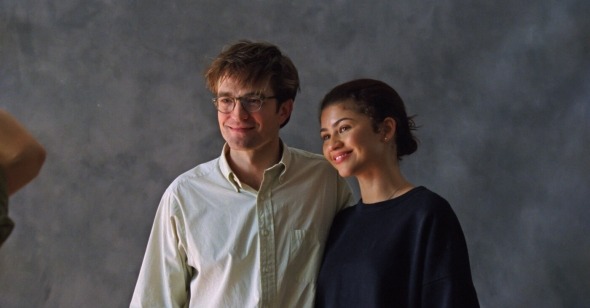
This inciting incident enables all manner of eccentric gags throughout The Drama, but little else. As with Borgli’s cancel culture satire Dream Scenario (2023), a high-concept hook is aimed at a pressure point in the American zeitgeist and struggles to find purchase. In the aftermath of her disastrous overshare, Charlie interrogates Emma for details, but Borgli keeps them vague: stray, context-free instances of bullying from her classmates are shown via flashback, and we watch her teen doppelgänger pose in mirrors and webcams with her father’s rifle. In the present, Charlie hallucinates both versions of Emma hoisting the weapon during a skin-crawling trial run of their wedding portraits. (Emma transforming into her teenage self next to her harried fiancé is a recurring, jokey abstraction that, given Borgli’s recently unearthed essay about dating a 16-year-old in his late twenties, has a very different meaning now.)
Tinged with Borgli’s usual absurdist zest, Charlie’s paranoia gives the film its forward velocity as we’re edged closer and closer to the couple’s impending nuptials. Sparks fly, loyalties crumble, and violence hangs in the air, but through it all, The Drama is a resolute farce. Its characters squirm and squabble for our amusement, ostensibly laying bare the foibles and frailties of human relations in a world gone mad. Performance and fantasy, calling cards for the ever-trolling Norwegian filmmaker, are abundant here; Emma’s knack for roleplay and Charlie’s active imagination are a match made in hell, casting her sincerity in a hopelessly sinister light.
The film seems to hinge upon the difference between holding a weapon and actually using it; the one time a gun actually fires on screen is when the teenaged Emma permanently loses hearing in her right ear during target practice (this disability figures prominently in the mechanics of Borgli’s script). The malcontent youth doesn’t carry out the murder spree because someone beats her to the punch, shooting up a local mall and killing one of her classmates. More flashbacks show us how easily she’s lured into activism for gun control, an irony that Charlie likens to Louis Malle’s Lacombe, Lucien (1974), in which a man is rejected from the French resistance and joins the Nazis instead. What motivates Emma is never quite clear; she admits in voiceover that she was mostly “caught up in the aesthetics” of mass shootings.
It’s tempting to say the same of Borgli as well, but The Drama is obsessed with gun violence as a cultural concept, stripped of content and context; it is distinctly European in this bemused detachment from the social ill at hand, and resolutely aligned with the perspective of Pattinson’s flailing Englishman. A riskier film like Gus Van Sant’s Elephant (2003) examines and, more riskily, emulates the insidious iconographies of sadistic bloodshed, but The Drama mostly shies away from them, skirting any genuinely discomfiting image, idea, or dynamic along the way. Issues of race, gun culture, disability, and gender are gestured toward in passing but never meaningfully dramatized or satirized, merely garnishing Borgli’s banquet of food for thought. The film’s apparent aim is to engage with the trickle-down effect of such unthinkable phenomena to the behaviors and biases of everyday life, but it ignores the deeper facets of its crudely sketched characters. The delusions and doubts of its central pair are glibly italicized, their predicament drained of any real physical or emotional danger (when blood is finally spilt, it’s from the least consequential perpetrator).
In a certain light, these oversights are features of the film’s design; The Drama seems deliberate and unapologetic in its resolve to be “about” absolutely nothing. As the characters project their wildest impulses and imaginations onto the situation, the audience is invited to ascribe whatever they like onto the film’s skeletal frame, and thus do Borgli’s work for him. Like Dream Scenario, itis an exceedingly and elaborately funny movie that flattens its world and hollows out its characters one joke at a time. It’s all well and good to operate in two dimensions––at least it’s a worldview––but both of these films attempt to reestablish a sense of humanity in their final passages, building to moments loosely resembling pathos that come too little too late.
Borgli keeps his characters at a distance from the get-go. We speed-run through Charlie and Emma’s relationship as they each convey its milestones to their gendered confidantes––best man Mike (Mamoudou Athie) and maid of honor Rachel (Alana Haim), a married couple themselves––in preparation for the wedding speeches. It’s one of many clever devices in Borgli’s screenplay, compressing the history of a partnership, establishing how they present themselves to an audience, and laying the groundwork for the film’s litany of subjective flourishes. Through this framing device, we are shown their bumbling, creepy meet-cute; their first date, when Charlie quickly admits to his prior stalkerish impulse and ends up providing Emma with a turn-on; and their first kiss, which transpires between two locked doors with literal alarm bells blaring as a nighttime entry to Charlie’s workplace goes awry. More flashes of intimacy are staged and cut with a similarly ironic detachment. The relationship is built upon faulty foundations before our very eyes, and we don’t believe in this couple for even a second––we are already waiting for the other shoe to drop.
Emma’s confession emerges, around the 20-minute mark, during a menu tasting with Mike and Rachel, teased out to agonizing length as the quartet play a drunken game in which they each share the worst thing they’ve ever done. Mike admits to using an ex-girlfriend as a human shield against an aggressive canine, and Rachel admits to having once locked a child, implied to have been mentally disabled, in the closet of an abandoned RV and leaving him there overnight (she insists they “must have found him”). Charlie, predictably, cops out, grasping for the memory of cyber bullying someone “really badly.” Then Emma proceeds to suck the air out of the room. Rachel, whose cousin was disabled in a mass shooting, is especially appalled. Despite being no angel herself, Rachel becomes the main antagonizing force for the couple, disrupting Charlie’s convoluted attempts to rationalize Emma’s past and present behaviors just as much as he does himself.
Haim’s splenetic, pugnacious performance is an unmistakable highlight in a film whose expressive cast is working overtime. Pattinson, allowed his natural British accent, ably articulates the ineffectuality that Borgli seems to favor in his pathetic leading men. Zendaya, freed from the vocal tics that stifle her big dramatic roles in projects with Sam Levinson and Denis Villeneuve, relishes the chance to be batty, awkward, and occasionally menacing. Athie and Hailey Benton-Gates, as Charlie’s co-worker Misha, do hilarious work on the sidelines. The film’s pleasures begin and end with watching these performers bounce off of each other. When we are asked to care in the final stretch, however, Borgli’s anything-for-a-gag sensibility and empty-calories style––all snappy movements and arch tableaux––betray him. Whether he’s aiming for a twisted treatise on leaps of faith or prankishly satirizing the delusions that inform them, the film concludes with a preordained thud.
Despite its transparent (and already successful) attempts to court controversy, The Drama goes down remarkably easy. Its characters’ wrongdoings are obscured and cushioned, embodied with enough conviction to distract from all the punches pulled. It’s pressurized and stressful, but still offers plenty of release valves. The film’s spring-loaded skittishness is the main attraction, its emptiness the primary subject. The Drama is a comedy of manners where every laugh wears you down, a provocation where every offense flatters the man pushing your buttons.