Maximum Overdrive
by Savina Petkova
"Wuthering Heights"
Dir. Emerald Fennell, U.K., U.S., Warner Bros.
At the very start of Emerald Fennell’s “Wuthering Heights,” all we hear are creaking noises, panting, and strained gasps over a black screen. If the salacious bath water scene in Saltburn and the cynicism of Promising Young Woman were any indication, what follows should be an image of attempted sexual transgression. So it is: a close-up on a hanged man’s postmortem “stiffy,” pointed out by one of the many children observing what turns out to be a public execution. Indeed, those were still a regular occurrence during the period Emily Brontë’s eponymous novel is set (18th-century England), yet Fennell’s script values spice over historical accuracy. As soon as the last quiver has left the lone, dangling body, the crowd goes wild with touch, kisses, and sexual advances; the camera whizzes past numerous couples, each in their own bacchanalian daze, making sure the message is loud and clear: the spectacle of death is nothing more than an orgiastic prompt.
But the point of view of this Wuthering Heights belongs to Catherine (Cathy) Earnshaw (played by Charlotte Mellington as a child and Margot Robbie later) who, as per Brontë, opts for a life of riches over love and ends up regretting it on her death bed. A long tracking shot follows the young girl as she flees the opening death/sex scene, haunted by the drones and heavy bass of Charli xcx and John Cale’s song “House.” At home, Cathy is reprimanded by her stern, tippler father (Martin Clunes), who calls her a “sourpuss” for crying over what she saw at the town square. As exacting as Mr. Earnshaw is, he seems to have a soft spot for strays, bringing home a scruffy-looking boy. “I’ll name him Heathcliff, after my dead brother,” declares Cathy. “He shall be your pet,” her father responds, introducing the submissive vernacular that will heretofore define the relationship between the Miss and the stable boy. It’s true that Brontë’s novel relies on sex and death as driving forces and its Victorian setting makes it (nearly) impossible for them to sublimate their sexual feelings for one another in adulthood. Perhaps this is why Andrea Arnold’s adaptation of Wuthering Heights (2011) pulled the viewer down to the squelchy ground, rolling side by side with its young protagonists, to remind us that child’s play is always, in some way, inherently erotic.
Sigmund Freud, who published his Three Essays on the Theory of Sexuality in 1905, wrote of “libido development” and “psychosexual stages” related to erogenous zones in children, which exist until social norms insist on channeling the libido into more fixed forms. Even if psychologists today deem this theory empirically unverifiable, its sociocultural value stands, reminding us that children do not exist in a sexual vacuum, like they do in Fennell’s film adaptation. Young Cathy and Heathcliff are cherubic, with the occasional glimmer of sad purity in their mischievous eyes, but when they play, they play grown-ups: Heathcliff lies to spare Cathy from her father’s whip, she then nurses his wounds. He swears he will protect her at all costs, love confessions follow. If the children are already acting like (chaste) adults, then childhood in Fennell’s Wuthering Heights is just a prelude, a mandatory act one of three—a neat way to signpost “sex begins here,” in adulthood.
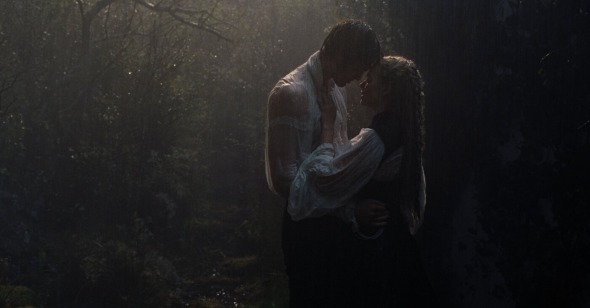
In the scene signaling the shift, Cathy finds herself a voyeur, witnessing a racy encounter in the stables, with elements of consensual non-consent, BDSM, and pony-play. Afterwards, her gaze imbues trivial acts like the kneading of dough with libidinal energy; DP Linus Sandgren moves from painterly, long shot compositions to shards of handheld cinematography. Heathcliff (Jacob Elordi), who’s never far away, implicates himself in her arousal by watching her masturbate on the moors. Afterwards, he even sucks on her index and middle finger with pronounced delight, declaring that now he’s tasted her, he can find her anywhere, “like a dog.” (Later in the film, there is a scene of puppy-play, but it doesn’t involve Cathy— she’s too good a girl for that.)
As a model adult, Cathy plots her future—leaving her alcoholic father behind and trading the alarmingly handsome help for the wealthy Edgar Linton (Shazad Latif)—and succeeds with aplomb at becoming a miserable wife. With the corsets, gowns, and ribbons aplenty comes a sister-in-law, a playmate. Isabella (Alison Oliver) enjoys braiding Cathy’s hair and dressing her up, when they’re not playing on the swings out in the garden. The childish modes of entertainment don’t end here—the Linton mansion looks like an extravagant dollhouse, with its naked walls and bare wood floors, and it also has an actual dollhouse that’s a perfect, scaled-down copy of the place (and the dolls have human hair). Childish touches reduce even the stylized amor vacui (regard for empty spaces) to a gimmick. The (aesthetic) spirit of Barbie haunts Wuthering Heights, and no wonder—they share a costume designer, Jacqueline Durran. But there’s more in common here with the two period films she won Oscars for, Anna Karenina and Little Women. Anachronistic fabrics like leather (for corsets), latex (for gowns), and cellophane (for robes) tend to lean heavily on what the look symbolizes, but as part of a mise-en-scène that’s childhood-coded, we only notice the surface.
There’s a certain infantile regression to the adult Cathy that’s more pronounced than that of her younger counterpoint. Try as she might to carry on Mellington’s charming petulance, Margot Robbie’s acting comes across as uncalibrated and histrionic, and the icy beauty of her features prevent her from embodying a protagonist that’s sensual as she is jejune. In place of the defiant, desiring Cathy the film desperately tries to conjure, we find a woman whose extramarital affair upholds the status quo. Admittedly, Fennell’s decision to include sex scenes instead of simply alluding to or allegorizing sex, as other adaptations have done, may be somewhat transgressive. But her "Wuthering Heights" so insists on a clean break between libidinous and infantile that the film neuters the ambivalent eroticism fueling the novel. What happens when you unload all of your erotic charge at once? Postcoital depression.