You’ll Never Walk Alone
By Matthew Eng
My Father’s Shadow
Dir. Akinola Davies Jr., U.K./Nigeria, MUBI
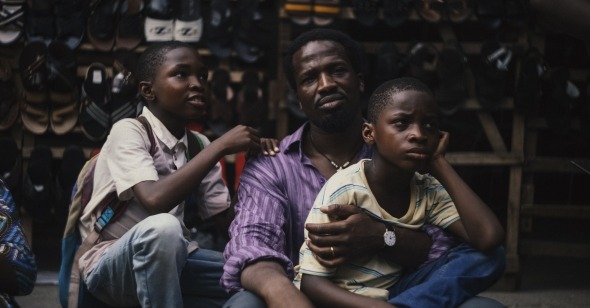
A young boy rests a lazy hand on his father’s kneecap and casually pats it as they skirt along Lagos, four on a motorbike, during a balmy June afternoon in 1993. The filmmaker Akinola Davies Jr. captures this idle gesture in pointed close-up in his debut feature, My Father’s Shadow, which swells with tenderness and concern in moments of physical contact between loved ones: a boy propping his brother’s weary head on his shoulder; a man draping a protective arm against his sons’ small bodies as they navigate restless city streets; the same man rubbing the back of a female relative who has gripped him in her embrace, overcome by his flesh-and-blood presence. Touch is reassurance; sometimes, it is no small comfort to reach out and be reminded that the body beside one still breathes.
In My Father’s Shadow, 11-year-old Remi (Chibuike Marvellous Egbo) and eight-year-old Akin (Chibuike’s real-life brother Godwin) accompany their father Folarin (Sopé Dìrísù) to bustling, clamorous Lagos as it teeters on the brink of civil unrest. A distant provider, Folarin aims to collect six months’ worth of wages from a dodgy factory supervisor at his worksite, many miles from the small village in Ibadan where the boys reside with their mother. The film is the creation of Davies and his older brother Wale, an A&R head for Sony Music’s African division, following up on their Sundance-winning short Lizard (2020), a child’s-eye view of an armed heist that underscores the graft of a megachurch’s congregation. When Wale was four and Akinola only a year old, they lost their father to an epileptic seizure and were subsequently raised by their mother in Nigeria. The siblings collaborated on the screenplay, writing by the Volta River while visiting Ghana, conjuring a missing chapter of life during wartime.
Both Akinola and Wale maintain that Dìrísù’s character is not a direct representation of the father they barely knew but a broader symbol of paternal strength and the fallible masculinity it obscures. The resulting work is much less a memory piece than a sustained act of mournful imagining, one that begins with the eldest of the makers’ youthful avatars staring forlornly at a louring sky and repeating the mantra, “I will see you in my dreams.” The boys have been left alone at home to play and bicker as their mother runs an undisclosed errand in town. When they come across their father half-dressed in his bedroom, he seems to have emerged from a gash in the space-time continuum.
The Davies brothers set their story against the fraught backdrop of the country’s 1993 presidential election, in which the opposition candidate MKO Abiola, a telecom tycoon, was democratically elected until the results were annulled by the military dictator Ibrahim Babangida. Armed forces lethally suppressed protestors. Abiola was imprisoned the following year and died there of a possible poisoning; his wife Kudirat, who took her up her husband’s pro-democracy fight, was assassinated during his incarceration. Though fleetingly incorporated, archival footage of the ensuing rebellion makes for some of the most cogent imagery in the film, tying it as much to present injustices as to those of the past. Lagos was one of the many Nigerian cities where mass protests were held in August of 2024 in response to the widespread hunger and financial hardship spawned by an administration of neoliberal policies. Under the banner of #EndBadGovernance, millions of Nigerians took to the streets over the course of nine days until their demonstrations were violently and fatally quelled by government agents. (In December of last year, 11 protesters were released from prison following a sixteen-month internment after the Federal High Court threw out a case built on charges of treason, among other trumped-up allegations.)
Folarin stands firmly and vociferously on the right side of history. Newspaper headlines, radio reports, and urban confabs in My Father’s Shadow make repeated reference to “Bonny Camp,” a military base where supporters of Abiola were massacred while upholding his victory. At the slightest mention of the name, blood trickles from Folarin’s nose, spurring a murky recollection that rips through the fine fabric of the film. But Folarin only wipes his face clean and proceeds to defend Abiola with the gravitas befitting a man who is reverently called “Kapo” by various intimates and passersby.
It is because of Dìrísù that the nickname sticks. The British Nigerian actor is an imposing yet untiringly elegant performer with whom DP Jermaine Edwards’s camera is understandably besotted. Such doting attention, and the texture afforded by the choice to shoot on 16mm Kodak stock, allows the viewer to become acquainted with and gradually accustomed to the particulars of Dìrísù’s expressions, the way one would a favored relation: the smile that lightly illuminates the whole of his face as though the sun shines solely on him; the winged crease of his perplexed forehead; the brooding frown that draws all of his features downward, save for a left eyebrow that remains cocked in defiance, especially when encountering the military trucks that circle the city, conveying soldiers who bear identical, trigger-happy sneers.
If only the script allowed Dìrísù to display a greater range of feeling and psychological scope, to deepen his characterization into something pricklier than a stern yet charismatic emblem of patriarchal pride, a repository for a nation’s woes. As father and sons meander from fairground to the sea to the bar where the city finally erupts in exasperated fury over the stolen election, the narrative lurches haphazardly towards inevitable if markedly telegraphed tragedy, blurring the edges of its central performance. The Davies are attempting something grander and more politically focused than autobiographical portraiture, but the conflicts of foremost concern to their screenplay are undeniably interpersonal, making for a sentimental narrative situated uneasily within a diagrammatic history.
Scenes intended to be intimate and tempestuous—like Akin berating Folarin for leaving the boys and their mother on their own for months on end, forcing them to conduct their lives around his glaring absence—are among the most prolix and pat in the film, wrinkles insistently smoothed out before fully laid bare. Despite Dìrísù’s resourcefulness, there is not much to be gleaned beyond contained emotion and well-intentioned platitudes from the overlong beachside interlude in which Folarin reminisces about a deceased brother and a felicitous fortune teller. (As plenty of writers have already noted, this sequence dwells in the shadow of a father named Barry Jenkins.) Elsewhere, certain figures are frustratingly short-changed, primarily Abike (Uzoamaka Aniunoh), a waitress who strides into the film near its conclusion staring daggers at Folarin but whose true connection to him is skimmed over, a hazy suggestion of indiscretion that the filmmakers refrain from exploring. Their script is quick to make its characters proclaim its overarching emotional and thematic meanings, even when these actors are supremely capable of personifying them with little more than shared glances and clasped hands. The Egbo brothers are exceptionally gifted at evoking the gentle, conspiratorial regard of fraternal attachment. But they are even better at animating the zero-sum stinginess and stunning pettiness of children, how coldly refusing to dip into one’s hard-earned savings and spot a sibling the money for ice cream becomes a matter of stubborn principle.
My Father’s Shadow is never less than an enveloping experience, its diaphanous surfaces as pleasing as the lush crescendos of Duval Timothy and CJ Mirra’s elemental, piano-heavy score. But at the narrative level, one craves some of the discordant reverberations that disturb and propel this expansive soundscape past a mode of mere entrancement. This is a work borne of anguish for a parent and the many lives senselessly ended by state-supervised violence. Its heart unmistakably aches, but this is more a fact perceived than a pain that palpably rends.