Spirited Away and Back
By Đăng Tùng Bạch
A Useful Ghost
Dir. Ratchapoom Boonbunchachoke, Thailand, Cineverse
In 2010, former Thai Prime Minister Abhisit Vejjajiva and his deputy, Suthep Thaugsuban, ordered a military crackdown on anti-dictatorship protests, resulting in the bloody Red Shirt massacre, leaving nearly one hundred people dead. Now, a decade later, when the world seems to have forgotten about it, director Ratchapoom Boonbunchachoke forces us to remember with A Useful Ghost, his politically charged feature debut, an alternately tender and angry romance that features a sex scene between the narrator and his haunted vacuum cleaner.
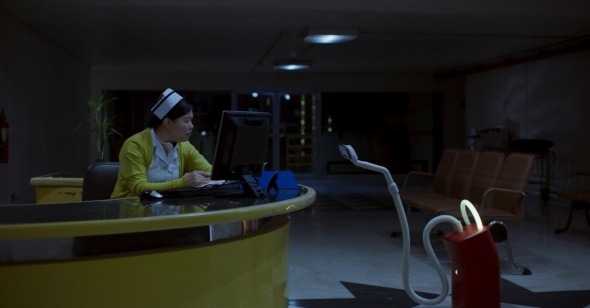
A Useful Ghost opens with the chiseling of a mural depicting students, workers, a monk, and a soldier. Fast forward to a gloomy present, the mural, now a relic of the People’s Party that overthrew Siam’s absolute monarchy in the 1930s, is removed to make space for the construction of a shopping mall—The Future Is Now, its sign says. When the mural is mishandled and breaks, its dust is sent to the wind and causes nationwide air pollution. Of course, to combat dust, a vacuum cleaner is the most useful appliance, and Nat (Davika Hoorne), who possesses one, is a useful ghost. Having died from a respiratory disease while with child, Nat inhabits a stylish red vacuum cleaner from her family’s factory to return to her grieving husband March (Witsarut Himmarat), much to the dismay of Suman (Apasiri Nitibhon), her mother-in-law. Though confined to her dust-sucking vessel, Nat sometimes appears in human form, clad in a glossy blue dress with padded shoulders. The phantasmic love story is inspired by the Thai legend of Mae Nak, the ghost wife with arms that stretch to impossible lengths. Hoorne, a global Thai star, had her breakout role playing Nak in Thai box-office record-holder Pee Mak (2013). Here, instead of extendable arms, Nat has an extension tube that lets her do many tasks, from spoon-feeding her husband to stimulating his nipples in front of flabbergasted Buddhist monks.
To achieve her happy ending with March, Nat must overcome a series of obstacles. Even as a ghost, she is still bound by the same rigid bureaucratic systems as the living. These, however, can be bypassed by those with power, suggests Prime Minister “Dr. Paul” (Gandhi Wasuvitchayagit), whom Nat chances upon every time she runs afoul of the law. Boonbunchachoke cleverly embeds the film’s political commentary within its deadpan humor, using the blank, indifferent reactions to Nat’s existence as a possessed vacuum cleaner to create comedy while demonstrating the tight grip of Thailand’s power hierarchies over its people, even beyond death.
Nat is also obstructed by her disapproving mother-in-law and extended family. To win them over, Nat agrees to exorcise Tok (Krittin Thongmai), a dead worker haunting the family’s factory. Since ghosts are brought back by the love of those who still remember the dead, Nat must find the worker tethering Tok to the living and have their memory erased via electroshock. Nat’s successful attempt causes the separation of a human-ghost couple, much like her own. As she continues to carry out the demands of others, she herself corrupts love, the very force that brought her back. In return for the possibility of having a child with March through a surrogate, Nat agrees to erase the ghosts that haunt Dr. Paul and his ministers—victims of their atrocities, including those killed in the 2010 Red Shirt massacre.
Dust functions as a useful metaphor—on one level, it is residue of the past, representing how historical memory is pushed aside or erased, much like how the constitutional democracy introduced by the People’s Party is now trampled on by a power-abusive government. On another level, it symbolizes those in society who are seen as insignificant, such as the workers at the factory and queer people like Tok. However, just as dust is persistent and pervasive, the marginalized choose to resist—refusing to be sucked into a vacuum and have their memories erased. Remembrance becomes defiance, as the loved ones of the Red Shirt massacre’s victims refuse to forget, no matter how many Nat roots out.
As it turns out, not all ghosts that possess vacuum cleaners are “useful.” The film’s narrator, an unnamed man played by Wisarut Homhuan who describes himself as an “Academic Ladyboy,” is startled when his vacuum cleaner begins coughing up dust in the middle of the night. This machine is haunted by Krong (Wanlop Rungkumjad), a sexy young man with bad-boy charm. Krong was killed during the Red Shirt massacre and returns as a ghost to tell Nat’s story to the “Academic Ladyboy,” who has the hots for him. “Ghosts are those who don’t give in to death,” says the “Ladyboy,” “their very return is an act of protest.” Touched by the sentiment, Krong makes love to his newly recruited revolutionary in an unforgettable sequence filled with queer sensuality, melancholy, and comedy. As they climax, the “Ladyboy” declares that he will remember Krong, from his death and resistance to his moans of pleasure.
A Useful Ghost’s harmonious interplay of absurdist humour, eroticism, and politics are anchored by its deeply resonant human drama centered on memory and yearning. While opposing Nat’s return to the living, Suman harbors hope that her deceased husband will also come back. Though surrounded by ghosts, Suman’s deepest haunting is her loneliness. Burdened with single motherhood and the forced responsibility of managing the family factory, Suman is further ostracized for her Teochew heritage. “They didn’t want me to raise him,” Suman says, describing how her husband’s family took her son out of fear that he “would not speak standard Thai.” As Teochew-Thai people are increasingly assimilated, the preservation of their dialect and cultural memory becomes more critical, reinforcing the call to remembrance Boonbunchachoke has meticulously crafted.