Kiss of Life
By Matthew Eng
Cactus Pears
Dir. Rohan Parashuram Kanawade, India/U.K./Canada, Strand Releasing
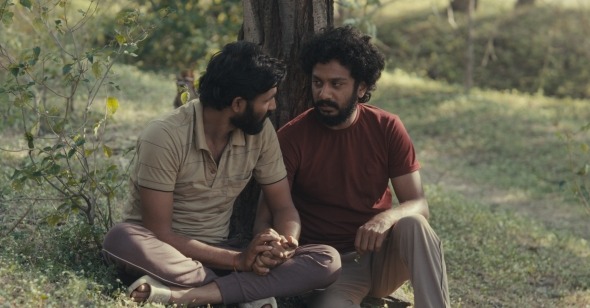
The grieving man from Mumbai has the downward stare and stooped shoulders of the touch-starved, his back perpetually stiffened into a forbidding carapace. This is Anand (Bhushaan Manoj), the recessive center of Cactus Pears, the semi-autobiographical, Sundance-winning first feature of writer-director Rohan Parashuram Kanawade. Anand is a reluctant visitor to the small, rural area where he spent part of his youth, guilted by his mother into observing all ten days of the traditional Hindu mourning period for his recently deceased father. Disinclined to stay home and receive guests, Anand has taken to venturing off with an amiable local man named Balya (Suraaj Suman), a childhood companion who has become a field hand and chauffeur in lieu of being a farmer without a farm, sold as it was for his sister’s dowry.
It is difficult to determine how much Anand’s sorrow predates the loss of his father—if perhaps he has long ago accepted loneliness as his lot in life and retreated irrecoverably inward. But when Balya runs a hand through his distant friend’s bushy, white-speckled hair and begins to massage it with slow and keen strokes, Anand shutters his eyes in tranquilizing rapture. All jadedness dissipates. The cheep of birds and the sigh of a breeze are faintly audible, but the tactile tenderness on display is so unbearable that one might be excused for hearing dulcet tones of Sade: There must have been an angel by my side. The moment spans three shots and runs for just under a minute, a veritable eternity in our chopped-up, hyper-distracted cinematic landscape, and it serves as a kind of test for both Anand and the viewer. Can he still surrender to the open palm of romantic entreatment? Can we?
Cactus Pears comes seven years after India’s Supreme Court repealed the anti-sodomy law known as Section 377 of the colonial-era Indian Penal Code, which deemed that same-sex intercourse was “against the order of nature” and potentially punishable by life imprisonment. (The Code itself was revoked two years ago.) It is a gay romance that stands apart from its fusty, doom-laden, and conciliatory contemporaries by treating its characters’ sexuality with uncommon candor and delicacy. The film was spurred by the filmmaker’s own experiences returning to his ancestral village upon his father’s death in 2016, suddenly surrounded by kinfolk vocally curious about when he might rectify his singledom. Kanawade’s screenplay is novelistic in its precision of detail, richness of feeling, and complexity of character; there is not a dunce, scapegoat, or villain to be found, only a measured, meditative regard for how abiding marital customs and the dehumanizing criminalization of gay sex have ingrained homophobia into a cultural norm. “You’ll get married when you find a nice girl,” Anand’s knowing mother, Suman (Jayshri Jagtap), instructs him to tell inquiring minds—namely, the rural relatives befuddled by his being thirty and wifeless. But Anand resists; he refuses to give anyone false hope, which is to say he will not capitulate to the wishes of others and be what he is not, even though explicitly claiming his queerness is firmly out of the question. Later in the film, it emerges that his parents have taken to telling their relations that Anand is still reeling from a broken engagement to a faithless fiancée. In a cruel irony, the part of jilted lover turns out to be one Anand is well-equipped to play, for his heart has been left numb by an ex-boyfriend’s choice to marry a woman rather than pursue a future with him.
Balya, radiating with grace in Suman’s mellow portrayal, thus reappears in Anand’s life at a pivotal moment. He is awed by the city-dweller in his midst, peppering Anand with questions about his job as a call center representative and the “special friends” he has left back in Mumbai. Balya has similarly been shirking his family’s efforts to get him engaged and proves relatively unguarded about his own liaisons; in a humorous scene, he interrupts a conversation with Anand to shoo away a hapless, would-be hookup who has ridden by motorbike a considerable distance, the hasty rebuff occurring within earshot of his parents. But as soon as Balya and Anand reunite, the pair only have eyes for each other.
The men were close in their younger years, and Kanawade leaves enough ambiguity in their conversation that one might surmise they first discovered their own desires through the other. Or perhaps they only had courage enough to wonder. But their shared history is not strenuously unpacked for our sake; we ultimately know as much as we need to about each man. And no amount of dialogue could possibly illuminate this bond more than the casual ease and languid carnality of the film’s lead actors, who seem to gradually discard any ounce of self-consciousness when in the arms of the other. Kanawade spent three years searching for his leads before casting Manoj and Suman, trained theater actors and real-life friends making their screen debuts. One can trace the intensification of Anand and Balya’s relationship in the gazes and gestures but also the postures of these performers, whose distinct physicalities become increasingly symbiotic, reflexively folding into familiar patterns and locking into a singular parallel groove; like all couples, their bodies converse in a language in which only the two of them are fluent. The braiding of their naked, hirsute bodies is a frank sight, but so, in its way, is the shot that immediately follows this first sexual encounter: one man staring up at his sleeping lover in a state of rapt stillness, as if even the slightest movement could break the spell. Amorous devotion has seldom been embodied onscreen with such nonchalant conviction.
Sincere emotion blooms over the course of Cactus Pears, which takes its title from a bittersweet delicacy that Balya passes along to Anand as a token of his affection. In the same scene, Suman runs her hands through her son’s hair as he nestles his head in her lap, an idyll of childlike contentment that echoes the earlier moment of renewed contact between Anand and Balya. The intimacy between mother and son is equally profound: it comes to light during their heart-to-heart that Suman knows far more than we might have assumed about her son’s love life—as did her late husband—and that her disapproval is neither total nor does it limit the depths of her devotion. Here, a mother’s stance on her son’s sexuality is sympathetic and protective (at one point, Suman defends Anand’s right to light the funeral pyre over the objections of a rule-bound aunty), but it is not without misgivings—in other words, it is as fluid and unfixed as most relationships are in life.
Such nuance distinguishes Kanawade’s vision, as does the fact that this exchange is captured by cinematographer Vikas Urs in a glorious, five-minute master shot that exerts a hypnotic hold. It is one of many lush, careful compositions in which multiple actors occupy the same frame, frequently in lengthy takes that allow them to (inter)act without interruption. Camera placement is never cursory in Cactus Pears, which continually offers new angles from which to limn and luxuriate in its pastoral milieu. (In a touching homage, Kanawade shot the film in his mother’s hometown of Kharshinde.) It makes all the difference that when Anand and Balya look up at the stars during one of their first moments alone after years apart, the camera occupies a position behind the craned necks of the actors so that it is not just the sky we see but the joint act of beholding it.
As their attachment deepens, any viewer accustomed to so-called queer misery might wonder when the other shoe will drop, when this coupling will be revealed as a mere respite from a lifetime of longing. But the film’s third-act progression confounds these presumptions. Caution is thrown to the wind, and though much remains uncertain, love is at last enough to assuage the nocturnal doubts. This is a long, becalming, and all-enveloping caress of a film, one in which the world is toned down to the soft, even breaths shared between huddled lovers who feel a future stretching out before them and cannot yet submit to sleep.