The New Age:
An Interview with Robb Moss (The Bend in the River)
By Farihah Zaman
Where so many works of cinema end as middle age begins, the River Trilogy, from pioneering American documentary filmmaker Robb Moss, continues beyond the (in his words) “young and naked” days of his friends’ lives depicted in his exuberant 1982 film Riverdogs. In 2003, he released a startlingly honest depiction of the process some might call settling down in The Same River Twice, seeing those same Dogs shaking off the days of abandon on the river as they tend to children, careers, and other grown-up concerns.
Now, nearly 50 years after documenting that epic trip down the Colorado River, we revisit the friends on the precipice of old age in Moss’s The Bend in the River. Each successive film incorporates footage from those that preceded it, creating a portrait that moves freely through time. This rejection of traditional linear structures and the willingness to submit to the flow of nature allow Moss to capture the deeply moving ordinariness of human experience. Beyond that, this third film doesn’t try to mimic the experience of time passing—it wrestles with time itself: what it means to us, how it functions in both life and the witnessing of it, how to comprehend that one day it will run out.
During its recent NYC theatrical release at Film Forum, I spoke with Moss about mortality, making art, and friendships that last a lifetime.
Reverse Shot: How did you approach the construction of the film, which is a work of unfolding moments that also incorporates scenes from the past?
Robb Moss: I think of it as creating its own archive, but it still has to be transformed into something that makes sense for the new film. It's not the same as repurposing found archival footage, it's something else. The premise of all the films is, at some level, the view from that moment in time as the filmmaker, and in their lives, are twinned. These are my friends, and they're aging as I'm aging, or I'm aging as they're aging, and filming their aging is a way to film my aging. The use of the older films is a complicated thing, because the old footage can mean what it meant then, or it can mean something quite different. And then the film itself, in terms of its organization, is also a film about aging, but in any moment it can go backwards or forwards in time. And the juxtapositions between the backwards and forwards sheds light on the thing you just were looking at, or sheds light on where you might be going. What an amazingly complicated thing, to try to make a film that actually moves forward without paying any attention to chronology.
It’s an emotional approach. When I think of somebody that I love, I don't think, “oh we did this, and then we did that,” It’s more that something triggers a thought or a memory . . . it's an emotional circuitry. And the film tries, at some level, to function in a way that acknowledges that our inner lives are not chronological. They don't organize themselves neatly from one thing to another. We're trying to find a way to keep it moving forward, and to keep people's attention, by constructing in a non-directive way that allows people to interpret the film from their own experience
RS: I would love to hear you talk more about the act of portraiture. How does this idea connect to what you were saying around emotional logic, rather than chronological narrative?
RM: You know, I went around and asked people if there was anything in the film that put them off, that they didn't like. And Barry [one of the film’s subjects] said, no, but there's lots of things that aren't in the film that I wish were. And those wishes are always around biographical pieces, what people did with their lives. If you're making a film that purports to be about people's lives over nearly a half a century, it's not unreasonable for them to say, “I was the mayor of my town. I had a whole political life. I’m proud of that, but none of it is in the movie.” And I totally agree. It’s completely true. But what I found in the editing is that the more biographical it was, the more plodding it was. The film would get lost in a certain mode of storytelling and portraiture. And that it seemed by taking out—not all biography, but a lot of the biography—something else seemed to emerge, about what lives are constructed out of. Lives are constructed out of these infinite gradations of forgotten intimacies.
Things happen that are just the most casual, but beautiful, and forgettable…but the camera doesn't forget, if you film them. The film that’s made of these moments and fragments of moments becomes a little like a stained glass window or a mosaic, rather than a linear narrative. And then there’s the way a film takes those moments and juxtaposes them with others
So, for example, there's a shot in the film where we see Barry has his toddler daughter in his arms. And he comes into the room, and he sets her down, and he goes to get a fresh diaper, and then he sort of looks at her while he has the diaper in hand, and he looks at 2-year-old Teague and says,” Here, catch!” and he tosses the diaper. And it hits her on the belly, makes this little sound that's incredibly beautiful, and she laughs, because it's funny. Then it cuts to him sitting with Deb, Teague's mom, and his first wife, and he's describing to me how Teague came to be conceived. It's a beautiful little story. And he says at the end of it, you know, and that night, we conceived a little girl, unbeknownst to us, and that was Teague. And then it cuts to Teague 20 years later, rowing a boat down a river. And you know that cut—that's my experience as a parent. You're with your children, and it seems like each moment's gonna last forever. It's so intense, and such a big moment, which you were experiencing this morning. And then you blink, and it's 20 years later. Film can do that. It can make cuts that are suggestive of a big picture. That is the daunting opportunity of trying to make a film like this.
RS: What is it like for you to understand yourself and your friends anew? What has it been like for them to confront that image that you've constructed to reflect them back to themselves?
RM: When people first see themselves on the screen—and I’m like this too—really all you see is yourself. “Am I okay?” You're holding your breath and hoping not to die of embarrassment. “How am I doing in this one? Why did I do that?” Or you're so grateful that nobody saw this thing that was coming out of your nose, that you’ve been worried for the last several years was going to show up on film. But then, you see it a couple of times, and see it with audiences, and it begins to move away from being you. Being part of a film, to the extent that people can see themselves as part of a film, one can lose that complexity of self-presentation and, hopefully, start to feel part of something else, which has a larger meaning than just a personal biography. I mean, I think it's an incredibly big ask of them.
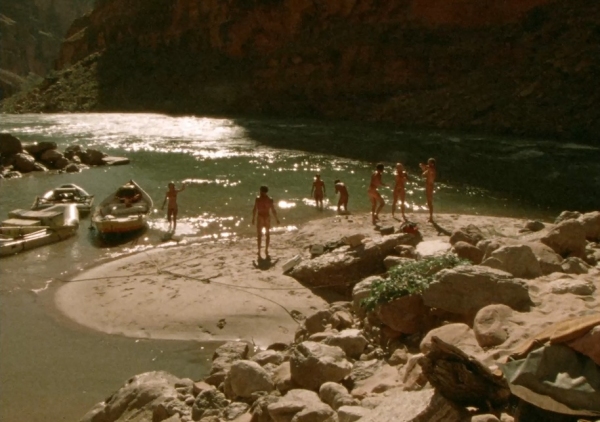
It was different with Riverdogs. That was 35 days on the Colorado River. People are often without clothes, they're really good outdoors, they're incredibly comfortable, there's a real community. Some of these people I met on the river, but many I've known for my lifetime, and we all joined forces and became part of a larger community. And so I wasn't noticed. I just wasn't. For the second film, I showed up with my little, dinky video camera, so it wasn't even professional like the 16mm was, with the wires and big cameras and changing bags, and the NAGRA. And this little dinky standard definition video camera, like a home movie machine. I would film them doing the most ordinary things, and who knew what kind of movie that was gonna be?
By the third film, they were not that comfortable being filmed at the beginning. They were aware of the fact that they were actually being recorded. For really the first couple of years people were a little standoffish. And then over time, it's just harder to not be yourself than to be yourself. And also, I'm filming in a way that's not asking very much of anybody, I'm just there. And every once in a while, I am talking in a more direct way, but a lot of times I'm just there. And just showing up, year after year, and gathering material that you can only get by staying with something for so long.
RS: Can you talk about that experience of having to slow down, of not being in control of the timeline?
RM: For a long time during the making of these films, I was married, I had three kids and a full-time teaching job. If I had been on my own with this idea, I would have tried to finish the film in a year or two. But because of my own circumstances I was required to slow everything down. At the time, it seemed like a real problem, but as it turns out, that reality is what allowed the film to live in a different way. And I'm incredibly grateful for that. I was also mindful of how we all needed to survive this time of filming, because that was no longer a given. When I started shooting, it was like, “are we gonna stay around forever? We're not gonna stay around forever…” So, when do you start a film like that?
RS: And when do you end a film like that?
RM: That's for sure. But you know, in a way, because of the conception and momentum of the films, each has gotten done for different reasons, and then there’s always the next film. So this one is done—is there going to be a fourth film? And this time, the answer to that is utterly a question of people's health and what happens to them, let alone people being willing to put up with another film. I'm 76, so I'm not young. It feels like I'm in the portal of old age; I'm not entering it, I'm in it, but it’s an early part of it, and it's still unfolding. But the next ten years are going to be much more challenging. It's just harder to be 86 than 76, harder to be to 76 than 66. And the next film would have to account for those things, no doubt, in some kind of way. Assuming the filmmaker is even around, and assuming the people in the films are around.
RS: What you are describing sounds so humbling for a filmmaker— and I also felt humbled as a viewer. I felt this sense of collapsing time; like at any given moment I could most see myself as someone’s child, or someone in middle age, or craning my neck to see what is coming next. I want to talk more about how the film considers aging and mortality, and trying to contain not just a moment, but a lifetime of moments at once.
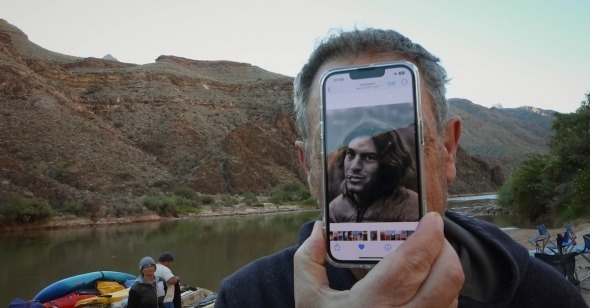
RM: That's beautiful. A lifetime of moments at once. I think part of that arc is reflected in the media archaeology of things. So, the 16mm at the beginning; when that came out, it was glorious. The color, the ways in which light is rendered in cinema, and people being young and naked. We're a part of this landscape, in the garden. We had this incredibly extended adolescence, very beautiful, and a kind of extravagant vision of youth at that moment. And then we left the garden, to live in the temporal world, and have knowledge of the temporal world. That next period of life is filmed in standard definition. Our aging is now quotidian; there's not that much resolution, everything's a bit blurry. That’s the way that middle age is. You're just moving so quickly through all the things you have to do. Now it’s like high def, and then 4K or 20K, whatever the K is when the next film happens.
I think there's something moving about seeing people heading into being old and having mortality closer and closer. I think the film has you experience that in a way that surprises you. You're watching it, and they're sort of funny, and things are going along, and there’s all this cutting back and forth between people and different moments in their lives, but really, the whole thing moves from being young to being old. Young to old is a powerful thing. I'm asking the characters in the film, my friends, to house mortality. That in itself is a big ask—it’s incredibly generous. I'm endlessly moved by how generous. But then it also gave me a chance to witness my own mortality, without looking in the mirror, but by looking in the mirror of my friendships.
RS: And perhaps that made it easier to witness your own mortality?
RM: Absolutely, because it was shared.
RS: How does it feel to say you are in the portal of old age?
RM: When I was about to turn 50, so when I was 49, I spent a lot of time telling people I'm going to be 50. I figured I must be looking for a way to work it into my vocabulary and get used to the idea. And at some point, about two-thirds of the way through the year in which I'm constantly telling people that I'm turning 50, I realize I'm not doing it to familiarize myself with this change. I'm doing it so they'll say to me, “You don't look 50!”
RS: [laughs] That is a hard thing to admit.
RM: It was completely true. But in a way, the same thing is true now, at 76. In some ways, I feel lucky to be this old. I feel lucky to have had the life that I've led, and incredibly grateful, and that I'm still intact. Even if diminished, in some ways. And then, probably, when I'm 86, I'll say the same thing, that I'm sure I'm doing better now than I will at 96. There's some way in which we keep putting off completely confronting our mortality. I think if you are your age, looking at my age, you wonder, “How does it feel to have arrived there?” But I don't quite absorb it in the same way, my age, I don’t feel that I’ve arrived somewhere. Because I'm still in my body, and I'm still thinking about things, and I'm still doing stuff, and it's continuous.
RS: Your film made me think about how nothing looks like you thought it would 20 years ago. I did not think this is what 42 was, or what marriage was. I just had a different vision of what the interior life of a middle-aged person might be.
RM: Yes, I think we have these ideas. I mean, when young people see Riverdogs, and then Same River Twice or Bend in the River, they reckon with the inevitability that, with luck, they will get older. And then they wonder, “Does it hurt to get old? What's that like?” A student of mine saw the film in the fall, and then wrote me this really beautiful note. Part of it was about being a 20-year-old trying to make a resume out of her life, and being reminded that life isn't built out of resumes was comforting for her. Learning that a lot can happen after 30 was also comforting, and this idea that people seemed to hold on to themselves, even as they got older. Something that Jim says in the film, is that there's a way in which you can see life as the perfection of what is. Which is to say, just be present to the moment.
RS: What has surprised you about aging, in life, and in the film?
RM: I'm grateful to know that it's possible to keep your friends for your lifetime. I think what you see in the film is that people do stay the same to a large degree. But aging also deepens us. I met Jeff when I was 11 at a summer camp, Danny when I was 13 in junior high school, Barry when I was 15 at a summer camp, and Jim and Cathy when I was 25 and running rivers. To stay friends with people that long, and to have our lives intertwined in this way, and being able to chronicle that, is an incredible privilege. It's surprising that we can age and change, and all kinds of things happen to us, but we can stay friends. I don't feel like the film has a message, particularly; it's not designed that way. But if there were any kind of overriding message, it would be to stay friends with your friends.