Dial Up:
An Interview with Rachael J. Morrison
By Edward Frumkin
Joybubbles screens May 2 at Museum of the Moving Image as part of First Look 2026.
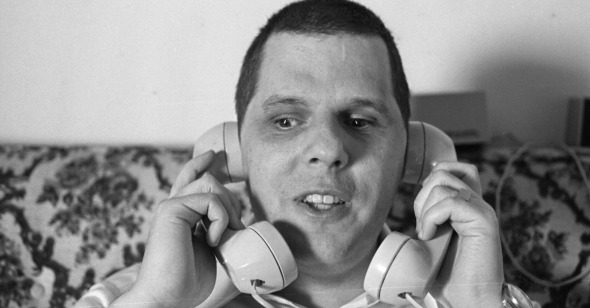
The overwhelming presence of smartphones and laptops reduces in-person opportunities for human connection. Archival producer Rachael J. Morrison examines what life looked like pre-social media in her debut feature, Joybubbles. Her subject is phone phreak subculture luminary Joybubbles. Born blind and into a working-class family, Joybubbles (which he adopted as his legal name later in life) whistled and tapped specific patterns over a landline at age four and discovered the telepathic wonders of the world when he could call people domestically and internationally without paying. Despite his talents and tabloid fame, he was harassed by authorities during his time at the University of South Florida, where he was suspended and fined $25 per illegal phone call, and faced systemic ableism in the marketplace.
Her film includes interviews with phone phreak experts like Phil Lapsley and future Apple co-founder Steve Wozniak, but Morrison largely draws on archival media and relies on soundbites from Joybubbles’ “Funlines” (offline radio shows) Dial a Conversation, Zzzzyzzerrific, and Stories and Stuff, to trace his legacy and reflect on the many forms of loneliness he endured. (He says early in the documentary that he likes the word lonely.) Through clips from mainstream films like Penny Marshall’s Big (1988) and episodes of Mister Rogers’ Neighborhood, Morrison examines how certain methods of spreading joy have been policed by managerial figures as childish, indecorous, and unprofessional. If Joybubbles, both the film and the person, taught us anything, it’s that relationship-building transcends order and that happiness makes ideas come to fruition.
I caught up with Morrison at a Brooklyn cafe before the film’s New York premiere at First Look on May 2. We spoke about crafting Joybubbles’ story through audio, how he expressed his inner child in an ableist society, and living in a highly digital reality that is the polar opposite of the eponymous protagonist.
Reverse Shot: What was your relationship with Joybubbles, the person, before you embarked on the doc?
Rachael Morrison: I never knew him, so I found out about him when he passed away. I read his obituary in the New York Times. And I didn’t know that there were phone phreaks. I didn’t know there were people hacking phones before computers. So, I was just fascinated by the fact that he changed his identity later in his life, and I thought there would be a movie about him, or a book, or something, and there wasn’t really any big piece of art or work about him. And so that’s when I decided to start making the film. So, I got to know him, you know, posthumously, like through the process of making the movie. Like a lot of people, they would call his fun line, listen only to his fun line, and that’s how they “knew him.” And so I feel like I kind of had a similar experience. I never talked to him. But because I listened to all these tapes of him talking, I know him, almost as if I were listening to him.
RS: You have a background in archival producing and working in libraries. There's a great deal of media on Joybubbles. Were you aware that you would have to primarily use archival materials to tell Joybubbles’ story?
RM: I knew right away that I would have to use archival [material] because when I first started making the film, I hadn't discovered any. I barely found any audio of him, and I only found it through interviews with people. That really changed the whole scope of the documentary. But my plan was always to use archival material to fill in the visual elements.
RS: How many hours of tapes did you work with?
RM: So, the audio probably had like, maybe almost 50 hours of stuff. Yeah, because somebody recorded all of his “Funline” called "Stories and Stuff." And those were what I had and are on archive.org. And so those episodes were like 20 minutes each, and they recorded like 72 of them. We sifted through all those, and then I had a bunch of other cassette tapes I had found from people along the way, so, more than footage, we were sifting through a big archive of audio, and that's kind of how we started the edit. We did “a radio edit,” where we just did an edit of the audio, only as a bed at the beginning, and then we layered the visual elements on top of that. So, for a while it was just interviews and audio, because that's really where the story comes from: the phone. It felt right.
RS: How many of the storytelling decisions you made were more determined by listening rather than seeing? Most people never saw Joybubbles’ face.
RM: It was an audio-focused story, for sure. The storytelling is 90% through the audio. I consider a talking head interview to be audio because you're just listening and the visual is not wildly compelling. When you're watching someone being interviewed, it's nice to see them, but it's more about what they're saying than what they look like. Then it was like finding the archival footage that would fill in the visual space.
RS: I want to ask about age regression, because people with disabilities—mental or physical—experience the childhood that they never truly got after acquiring their disabilities in their youth. Joybubbles was experimenting with telephones before he would get criminalized for something that he didn't know was illegal.
RM: When he discovered how to make a free long-distance telephone call, he had no idea that he was doing something illegal. He was just a kid, and his intent was never malicious. When he was making free calls and hacking into the phone, he was sort of a pure hacker. He just wanted to take the machine apart and put it back together. He wasn't trying to break something. I think he wanted to relive a childhood that he felt was lost to trauma. But I do think it might have been a response to feeling like people had infantilized him his whole life, which you do see in the film, like people just didn't believe. You know, at one point, he says that his boss wouldn't let him get up and walk around the telephone office because he thought he was going to trip or fall over or something ridiculous like that. So, I do think it was a response to feeling that way and maybe sort of trying to take control over that feeling, but I don't know. I can't speak for him, but I do think it's complicated for sure.
RS: As depicted in Joybubbles, phone-hacking later evolved into computer hacking. This occurred before the smartphone.
RM: Oh my gosh, way before. Did you know that people were hacking into phones before computers? Before you watched the movie.
RS: No.
RM: Most people don't. So it's cool to be giving him his due. He's an important person in the history of tech, but no one's ever heard of him.
RS: The phone is a device that should unite people instead of adding barriers in how to communicate.
RM: I totally agree with you. One of the big things that I want people to take away, and it sounds like you did, is the beauty of human connection, like a one-on-one connection with someone, just a phone call. It's so simple, and now we're just so saturated with technology. It's like we forget that that was the beginning. You know? It was just like talking to a friend, a family member, or a co-worker.
RS: Do you think modern day technology has benefited humanity or put us as a society backwards?
RM: It's complicated because, you know, when I work as an archival producer now, I am remote. I don't go to an office anymore, and I don't work with people in person. So that's a bummer, because it's nice to get, you know, face time with people and be with people, and it can be a lot more collaborative, but at the same time, I work with people who live all over the United States, so it can be like a totally different group of people. It's certainly very easy to communicate with people, but it's kind of too fast, and so we don't feel as precious or valuable.
RS: I wonder how the modern-day smartphone affects phone hacking today. I can't whistle to a digital button.
RM: In the ’80s, when the telephone system switched from analog to digital, it was really just the analog system where you could use tones. The phone company got hip to this whole thing because it did get out of control, and it was a major security flaw. So, when they were, I think, building the new system, they made sure that they were putting measures in place that would not allow people to do that. If you wanted to hack a phone, now, it's just a completely different game. Because back then, they were hacking a free long-distance call, and that's meaningless now. We have our plans, and we can call anywhere in the world. Now, hacking is just really malicious. It's like all the spam that we're getting and stuff like that on our phones.
RS: Joybubbles lived in a different world than ours.
RM: I wonder what he would think about the world. He passed away in 2007. He could have been doing things with computers, but he just wasn't interested. He just loved the phone from the beginning to the end.