All This Jazz:
An Interview with Rachel Lambert (Carousel)
By Natalia Keogan
Carousel screens March 24 at Museum of the Moving Image’s First Look 2026 festival.
Rachel Lambert and I got off on the wrong foot. My questions seemed convoluted, her answers were curt, and we quickly realized we just weren’t clicking. But after ditching the script for a few moments, we found a rhythm, one based on our shared connection as fellow human beings as opposed to rigid roles of interviewer and subject.
It occurred to me that our initial awkward brush could have just as easily been a scene in one of her films. This is especially true of her self-described trilogy of sorts—I Can Feel You Walking (2021), Sometimes I Think About Dying (2023), and now Carousel—which depict the innate awkwardness of attempting to forge an interpersonal connection. In Walking, Lambert and Milton Katz play neighbors who form a bond after one overdoses on the other’s front porch, while Dying centers on Fan (Daisy Ridley), an introverted office worker whose macabre daydreams take a backseat to chasing the affection of new co-worker Robert (Dave Merheje).
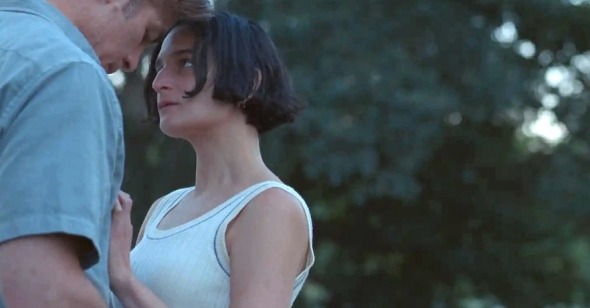
Carousel, Lambert’s latest film, follows Rebecca (Jenny Slate), who puts her political career in D.C. on pause and moves to her hometown of Cleveland, Ohio, in order to help her aging parents move out of the family home. She unexpectedly reunites with Noah (Chris Pine), her high school boyfriend, now a local physician and single father of a teenage daughter, Maya (Abby Ryder Fortson). As the title suggests, all of these characters exist in constant flux, but they must eventually make the decision to get off the ride and land on solid ground. Rebecca must choose between Capitol Hill or building a life with Noah in her hometown, ironically losing access to the house she grew up in herself; Noah can’t come to terms with selling his father’s practice, his daughter’s fast-approaching adulthood, or the idea of potentially losing Rebecca again; Maya has yet to process her parents’ divorce, leaving her emotionally raw and prone to anxious outbursts that could potentially hinder college prospects.
Lambert’s characters tend to possess an almost painful relatability, as the awkward silences, boring small talk, and daily minutiae of their lives are made out to be of utmost narrative importance. In the filmmaker’s view, the quietest moments of our lives are perhaps the most authentic, making them just as worthy of cinematic depiction. In Carousel, DP Dustin Lane captures the quotidian in dreamy pastel hues, while composer Dabney Morris scores ordinary activities with dramatic sonic swells.
I spoke to Lambert via Zoom a few days before Carousel’s April 24 screening at Museum of the Moving Image. We eventually got to discussing her longstanding “allergy to the artificial,” why all artmaking should feel like playing jazz, and the spontaneous cinematography behind the film’s final scene.
Reverse Shot: Your films are rooted in the quotidian realities of your characters. I noticed a familiarity of the sonic texture through your collaboration with composer Dabney Morris. Can you tell me about differentiating the approach between this film and your last?
Rachel Lambert: Yeah, quotidian is a great word. That's Chris Pine's word for this film, so he'll be thrilled that you used it. This is sort of the third in a trilogy of films that me, Dabney, Ryan [Kendrick, editor] and Dustin [Lane, cinematographer]—though he wasn't involved on one of them—knew were in conversation with each other. We spoke deliberately about this one having some syncopation and jazz-like play with these pieces that have a root structure in the romantic classic period but then take on a rhythm that has a truly American sound. Brass is really heavy in the music because it just conjured America to us. There's very little string work—I think there are only strings in an airport scene actually meant to conjure carousel music. Dabney had never played saxophone before, but we were really searching for the instrument for Noah's theme. I'm pretty sure that the music that starts the film is one of these jazz interpretations of Noah's theme, and Dabney was teaching himself how to play it on the saxophone. He was innovating on this instrument in a really free way.
I think the reason why I love doing what I do, even though it can be really tough, is that I love conspiring—whether it be with my script, or someone else's script, or random idea—to get artists that I adore together and watch them work. I'm not a director that tends to get into people's minds. I don't like to manipulate people that way. I'm really interested in what people come to me with. I would say that's probably my M.O.
RS: With your previous films, you’ve utilized improvisation with your actors. Did that technique also make its way into Carousel?
RL: Definitely. I feel like I'm always using it, though in some films more than others. This one didn’t have as much as the previous two, so there was more of a dividing line between when we were improving and when we weren't. Chris is very text obsessive. He's a true theater actor, so he took every period, pause, and ellipsis like gospel, which I love. And Jenny is a writer, she loves language. They were like pirates finding the treasure in all the scenes.
I tend to shoot quickly, so I always have a little extra time every day to be able to have these moments that we call “bonuses.” There are moments where I didn't end up using what was scripted and only used what was improvised. I'd be in the editing room going, “This is more real.” The writing got them in the right mindset, perhaps, but then they took off and now the scenes are better than anything I wrote. For instance, when Sam Waterston talks about going to Rome, that was informed by the history document that I've given [the cast]. There's a whole backstory to Sam in this novella that I wrote for them, a whole passage about Sam's final trip to Rome with his wife the year that she was dying. They kiss in the Santa Maria Maggiore while she's wearing that little piece of paper that you have to wear over your shoulders. Because Chris read the same thing, he had this instinct to set Sam up to say something rich from that backstory.
RS: Noah’s clothes possess a timeless, almost vintage quality, while Rebecca has an enviable denim collection. Did the actors work with costume designer Fernando Rodriguez to bring their characters to life, or did the aesthetic input come from you?
RL: Fern was a wonderful addition to the team. They work with such meticulousness. It comes off as effortless, but it’s beyond thorough. On every film I do a color meeting between the art department, camera department, costume, and me. Dan [Maughiman], my production designer, already knew I was going to do this because he was on the last one. He came in with paint chips, and we spread them on the table. We made color groups, then assigned characters and certain symbolic emotions to them. There’s one color that we called “the connective tissue,” a dark maroon color that you see on characters in very specific moments, always a shirt that's close to the chest.
Speaking of silhouettes, that was always rooted in who these people are. What are their daily routines? What are their demands? What's their relationship to clothing? How do they shop? Where do they shop? I love these sorts of conversations because it’s like being a writer. A writer thinks about these things, and Fern thinks this way. I really enjoyed this with Chris’s character the most. He looked like a completely different person when he was Noah. We had dinner on our last day, and he showed up as himself and it was truly jarring. That is such a credit to Fern and I'm just so thrilled that we got to benefit from their work.
RS: I noticed David Merheje, co-star of Sometimes I Think About Dying, in a very small role here. What prompted you to bring him back for this film, even for just a brief moment?
RL: There's a couple of ways to answer that. One is that when you're shooting in an airport, you want people that you can rely on. I can rely on Dave and Milton [Katz], who plays the other guy in that scene. I wanted Chris to be supported and be able to take his time and play with things. The second reason, and this is a very self-indulgent reason, is that Carousel is the third in a line of films that are all related to each other. Milton is the male star of I Can Feel You Walking, and Dave is the male star of Sometimes I Think About Dying. So, for a very dumb, selfish reason, it gave me a giggle to have a scene with all three of these men together.
RS: In terms of the location in this film being Cleveland, what was your experience capturing the essence of this city in the film?
RL: [Laughs] Can its essence ever truly be captured? Yeah, I grew up there. Rebecca's house is my childhood home. We actually cut down my dad’s apple tree. We actually remodeled my parents' house. [Rebecca and Noah] kissed in my backyard. They had a conversation while he’s getting dressed in my sister’s childhood bedroom. We shot at my high school. The farmer’s market is my town's farmer’s market. The doctor's office is my dentist in the town square. The streets are my streets.
RS: How did you decide how your characters were going to interact with places you were so familiar with?
RL: By being familiar with these places, [I possess] a certain authority about what's real. It comes back to my thing about how I don’t get super into people's brains, but what I do get is the opportunity to really be curious with people. An example is that I don't tell Dustin where to put the camera all the time. We talk rigorously about what's important. We ride around in the car together going, “That's beautiful, we need that.” We shot-list the whole movie before we're fully through prep. No scene is approached in any way that we haven't discussed rigorously, but he's the photographer in charge. Like, why is he here if I'm not interested in what he wants to shoot? If I'm just going to be a dictator, then I might as well be a novelist. The ultimate reward is in these moments where you're really having to fly because there's that trust. You’re just playing jazz with each other. Jazz is the ultimate expression of human beings.
I'll give you an anecdote about this film. The final scene was staged in a totally different part of the house. The script just says that the actors can do whatever they want, essentially. It’s written in such a way where anyone can say any of these lines in any order. The actors have to rehearse together and decide who’s saying what and why, and then don’t show me until the day of. Dustin and I thought we were going to shoot it from a different angle into the room. We're getting ready to set up and he goes, “This isn't the side of the room to shoot on.” So, I went and looked at the image and I went, “Yes, I agree with you.” We move this furniture out of the room so that we can back the camera up. Then I said, well, “What if we really fucked around and just did it all in one shot and just pushed in on one mag?” And he was like, “You want me to lay track right now?” And I was like, “Yeah!” I was so pumped, it gets your adrenaline up. I didn't know exactly how he framed it up. I didn't really care. I knew it would be beautiful; we were playing jazz. So, I explained to the actors that Dustin is going to time the push in off of your performances. There’s nothing to worry about, you can do whatever you want. So, then they do it, and that moment at the end where the film runs out really happened. The heartbeats [that you hear] are really Chris and Jenny's heartbeats.
I mean, you're learning in this interview that I’m pretty subdued, and that’s just my personality, but I was not subdued that night. I was celebratory. That made everyone go, “Woah,” because normally I’m very serious. But it was hard not to feel electrified by this perfect combustion of every department, every instinct. It timed it to the second. I guess the other moment of jazz is the fight scene. Some people hate that scene because they don’t want to deal with it. They’re like, “Well, it doesn’t make sense.” And I'm like, “When have your fights ever made sense?”
RS: What are moments in your everyday life that you feel compelled to pay attention to and mine for your creative work?
RL: I have such an allergy to the artificial. It's why I can't stand exposition. I just fucking hate it. It's not how people talk. I think that I'm most inspired by documentaries, which I watch more than anything else. Frederick Wiseman is probably the greatest inspiration to the scene work I do. I mean, who could ever be a better model? The other inspiration for me is Anton Chekhov. I started in the theater.
RS: I know you trained as an actor.
RL: Yeah, and I directed theater and made theater. When Anton Chekhov entered my life, it was a fusion of [passions], because I love literature. I love Raymond Carver. He really helped me form confidence around how I saw storytelling. But I had never seen anyone then take that point of view and put it into a dramatic structure. Anton Chekhov is like, “These people are just at this country house.” What's the plot? The plot is that these people want a life that's different from the one they're living and they don't know what to do about it. So, they're going to destroy themselves and each other to get there. He made the quotidian monumental, made the casual violence of disregarding another human monumental, and [made] casual the monumental experience of love.
I speak to the inspirations because I think it's important to contextualize what guides me. One of them is turning back to those inspirations when I'm looking to make something new. I tend to be in a very melancholic state after I’ve made something. You happen to be meeting me during that time. I get very depressed, and the only way out of it is through art—for me, anyway. So, I go and I see my friends, who are unfortunately dead and can't talk to me except through their work. I look at their work, I read their work, I watch their work, I think about their work. By resuscitating these inspiration points, it puts me in a frame of mind of curiosity. It gets me to care about the world and myself again. Like, this woman the other day on the subway threw a couple of ZYNs in her mouth and pounded a Celsius with this rhythm and this urgency. It was the first time I felt curiosity in a long time, probably since making this film.