The Art of Losing:
An Interview with Simón Mesa Soto (A Poet)
By Chris Shields
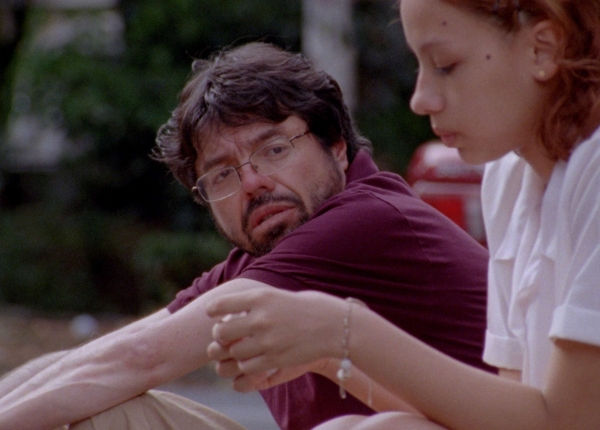
Søren Kierkegaard described a poet as “An unhappy man who hides deep anguish in his heart, but whose lips are so formed that when the sigh and cry pass through them, it sounds like lovely music.” Simón Mesa Soto’s A Poet is about just such a figure’s struggle to make lovely music. Set amidst the poetry scene of Soto’s native Colombia, in the country’s second largest city, Medellín, the caustic film follows the travails of Oscar Restrepo (Ubeimar Rios), a miserable middle aged, alcoholic, unemployed poet. He’s pathetic and wildly erratic—the only reliable assumption about him in the eyes of his family and friends is that he will fuck up yet again. Despite this, he’s committed to his art. Not so much making said art but ruminating on it, extolling the unique, sacred virtues of poetry. It’s been years since he’s published, and the once lauded poet is now sleeping off his latest bender in his mother’s apartment and taking her car without her permission, weeping as he drives. If this sounds so depressing that it’s funny, well, it is. A Poet is an aggressive, bitter comedy that feels like the middle-age malaise of Sideways reimagined through the crude daring of a film like Sebastian Silva’s Rotting in the Sun.
Through Oscar, Soto explores the material and emotional dilemmas that come with artmaking, exorcising some of his own personal demons by imagining his own life years in the future and gone horribly wrong. A radical comic descent into loserdom, A Poet is also an incisive critique of the mechanisms that promote, fund, and legitimize art, shining a stark light on notions of what we expect, and perhaps ask, of art from the socioeconomically marginalized. Oscar eventually finds reasons to turn his life around. He wants a relationship with his daughter and to help a young poet he discovers upon taking a dreaded teaching position. The tragic fool here becomes a noble hero, and the film shows us that an unwavering commitment to truth, love, and personal vision is not weakness but the most important skill an artist, and perhaps human being, must possess.
Simón Mesa Soto spoke with me about his new film, the challenges of making independent cinema, and trying to forge a new aesthetic in the face of global trends.
Reverse Shot: I wanted to ask you about the decision to place the film in the world of poetry.
Simón Mesa Soto: I’ve been familiar with the universe of poetry and the poets from my city here from Medellín for a while. I think it was back in 2014 that I attended readings and I met poets, and also the world of the bohemians. They are there on the streets; this in my everyday life. I was interested in this type of character. In 2020, I finished my first film, Amparo, and I had a struggle when I finished that film. I was the producer, writer, and director, and it was a big effort and a lot of sacrifices. In Colombia, making a film or being a filmmaker is kind of a hard thing, especially this kind of independent or art-house cinema. In my 20s I didn’t care about anything more than making films and I was so passionate and obsessive about making cinema. But when I finished this film, I was thirty-something and I started thinking about having a family, maybe, or buying a house. I made a living out of being a professor. I teach cinema in university, and I do that as I make my films. and when I made my first film, it was hard to make, and I realized that I didn't have stability, so I was in a crisis. So, I thought that maybe I would just be a full-time professor and give up this stressful life or this dream of cinema. But what kind of professor would I be in 20 years if I give up cinema? When I'm fifty-something, or sixty, I will be showing my first films to my students, my short films I made when I was 20 or something. And I will be a drunk, or I will be a bohemian, like these artists. So, I said maybe I'll do a film about the worst version of myself in 20 years, and then that's when I reconnected with the poetry world, because making a film about a filmmaker wasn't that interesting to me. It was more amusing to make a film using this figure of the poet, because poets are more idealistic, utopian figures, dreamers in a way. We have a big tradition in Colombia of poets.
RS: I consider poetry one of the purest arts: it’s solitary and, hopefully, without compromise. And you found the perfect lead for the film who is able to convey that, Ubeimar Rios. Can you talk about casting him and working with him, because he is just absolutely incredible.
SMS: I wanted to have a professional actor for this role, because it was such a demanding role. But at the same time, we were doing this casting process with people from the real world of poetry and the arts, to merge these two worlds to create a sense of reality, a documentary kind of look. A friend of mine showed me a Facebook profile of Ubeimar, the husband of my friend's auntie. And the first time I saw it, I thought, he can be one of those [other] poets that make up the world [of the film]. We did a test with him, and from that first test, as I was still looking for professional actors, I became a bit obsessed with these two screen tests we made of him. It was a big risk having a non-actor, and also because he was so particular, so specific in the way he was. My idea of this character in the script had been a bit different from that—it had been closer to myself: a more sober, serious, less comic character. He changed my idea of the character, he gave a different perception of how this character was, and that's interesting, because when you are in the process of developing a film, you learn things about the character, you learn your film. This is the first time I was making a comedy, and I was letting the comedy take over, and one of those decisions to guide it that way was Ubeimar. So we did another test with him and he was very good in front of the camera. He could act. And it was a matter of deciding to take the risk of having somebody who would change the film and make it his own.
Ubeimar is not [like] the character. He has a really different life. He likes drinking, but he's not an alcoholic. He likes poetry a lot, but as a hobby. He’s a professor, but he's quite a functional professor. He's been a professor for 40 years and he's about to retire now. He has a family with children who love him. It’s very different, but still the physicality of him is real, the way he speaks, the way he reads poetry, the way he runs, the way he pulls his pants up so high. All these little details are Ubeimar. So the action, what he says, is pretty much there in the script, but he transformed the character and brought empathy to him, and more comedy. So it was like an accident, and it was very magical as well, because he ended up giving a lot of personality not only to the character but also to the film
RS: Like you said, it's a very funny film. Much of it comes from the cutting. There are a lot of great punchlines. Can you talk about that transition from your first film, a very heavy drama, to something that made me laugh out loud?
SMS: I wanted to do something radically different from my first film because it was part of my process of growing up. I always say my films are like therapy, my psychiatrist, in a way. And also my dilemmas in the making of art, like making a film in Colombia. I wanted to depict it in the film. And one of the ideas is to create a language that was radically different, not only to my previous work but also to how we perceive cinema from Colombia. It was difficult to find funds, nobody really wanted to watch up a 55-year-old man suffering in the streets of Medellín as a comedy. It was hard, but we took this risk and we tried to do a strange aesthetic, because there is also this idea of freedom, not caring too much about following a trend, just doing whatever we want. And we came up with this idea of ugliness, with the camera and also the cutting rough. Of course, there's reference for that, like the Dogme 95 films, but we managed to make it our own. In the script it was very clear that it was going to be like that, this way of editing the film, and Ricardo [Saraiva], the editor, and I have been friends since high school. He was the editor on my previous films, and we discussed this new style a lot.
Another big decision was to shoot in 16mm. We didn’t have much film stock. This is a very low-budget film. It’s surprising how cheap these films are compared to a film in the United States. We needed to create this language of a documentary kind of cinema, and being meticulous about how to create that in one or two takes. The camera isn’t moving like crazy because the cameraman is looking for things. So, at the end we didn't have much material, which was a bit of a learning process for me. I loved that way of working; like now in digital, we can shoot so much. And here, we didn't have much in the editing room, so we went more radical. We were like kids playing in a toy shop. This same idea and concept of freedom, you know, finding something that is particular and weird—this is quite a weird film, but it works.
RS: We have expectations for independent and art-house films, like perhaps slow cinema, long takes. Can you talk about those expectations, because it's also integrated into the narrative of the film? For example, the characters of the Dutch emissary and Ephraim want the young poetess to write more about her hardships and her socioeconomic realities, and it raises questions about the European perception of Latin America, and what people think good or valuable art from a certain place is supposed to be.
SMS: When I see the film, it’s all about the many dilemmas that I faced. Comedy is a magnificent genre because you can play around with everything, and if you understand the tone, you can just laugh at yourself. So of course, when I was struggling with this idea of art and failure. I wanted to just shout about everything that was a dilemma in my life and about making art and [trying] to regain a bit of freedom. With cinema in Colombia or in Latin America, you have to consider what they want to see and where the film is going to play. It's good that art is a tool to show important dilemmas, political dilemmas, but at the same time, there's also the opportunistic way of using that. The young poetess in the film just wants to talk about a little tree or her room, little things in her life but because of who she is, where she’s from. Which is not bad, but it should be your choice. We don't [always] have that choice.