Here We Go Again
Kambole Campbell on Hades II
Supergiant's latest game Hades II marks a new kind of iteration for the acclaimed studio: it's their first sequel. Sequels in games hold different significance than in film and television. In addition to narrative and visual continuity, games must address the tactile dimension of player interaction. The Empire Strikes Back carries with it the expectation of detailing what happened next to Luke, Han, and Leia. But while Breath of the Wild tells the same story as ever—Ganon needs to be beaten, Princess Zelda needs to be rescued—how the player interacts with that same story might be wholly different from the previous installment. Although these changes might be considered "improvements" for an average tech consumer, in the case of Hades II, they are not so much "improvements" from the previous game as they are lateral moves.
Most developers strive to retain players and keep them excavating the depths of the world they built. Supergiant Games and its creative director Greg Kasavin perfected this in the first Hades, in part by making failure a motivating element. Each death in protagonist Zagreus’s quest to escape the eponymous underworld and find his mother constitutes story progression and character work. Supergiant had been making acclaimed games for 15 years (including 2017’s fantasy sports fame Pyre which featured variable story outcomes), but Hades, combined the illustrative art style of their previous action games, with a type of action game loop they hadn't yet explored.
In Hades each level comprises randomized rooms full of enemies. Completing each room means a reward: either an upgrade for the player to use during this single run (to expire at the end, or upon death) or a material (or currency) through which to craft permanent upgrades. The temporary upgrades stem from the game genre broadly known as “roguelikes” (named for the 1980 game Rogue). But the permanent upgrades connect Hades to the subgenre of “roguelite,” a version of the format more accessible to the average player. Big-budget studio games like God of War: Ragnarok and the sci-fi shooter Destiny 2 have toyed with gentler takes on the framework. Hades remains unique among such titles for incentivizing dying; you have to die, and often, to see a lot of the game. Iteration is so central in Hades that even the ending was retooled for an updated edition.
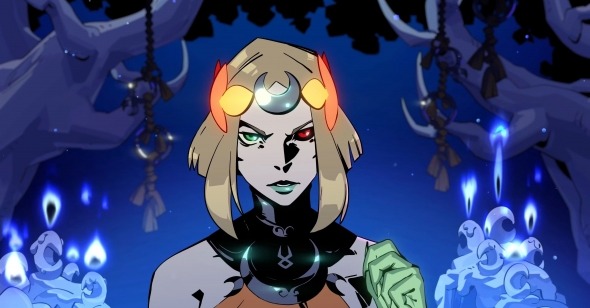
Hades II is set untold eons after the first game—fitting, given that the first has a running gag about no one in the underworld ever knowing whether it was day or night. The House of Hades has been usurped by the Titan of Time, Chronos, father to Hades and grandfather to main character Melinoë, who escaped the attack on her home as a baby with the help of the witch Hecate. Melinoë was raised to exact revenge on Chronos, so her mission, and the player’s mission is to infiltrate the underworld and find a way to slay the immortal Titan of Time. At the same time, Melinoë, who is Zagreus's younger sister, must also help her extended family of Olympian gods during Chronos's assault on Mount Olympus and the surrounding regions.
The gameplay loop is largely similar to the first game: the player (as Melinoë) fights through about four levels in a single run. But it's in the details where Hades II shines. Because the outline of Hades II is similar to the first game—progress through a series of levels fighting off folkloric creatures and the undead, various boss battles ripped from Greek myth—a new style of engagement makes a significant difference in the actual tactile experience of playing it compared to its predecessor. Melinoë’s offensive capabilities are steeped in her background of witchcraft, resulting in deliberate and complex (and often slow) attacks compared to Zagreus's twitchy melee in the first game.
This minor change in pace befits Melinoë as a character and where the story takes her. Compared to her cocky and hot-blooded older brother Zagreus, who barrels headfirst into conflict, Melinoë is much more coldly pragmatic in how she tackles her cataclysmic family drama and those pulled into its orbit. Supergiant reconfigures the mechanics of Hades to resemble its protagonist's temperament and background. Hades and Hades II are similar in appearance but different in personality. New depths of customization express this: as in its predecessor, each weapon comes with a series of “aspects,” which tweak how they function, but the introduction of “familiars” adds complementary bonuses and defensive capabilities like a polecat who can block instances of damage a limited number of times in each level.
Similarly, design of the levels differ from those of the prior game, through a mix of more open spaces and winding corridors, even revisiting a locale from the first game, here approached in the opposite direction now that Melinoë fights to get into the house rather than escape it. That inverse journey is reflected in every component of Hades II, its soundtrack included. Supergiant's regular composer Darren Korb (who also voices a handful of characters in the game, including Zagreus) threads in familiar motifs among a breadth of newer sounds, the most exciting of which often in on a guest instrumentalist. One standout is jazz drummer Louis Cole's ferocious drum solo from “The End of Time.” Focusing on specific instruments, an unsual approach to video game soundtracking, distinguishes the sequel from its predecessor by pushing specific elements further without compromising the fundamental identity.
Melinoë’s entire life is built around attempting one thing over and over, so what happens when that's done? Some kind of routine has to take the place of her life's mission, so the game continues into perpetuity. Even if the story is set by the writers, players are responsible for ongoing “emergent” storytelling. Maybe in one run the player snatched victory from the jaws of defeat with few health points remaining. Maybe in another the player had a great bit of luck. This is what keeps a game’s narrative shortcomings from feeling fatal—just as critic Rollin Bishop said of the "just one more go" temptations offered by Kirby: Air Raiders in his review. It's all in step with Supergiant's approach: each game from Bastion and Transistor to Pyre and Hades is so different in tone and genre that even with the mechanics or narrative design maintained between each game, there's no sense of any of them feeling outdated.
Perhaps Hades II is the platonic ideal of a video game sequel, far enough removed that new players won't be lost (like NieR: Automata) while developing changes which bend the formula without breaking it. Each entry in the Dark Souls series, another group of games built around the idea of violent trial and error, feels unique because it essentially starts fresh. A sequel like Alan Wake 2 aggressively leans into mechanical and tonal differences, while others (often more mainstream action games like Spider-Man 2) look for addition. Hades II leans on subtle differences of character both in the story and in the game mechanics: cutting features from the first game as well as adding new ones makes this feel like it looks to exist in harmony with the previous game rather than supersede it.