The Dance Goes On
Gabo Arora on Silsila
In the early 1980s, my sister, my parents, and I were living in Queens. My parents, like many Indian immigrants at the time, bought a VHS player so they could watch the latest Bollywood films from back home—mostly pirated copies rented from local Desi grocery stores for a dollar. Every Friday evening after dinner, the energy in our living room shifted. For a few hours, we were transported elsewhere. Garish pastels. Maximalist orchestrations with the piercing vocals of Lata Mangeshkar that bordered on cacophony yet somehow worked. Melodramatic performances and elaborate dance sequences that were staples of Hindi cinema.
After school, while my parents were at work, my sister and I rehearsed what we had seen. We synchronized our movements, lip-synced songs. Though I was ten years younger, I played her romantic lead. We repeated gestures of longing and desire that we did not fully understand.
Most Indians at the time, including my parents and their parents before them, had arranged marriages. They married people they did not know. Love, as Bollywood presented it, was fantasy—a fever dream one could not shake, a force that pushed against safety and tradition. The films almost always ended happily; the parents relented, the lovers prevailed. Yet no one we knew had acted on love, even if they privately felt it. It was contained to the movie screen.
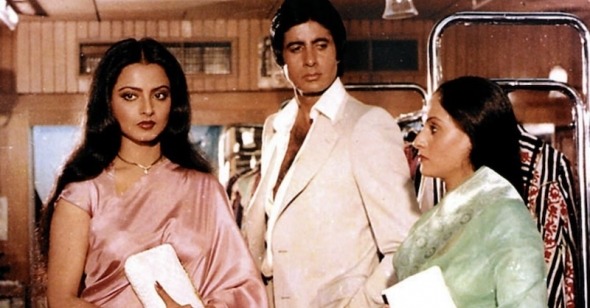
Then came Silsila, a film unlike any we had seen before. Released in 1981 and directed by Yash Chopra, it centers on the love triangle of the playwright Amit (Amitabh Bachchan), his wife Shobha (Jaya Bhaduri), and his former lover Chandni (Rekha). The film deals directly with adultery, a subject rarely handled so openly in mainstream Hindi cinema. Its emotional frankness—which included premarital intimacy, lovers in bed, and the open acknowledgment of desire—caused a stir.
The impact was heightened by rumors that Amitabh Bachchan and Rekha were involved off-screen while he was married to Jaya Bhaduri. Chopra cast all three actors in the central triangle, intensifying the sense of psychodrama and blurring the boundaries between performance and speculation. Gossip magazines went into overdrive. It seemed, for once, that life was imitating art. In Queens, we read those magazines at the Indian grocery between shelves of rice and spices. Bollywood did not feel distant. It felt personal, as if it were working through how complex love, marriage, and commitment could be.
What distinguished Silsila was not only rumor but also tone. The film treats desire seriously. The affair between Amit and Chandni is not framed as simple moral failure, nor is it romanticized without consequence. It is allowed to exist alongside marriage, obligation, and social expectation. The spouses are aware, and yet they remain together. In a cinema tradition that often privileges melodrama, the performances here are restrained and unexpectedly poetic. Especially Bachchan, whose work until then had been largely defined by his “angry young man” persona. Here, he is sensitive and vulnerable, a shift that revealed a different register of his talent.
The song and dance sequences around which Hindi films are structured are often abrupt and sometimes perfunctory. In Silsila, the songs feel integral to the emotional arc. Rekha’s performance conveys visible ache and longing. In “Yeh Kahan Aa Gaye Hum,” Amit and Chandni stand close but rarely touch. Much of the scene unfolds in hushed tones, as if proximity itself were dangerous. In “Rang Barse,” set during Holi, intoxication and ritual permit a different kind of contact. Colored powder becomes an excuse for touch; celebration creates plausible deniability. Even as children, we sensed that the film operated differently from others we had seen. Where many films simplified love into triumph or punishment, there was complexity here, marked by doubt and restraint.
Silsila ultimately resists a radical reimagining of relationships between the sexes. It acknowledges desire but returns to the safety of tradition. That decision was debated at the time. Some felt the lovers should have followed their hearts. To this day, many see Rekha—an icon in her own right—as a tragic figure who never ended up with the person she truly loved. For viewers raised within arranged marriages, the question was not abstract: what does one owe to feeling, and what does one owe to commitment?
A few years later, my sister married. It was arranged. Soon after, she moved away from Queens. I lost my dance partner. Yet we continued our Friday night screenings. The tapes kept arriving, and the songs kept playing. But I watched differently. The films felt formulaic again. The performances did not move me in the same way. We watched more quietly. I can’t recall when the ritual ended. But I remember Silsila clearly. It was the first film that allowed desire and duty to occupy the same frame.