Nosferatu:
The Hands of Time
by Greg Cwik
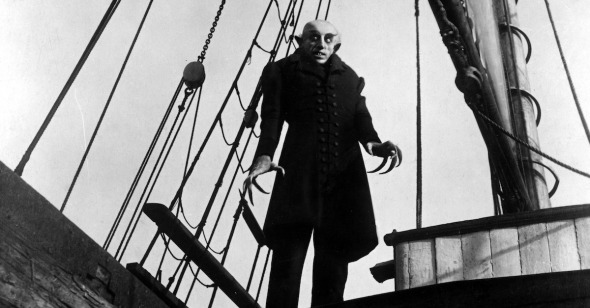
A shadow, shaped almost like a man, with long lanky arms and sickles for fingers, creeps up the stairs; it thirsts lasciviously for fresh hot blood, and there's a beautiful woman up there who has some. This living darkness, lyrical and ominous, is one of cinema’s eternal images and illustrates the way Friedrich Wilhelm Murnau’s Nosferatu: A Symphony of Horror sets the supernatural in a recognizable world. By juxtaposing its believable sets and location shooting with the vivid, abstract presentation of the infernal Count Orlok, the film conjures up damnable images that intrude upon its naturalism, allowing the real and the unreal to inhabit the same frame.
In 1838, in the fictional German vicinage Wisborg, estate agent Thomas Hutter is assigned by his boss, Herr Knock (who, with his disorderly eyebrows, decrepit teeth, and ghoulish smile, looks not unlike a monster himself), to travel to Transylvania to meet a new client, who plans on buying a house neighboring Hutter’s. As encouragement, Knock tells the man, “Of course, it will cost you some effort … a little sweat and … perhaps … a little blood.” Hutter agrees.
Hutter embarks on his endeavor, never suspecting the terrors awaiting him; up a serpentine dirt road he goes, into the Carpathian Mountains, to the count’s vast, infirm castle, seemingly unpopulated and pervaded by a sepulchral air. The scenes of his travel and arrival evince Murnau's unique marriage of naturalism and abomination, showing us a world made pretty by God offended by this desolate acropolis and the man-like thing who lives here. A creature who defies nature. Here, Hutter's “dreams are heavy,” and the reliable, familiar reality to which he is accustomed succumbs to the sublime impossible.
While Nosferatu’s style has, in the last century, been imitated again and again, it remains unsurpassed, a singular collaboration between artists who all broke new ground. Designer and occultist Albin Grau handled sets, costumes, and storyboards, and created the ratty countenance of Orlok, taking influence from Hugo Steiner-Prag’s black-and-white illustrations for Gustav Meyrink’s 1915 novel The Golem. Fritz Arno Wagner, a pioneer of German expressionism who worked with Murnau on The Haunted Castle the previous year, served as primary cinematographer, assisted by Günther Krampf. Together, they captured the grandeur of the natural world and defiled it with frightening, anomalous images. Screenwriter Henrik Galeen transcribed Stoker’s anglophile novel into a distinctly German voice. And Murnau brewed it all together.
And, of course, there’s Max Schreck, one of cinema’s most enigmatic personages, who has long passed into legend. He was, before the film, an accomplished thespian in Germany, having studied at the Berliner Staatstheater, and subsequently touring the country, though he is today known, almost exclusively, for Orlok. Hairless, with the visage of a vermin, and skin a cadaverous pallor, he moves with an inhuman rigidity, stares with eyes crazed yet diabolically focused, sleeps in a coffin in the dreggy dark crypt of the castle he inhabits alone, and he has a plan born of insidious ambitions. The combination of Murnau’s dreamlike naturalism and Schreck’s indelible presence creates a hypnagogic ambience. Even though the story of Dracula is universally known, there is still an inescapable, unsettling sense that something bad is coming, leaving us suffering in the grip of a cryptic seduction.
Nosferatu is for many the definitive vampire film, but Lotte Eisner’s essential book Murnau points out how many critics, filmmakers, and scholars disliked the film in 1922, and continued to do so for a flummoxing amount of time. As late as 1946, Theodore Huff, who helped program for the Museum of Modern Art, the Library of Congress, and the National Archives, dismissed the film with harsh conviction, calling it “Teutonic,” specifically deriding the acting and aesthetic, comparing it unfavorably with Hollywood films that he preferred. And yet, Nosferatu has had a profound effect on American films, a commencing influence on gothic horror, on noir, on the Universal monsters. David Thomson said of the brilliance of Jacques Tourneur: “Time and again in these films, it is the imaginative use of light, decor, space, and movement that makes the impact of the movie,” and the “supreme vindications of the menacing nature of shadow, composition, and pace.” You could say that this makes him a descendant of Murnau, as he helped pioneer all of this, here and in his other films.
Nosferatu is tagged as the first true horror film, which it isn't; consider, as one example, J. Searle Dawley's Frankenstein from 1910. But what it does that had not been done with such poetic intensity is capture a singular cinematic incongruity. “There is no energy unless there is a tension of opposites,” Jung wrote. “Hence it is necessary to discover the opposite to the attitude of the conscious mind.” Here, we have the undying clash between good and evil; surreal and naturalistic imagery co-existing parasitically; and the psychological, philosophical, and visual contrasts of light and dark.
Murnau also pairs different settings and actions occurring far apart together through montage, resulting in images linked spiritually. Building on and experimenting with the work of Abel Gance and D. W. Griffith, and predating Sergei Eisenstein, Nosferatu attests to the power and symbolism of crosscutting in a dreamy, eerie, sensual way that evokes the venereal nature of Orlok's malfeasance. Murnau gives us Orlok ambling awfully into Thomas's room as Ellen moves in a somnambulistic daze towards the balcony many miles away. Orlok bends over to drink from Thomas and Ellen reaches out desperately for a man who isn't there—or for a monster who, in a sense, is. “A sudden fever,” the doctor says. The scene shows how Orlok and Ellen are themselves an incongruous pair, and how his fiendish love defies nature—defies God. And in the end, it's this obsession, and his victory in finally getting her, that is his doom.
For Nosferatu, Murnau and DP Karl Freund experimented with what would come to be known as “unchained camera” employed in The Last Laugh, filmed two years later. Murnau uses static, careful, but not too finicky images of Orlok's sulfurous face, with his buckteeth fangs and crazed, wide-open eyes; lighted rooms infected with pitiless shadows as deep as abysses and large doorways evoking both escape and imprisonment; trees surrounding the castle; and a grand old ship marshalling rats and the pestilence brought by the blood-sucking settler.
“Murnau concerned himself with lighting effects because he did all he could to make a film a total work of art,” Heinrich C. Richter, the designer for Murnau’s earlier films Dr. Jekyll and Mr. Hyde / The Head of Janus (1920) and Journey into the Night (1921), said. “He was especially interested in effects that were still novel, like beams coming through a door or headlights piercing darkness.” Murnau’s main recurring visual technique is filling vacancies with unseen, unuttered dread. There is depth and density in his images, in Orlok’s lurking in doorways and the creeping darkness seemingly possessing its own autonomy; the poor portly doorman in The Last Laugh lets people in through a doorway; the space traversed by the trolley in Sunrise; the acrobats flying glorious through empty air, risking harm and death, in the lost film 4 Devils, as shown in Janet Bergstrom's Murnau’s 4 Devils: Traces of a Lost Film; the vast flaxen fields of crop around which everyone’s lives revolve in City Girl; the boundless, ageless, unsympathetic sea surrounding two lovers struggling to survive on a colonized island in Tabu. (Orlok too crosses the sea.)
Writing about Sunrise, Dorothy B. Jones said that moviegoers with “more finely developed capacities for discrimination find additional pleasure in the profound understanding of human nature—implicit in all of Murnau’s best work—and also admire and appreciate the subtle artistry with which he fashioned this picture.” This begins in earnest with Nosferatu, which elucidates the approach Murnau would take for the rest of his too-short life, tragically ended by a car crash. There’s a psychological acuity in the ways he delves so deeply and daringly into the minds of troubled men, and his faith in images is used to survey the fragility and tenacity of the soul, its ruination and its salvation.